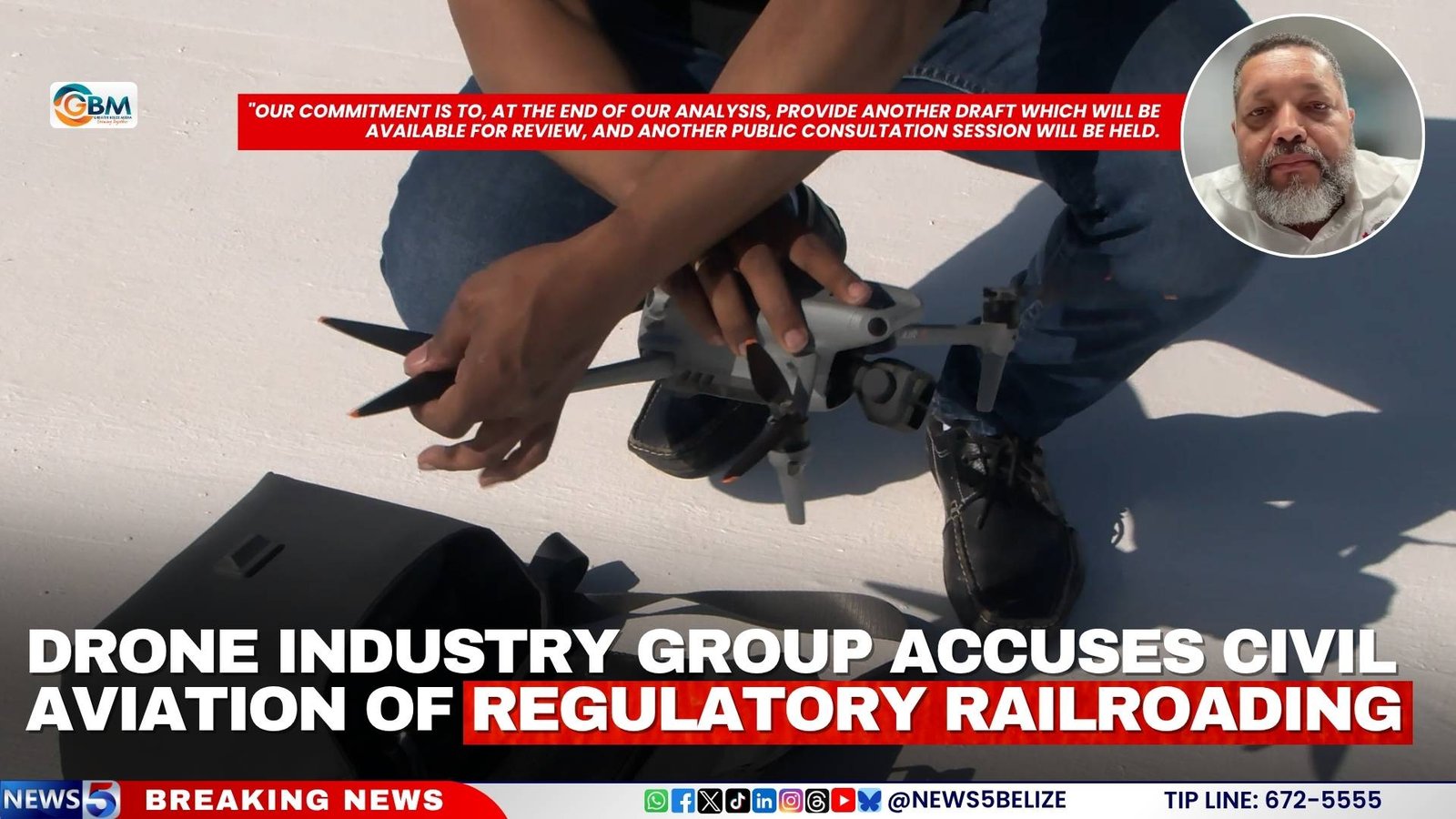
The Belize National UAS Industry Association (BNUIA) is accusing the Belize Department of Civil Aviation (BDCA) of pushing through drone regulations in a rushed and one-sided process that it says could severely damage the country’s emerging drone industry.
A workshop held on May 21 and 22 was meant to go through a line-by-line review of the proposed regulations. The association says what was promised as a two-day collaborative review turned into something far less.
According to the association, the agenda was trimmed the day before the workshop, cutting the session down to a day and a half. By the time it was over, only 24 of 55 pages had been reviewed. It says the remaining 31 pages were not discussed, despite containing what it describes as major departures from internationally recognised standards. The association adds that requests to reconvene and complete the review were rejected by the BDCA.

Director of Civil Aviation Nigel Carter, on the other hand, argued that the matter has been open for nearly eleven months. He said the document was first published for consultation in July of last year, with several extensions granted at the industry’s own request, the last running to January 5th. Comments, he said, continued to be accepted even beyond that date.
“Most of the concern was just people trying to understand the regulations a little bit more, and very few objections to the document itself,” Carter said, noting that all structured feedback will be evaluated before changes are made.
“Like any responsible organisation, we have other matters that we have to look at. And so at the end of the workshop, we asked that they go into the document themselves to understand it and then provide us with their comments,” he said.
The association also claims that participants from the consultations were asked to sign meeting minutes that described the workshop as complete. They refused until the wording was changed to reflect only a “partial” list of concerns.
Carter said the dispute over the minutes came down to a misunderstanding of how the BDCA drafts them. According to him, the document outlined the workshop’s objectives while also recording that stakeholders would be submitting additional comments after the meeting.
Shortly after, Carter reportedly wrote to stakeholders giving them until May 29 to submit remaining concerns. The association says that the same letter stated BDCA plans to publish a final draft by June 30, with a second forum possibly convened only to explain how comments were handled.
The association argues that this demonstrates an intention to proceed with the regulations before fully resolving stakeholder concerns. In response, Carter told News 5, “Our commitment is to, at the end of our analysis, provide another draft which will be available for review, and another public consultation session will be held. So in a sense, the consultation is not completed as yet,” he said. “It is just that we had to say, listen, we are at a point now where we must move on.”
He said that where changes to the document can be made, they will be made. Where they cannot, the BDCA will provide its rationale.
The association also criticised what it describes as a lack of transparency from authorities. It says a Freedom of Information Act request submitted on April 24, 2026, to the BDCA, the Chief Executive Officer in the Ministry responsible for Civil Aviation, and other government entities remains unanswered. According to the BNUIA, the legally mandated 30-day response period has expired without any acknowledgement from the agencies involved.
Carter said the information is being collected and should be shared “within another week or so”.
The association further argues that the proposed regulations amount to “copy-pasted” rules that could place heavy burdens on local operators and slow the growth of the sector, saying the process appears driven more by a desire to satisfy international auditors rather than serve a Belizean industry.
Carter stated the country has been obligated to implement standards from the International Civil Aviation Organisation since signing on to the Convention on International Civil Aviation in 1991.
“You have foreigners coming into the country and flying airplanes and they have certain expectations insofar as what to see when you’re flying around in Belize,” Carter said. “We try our very best to standardise rules internationally so that we improve the level of safety because people know what to expect.”
Post Views: 295