Monday, May 4, 2026
    The GeoStrategic Consensus
    No Result
    View All Result
    • Login
    • HOME
    • AMERICAS
      • Argentina
      • Brazil
      • Canada
      • Chile
      • Colombia
      • Costa Rica
      • Cuba
      • Dominican Republic
      • Ecuador
      • El Salvador
      • Greenland
      • Guatemala
      • Honduras
      • Mexico
      • Nicaragua
      • Panama
      • Paraguay
      • Peru
      • United States
      • Uruguay
      • Venezuela
    • ASIA-PACIFIC
      • Australia
      • Brunei Darussalam
      • Cambodia
      • China
      • Federated States of Micronesia
      • Fiji
      • Indonesia
      • Japan
      • Kiribati
      • Laos
      • Malaysia
      • Marshall Islands
      • Mongolia
      • Myanmar
      • Nauru
      • New Zealand
      • North Korea
      • Palau
      • Papua New Guinea
      • Philippines
      • Samoa
      • Singapore
      • Solomon Islands
      • South Korea
      • Taiwan
      • Thailand
      • Timor-Leste
      • Tonga
      • Tuvalu
      • Vanuatu
      • Vietnam
    • CARICOM
      • CARICOM – Non-English
        • Haiti
        • Suriname
      • CARICOM Associates
        • Anguilla
        • Bermuda
        • British-Virgin-Islands
        • Cayman-Islands
        • Curacao
        • Turks-and-Caicos
      • CARICOM English
        • Antigua and Barbuda
        • Barbados
        • Belize
        • Dominica
        • Grenada
        • Guyana
        • Jamaica
        • Montserrat
        • Saint Kitts and Nevis
        • Saint Lucia
        • Saint Vincent and the Grenadines
        • The Bahamas
        • Trinidad and Tobago
    • EURASIA
      • Armenia
      • Azerbaijan
      • Balarus
      • Georgia
      • Kazakhstan
      • Kyrgyzstan
      • Moldova
      • Russia
      • Tajikistan
      • Turkmenistan
      • Ukraine
      • Uzbekistan
    • EUROPE
      • Albania
      • Andorra
      • Austria
      • Bosnia and Herzegovina
      • Bulgaria
      • Croatia
      • Cyprus
      • Czech Republic
      • Denmark
      • Estonia
      • Finland
      • France
      • Germany
      • Greece
      • Holy See
      • Hungary
      • Iceland
      • Ireland
      • Italy
      • Kosovo
      • Latvia
      • Liechtenstein
      • Lithuania
      • Luxembourg
      • Malta
      • Monaco
      • Montenegro
      • Netherlands
      • North Macedonia
      • Norway
      • Poland
      • Portugal
      • Romania
      • San Marino
      • Serbia
      • Slovakia
      • Slovenia
      • Spain
      • Sweden
      • Switzerland
      • United Kingdom
    • MIDDLE EAST AND NORTH AFRICA
      • Algeria
      • Bahrain
      • Egypt
      • Iran
      • Iraq
      • Israel
      • Jordan
      • Kuwait
      • Lebanon
      • Lybia
      • Morocco
      • Oman
      • Palestinian Territories
      • Qatar
      • Saudi Arabia
      • Syria
      • Tunisia
      • Turkey
      • United Arab Emirates
      • Western Sahara
      • Yemen
    • SOUTH ASIA
      • Afghanistan
      • Bangladesh
      • Bhutan
      • India
      • Maldives
      • Nepal
      • Pakistan
      • Sri Lanka
    • SUB-SAHARAN AFRICA
      • Angola
      • Benin
      • Botswana
      • Burkina Faso
      • Burundi
      • Cabo Verde
      • Cameroon
      • Central African Republic
      • Chad
      • Comoros
      • Cote d’Ivoire
      • Democratic Republic of the Congo
      • Djibouti
      • Equatorial Guinea
      • Eritrea
      • Eswatini
      • Ethiopia
      • Gabon
      • Gambia
      • Ghana
      • Guinea
      • Guinea Bissau
      • Kenya
      • Lesotho
      • Liberia
      • Madagascar
      • Malawi
      • Mali
      • Mauritania
      • Mauritius
      • Mozambique
      • Namibia
      • Niger
      • Nigeria
      • Republic of the Congo
      • Rwanda
      • Sao Tome and Principe
      • Senegal
      • Seychelles
      • Sierra Leone
      • Somalia
      • South Africa
      • South Sudan
      • Sudan
      • Tanzania
      • Togo
      • Uganda
      • Zambia
      • Zimbabwe
    • HOME
    • AMERICAS
      • Argentina
      • Brazil
      • Canada
      • Chile
      • Colombia
      • Costa Rica
      • Cuba
      • Dominican Republic
      • Ecuador
      • El Salvador
      • Greenland
      • Guatemala
      • Honduras
      • Mexico
      • Nicaragua
      • Panama
      • Paraguay
      • Peru
      • United States
      • Uruguay
      • Venezuela
    • ASIA-PACIFIC
      • Australia
      • Brunei Darussalam
      • Cambodia
      • China
      • Federated States of Micronesia
      • Fiji
      • Indonesia
      • Japan
      • Kiribati
      • Laos
      • Malaysia
      • Marshall Islands
      • Mongolia
      • Myanmar
      • Nauru
      • New Zealand
      • North Korea
      • Palau
      • Papua New Guinea
      • Philippines
      • Samoa
      • Singapore
      • Solomon Islands
      • South Korea
      • Taiwan
      • Thailand
      • Timor-Leste
      • Tonga
      • Tuvalu
      • Vanuatu
      • Vietnam
    • CARICOM
      • CARICOM – Non-English
        • Haiti
        • Suriname
      • CARICOM Associates
        • Anguilla
        • Bermuda
        • British-Virgin-Islands
        • Cayman-Islands
        • Curacao
        • Turks-and-Caicos
      • CARICOM English
        • Antigua and Barbuda
        • Barbados
        • Belize
        • Dominica
        • Grenada
        • Guyana
        • Jamaica
        • Montserrat
        • Saint Kitts and Nevis
        • Saint Lucia
        • Saint Vincent and the Grenadines
        • The Bahamas
        • Trinidad and Tobago
    • EURASIA
      • Armenia
      • Azerbaijan
      • Balarus
      • Georgia
      • Kazakhstan
      • Kyrgyzstan
      • Moldova
      • Russia
      • Tajikistan
      • Turkmenistan
      • Ukraine
      • Uzbekistan
    • EUROPE
      • Albania
      • Andorra
      • Austria
      • Bosnia and Herzegovina
      • Bulgaria
      • Croatia
      • Cyprus
      • Czech Republic
      • Denmark
      • Estonia
      • Finland
      • France
      • Germany
      • Greece
      • Holy See
      • Hungary
      • Iceland
      • Ireland
      • Italy
      • Kosovo
      • Latvia
      • Liechtenstein
      • Lithuania
      • Luxembourg
      • Malta
      • Monaco
      • Montenegro
      • Netherlands
      • North Macedonia
      • Norway
      • Poland
      • Portugal
      • Romania
      • San Marino
      • Serbia
      • Slovakia
      • Slovenia
      • Spain
      • Sweden
      • Switzerland
      • United Kingdom
    • MIDDLE EAST AND NORTH AFRICA
      • Algeria
      • Bahrain
      • Egypt
      • Iran
      • Iraq
      • Israel
      • Jordan
      • Kuwait
      • Lebanon
      • Lybia
      • Morocco
      • Oman
      • Palestinian Territories
      • Qatar
      • Saudi Arabia
      • Syria
      • Tunisia
      • Turkey
      • United Arab Emirates
      • Western Sahara
      • Yemen
    • SOUTH ASIA
      • Afghanistan
      • Bangladesh
      • Bhutan
      • India
      • Maldives
      • Nepal
      • Pakistan
      • Sri Lanka
    • SUB-SAHARAN AFRICA
      • Angola
      • Benin
      • Botswana
      • Burkina Faso
      • Burundi
      • Cabo Verde
      • Cameroon
      • Central African Republic
      • Chad
      • Comoros
      • Cote d’Ivoire
      • Democratic Republic of the Congo
      • Djibouti
      • Equatorial Guinea
      • Eritrea
      • Eswatini
      • Ethiopia
      • Gabon
      • Gambia
      • Ghana
      • Guinea
      • Guinea Bissau
      • Kenya
      • Lesotho
      • Liberia
      • Madagascar
      • Malawi
      • Mali
      • Mauritania
      • Mauritius
      • Mozambique
      • Namibia
      • Niger
      • Nigeria
      • Republic of the Congo
      • Rwanda
      • Sao Tome and Principe
      • Senegal
      • Seychelles
      • Sierra Leone
      • Somalia
      • South Africa
      • South Sudan
      • Sudan
      • Tanzania
      • Togo
      • Uganda
      • Zambia
      • Zimbabwe
    No Result
    View All Result
    Agentially
    No Result
    View All Result
    Home AMERICAS United States

    Dinosaur skeletons are selling for millions. What does that mean for researchers and museums?

    The Analyst by The Analyst
    April 10, 2026
    in United States
    Dinosaur skeletons are selling for millions. What does that mean for researchers and museums?


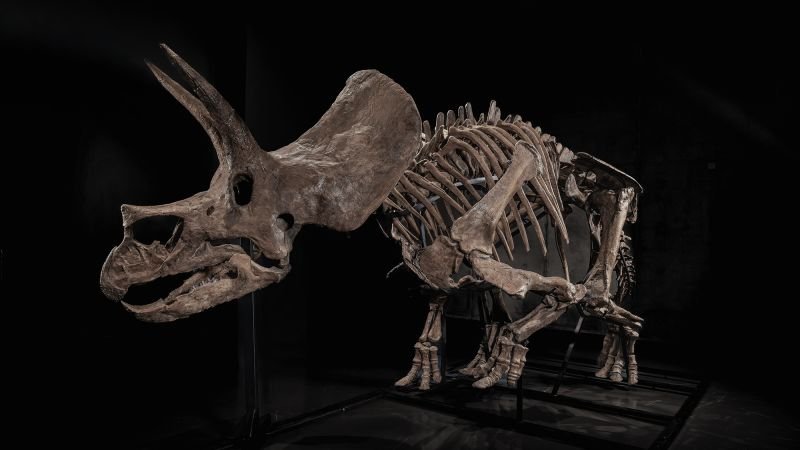
    A near-complete Triceratops fossil from the Late Cretaceous period, dubbed “Trey,” sold online for $5.55 million last week, marking the latest in a list of dinosaur specimens to fetch colossal fees in commercial sales.

    READ ALSO

    Supreme Court Temporarily Restores Access to Abortion Pill by Mail

    Wild parrots copy their friends when deciding whether to try new foods, study finds

    Experts say demand and prices for prehistoric pieces have accelerated in recent years as the wealthy have sought to secure a bone, a skull, or even an entire skeleton from the myriad reptiles who once ruled the world.

    In the last six years, three fossils have sold at auction for upwards of $30 million. The Abu Dhabi Department of Culture and Tourism shelled out a then-record $31.8 million in 2020 for “Stan,” one of the world’s most complete T. rex skeletons, before hedge fund billionaire Kenneth C. Griffin blew that sum out of the water with his $44.6 million purchase of an enormous Stegosaurus specimen, nicknamed “Apex,” in 2024.

    Then, last July, one of only four known Ceratosaurus fossils was the subject of a bidding war at Sotheby’s New York auction house, which ended with an unidentified buyer forking out $30.5 million for the 6-foot-3-inch (1.9 meter) tall predator.

    This juvenile Ceratosaurus fossil was estimated to sell for between $4 million and $6 million, but fetched $30.5 million in 2025.

    Hollywood has also had a bite. Nicolas Cage bought a Tyrannosaurus skull for $276,000 at auction in 2007, while Russell Crowe handed over $35,000 for a Mosasaur head he spotted mounted on the wall at the home of Leonardo DiCaprio.

    Trey’s sale was organized by Joopiter, an online auction house founded by musician, producer and fashion designer Pharrell Williams. Having primarily targeted younger collectors with “culture-shaping” art, merchandise and collectibles — from ultra-exclusive sneakers to a signed Michael Jordan trading card — a first foray into dinosaurs marked a dramatic pivot for the digital-first platform.

    “Part of Joopiter’s purpose in this industry is that the idea that you’d go into a Christie’s or a Sotheby’s and buy a rare book or an old master painting is a little bit something of the past,” Joopiter’s global head of sales Caitlin Donovan told CNN days before the sale.

    “You grow up fantasizing about dinosaurs, thinking they’re this mystical, incredible thing — it’s hard to fathom,” she added. “The idea that you can actually own one in your own collection is kind of like every 5-year-old boy or girl’s dream.”

    Trey’s seller, Chaw Wei Yang, would wholeheartedly agree.

    The 26-year-old art collector and cryptocurrency investor fulfilled his childhood dream of owning a dinosaur when he purchased the six-meter-long (20-foot) Triceratops roughly two-and-a-half years ago.

    Excavated from the fossil-rich Lance Formation of Niobrara County, Wyoming, by a commercial paleontology company in 1993, Trey was displayed at Wyoming Dinosaur Center for almost three decades as part of a loan deal struck with the dinosaur’s previous owner.

    Last year, the Triceratops was transported to a vault deep within Singapore’s Le Freeport, a fortified luxury storage facility dubbed “Asia’s Fort Knox,” to be prepped for auction.

    The universal appeal and nostalgia attached to dinosaurs makes their fossils a “no-brainer” purchase, not just as a collector’s item, but as a potentially lucrative business venture, Yang told CNN on a rare guided tour of the high-security freeport last month.

    “Of all the alternative assets I grew up seeing — wine, art, cars — I think dinosaurs are the most untapped, investment-wise,” the Singaporean said.

    01 118080_Singapore_freeport_THUMB.jpg

    Inside Asia’s secretive super vault for the ultra-rich

    Deep inside Singapore’s freeport, a fortified luxury storage facility often dubbed “Asia’s Fort Knox,” a near-complete Triceratops fossil awaits auction. Ahead of the sale, the dinosaur’s owner Chaw Wei Yang, a 26-year-old art collector and cryptocurrency investor, takes CNN’s Oscar Holland on a rare tour of the secretive tax-free facility.

    Inside Asia’s secretive super vault for the ultra-rich

    1:43

    Others, though, would rather see that tap run dry.

    Concerns about scientifically significant fossils moving into private hands have risen in step with the fees being commanded, not least among those whose careers involve studying them.

    Museum visitors walk beneath the skeleton of Patagotitan mayorum as it goes on display as part of the new

    The Society of Vertebrate Paleontology (SVP), with over 2,000 members, is among the professional organizations to have vocally opposed the commercial sale of landmark dinosaur remains, issuing open letters in response to various high-profile auctions imploring that the fossils go to institutions “committed to curating specimens for the public good and in perpetuity.”

    It’s an anxiety shared by Steve Brusatte, a professor of paleontology and evolution at the University of Edinburgh, who laments the “commodification” of scientifically important fossils, and the extreme sums they can command.

    “If somebody gave me $30 million, that would run my research group, probably, until the time I retire,” Brusatte told CNN. “That would fund decades of academic research, field and scholarly work on dinosaurs, the lab I have and so on. It’s just huge amounts of money that are way outside of the norm of the academic world.”

    Brusatte said public museums and academic institutions can no longer compete with the “eye-watering” funds being put up by, in the case of Apex and Stan, hedge fund billionaires and Gulf state governments.

    Those two fossils provide examples of what he sees as a happier, albeit not perfect, ending for key specimens sold at auction. Both the stegosaurus and T. rex are still currently on public display, at the American Museum of Natural History (AMNH) and the Natural History Museum in Abu Dhabi respectively.

    Apex was unveiled at the American Museum of Natural History in December 2024.

    Yet the uncertainty of what will happen to Apex after the four-year loan from Griffin to New York City’s AMNH ends is one of the wider concerns around private ownership. Some fossils will inevitably disappear “into the ether,” Brusatte says. It’s a fate he cannot rule out befalling Trey, who was seen by an estimated 1 million visitors during his residency in Wyoming.

    “This auction doesn’t make me angry, but it does make me particularly sad … I do feel a little bit of world weariness,” he said.

    “There’s a very realistic scenario here that this incredible dinosaur, this beautiful and very scientifically valuable and very educationally valuable fossil that had been on display and had been inspiring kids and families, now might not be on display anymore … that would really, really be tragic.”

    Joopiter’s Donovan would “love” the idea of the Triceratops ending up in a museum.

    “I think many people believe that these dinosaurs should be in museums,” Donovan said. “But I also think that the idea that it can go into a private home is also something that is very special.”

    Sitting in the middle of the debate between public and private ownership is the head of fossil vertebrates at London’s Natural History Museum, Professor Paul Barrett. He says people working in paleontology fall across a broad spectrum, all the way from those who see fossils as cultural commons, shared property of humanity that should never be bought or sold, to those who see them as objects like any other, free to be sold at will.

    He recognizes the transition of some specimens to collectible “status symbols,” spurred by the $8.3 million auction of “Sue” the T. rex to the Chicago Field Museum in 1997. But his pragmatic stance is rooted in a truth that Brusatte knows too: modern paleontologists and the commercial fossil trade have always had a somewhat symbiotic relationship.

    Sue the T. rex strikes a pose in its old location at the Field Museum in Chicago, Illinois.

    Large sections of the Natural History Museum’s sweeping paleontology collection, comprising some 8 million fossils and covering more than 200 dinosaur species, would not exist were it not for the efforts of collectors who sold their finds. Mary Anning, widely celebrated as a pioneering paleontologist, was, “first and foremost” a commercial fossil dealer, Barrett pointed out.

    “For any one of my colleagues to have some kind of epiphany where they think that all commercial collecting is evil, is to deny the fact that they’ve probably spent most of their career working on material that was purchased from a commercial collector, some of whom have amazing hagiographies [biographies],” Barrett told CNN.

    He tracks the root problem to the “rocketing” costs of select specimens, yet various proposed solutions only raise further issues. Moves to legislate who owns found fossils, for example, could lead to a form of “reverse imperialism,” whereby communities in developing countries whose livelihoods depend on selling fossils they find on their personal land are cut adrift.

    “Who am I, in a relatively cushy house in central London, to tell someone who would otherwise be scraping a living from a little bit of farmland in Morocco [where many fossils are found] that’s becoming increasingly arid because of climate change, that they can’t sell fossils to make their life better?” Bassett questioned.

    Some countries have introduced laws on the collection of dinosaur specimens. In South Africa, for example, it has been illegal since 1999 to collect or sell fossils without a permit, while in China, all fossils deemed to have “scientific value” are protected by the state in the same manner as cultural relics.

    Though intended to promote scientific research, “binary and harsh” legislation can often make it more difficult for scientists to access fossil-rich areas owned by wary landowners who see no benefit in welcoming them, said Barrett, who knew of Chinese researchers who had been arrested for legally collecting fossils, by local police forces “overinterpreting” recently tightened laws.

    Likewise, Brusatte is skeptical that any form of legislation could address the concerns raised by multimillion-dollar fossil sales. Yet while the price tags attached to such auctions are at the root of his fears, they are also a small source of comfort.

    “If somebody looked at an auction for a dinosaur skeleton, like, ‘What an old load of bones. Who cares about that?’ and nobody bid on it, that would be a sign that we’re losing the magic and wonder and awe of dinosaurs. That is the positive I take from it,” Brusatte said.

    “It’s not a good problem to have, but it means that there is still great public interest and enthusiasm in dinosaurs. That ultimately is what should keep us afloat and should give us momentum as a scientific field.”



    Source link

    Related Posts

    Supreme Court Temporarily Restores Access to Abortion Pill by Mail
    United States

    Supreme Court Temporarily Restores Access to Abortion Pill by Mail

    May 4, 2026
    Wild parrots copy their friends when deciding whether to try new foods, study finds
    United States

    Wild parrots copy their friends when deciding whether to try new foods, study finds

    May 4, 2026
    What passengers need to know about Spirit Airlines
    United States

    What passengers need to know about Spirit Airlines

    May 4, 2026
    Rubio to Visit Rome, Vatican Says, After Trump’s Feud With Pope and Meloni
    United States

    Rubio to Visit Rome, Vatican Says, After Trump’s Feud With Pope and Meloni

    May 4, 2026
    Americans Will Do Anything to Get Indian Mangoes
    United States

    Americans Will Do Anything to Get Indian Mangoes

    May 4, 2026
    How Republicans came to embrace psychedelic drugs
    United States

    How Republicans came to embrace psychedelic drugs

    May 4, 2026
    Next Post
    Government defends mandatory bioethanol to avoid cost overruns for the consumer

    Government defends mandatory bioethanol to avoid cost overruns for the consumer

    POPULAR NEWS

    Justin Bieber fans flood Coachella festival for headlining show – Entertainment

    Justin Bieber fans flood Coachella festival for headlining show – Entertainment

    April 20, 2026

    Over 600 flee homes as Army, NPA clash in Negros Occidental

    April 21, 2026

    Ex-DPWH exec recalls P800-M ‘delivery’ to Zaldy Co 

    April 20, 2026

    Former PM Paluckas suspends party membership, to waive immunity over criminal probe

    April 24, 2026
    Pres. Ali challenges CARICOM to transform into health research powerhouse

    Pres. Ali challenges CARICOM to transform into health research powerhouse

    April 23, 2026

    EDITOR'S PICK

    “It turns out that we don’t know the city very well ourselves.” Meghri, the cultural capital of the CIS

    “It turns out that we don’t know the city very well ourselves.” Meghri, the cultural capital of the CIS

    April 23, 2026
    It’s been a while, you’ve been separated, “Amin”…

    It’s been a while, you’ve been separated, “Amin”…

    April 29, 2026
    Teachers still footing school costs, says BUT

    Teachers still footing school costs, says BUT

    April 14, 2026
    Olympiakos and Fenerbahce storm to 2:0 in the Euroleague quarter-final series

    Olympiakos and Fenerbahce storm to 2:0 in the Euroleague quarter-final series

    May 2, 2026

    Recent Posts

    • 01:29Thun is champion20 minutes on site”We’re going steep!”: That’s how great the title ecstasy is after Sensation41131
    • Swiss May 1 demos planned at 50 locations
    • Flight safety in Estonia not compromised by Russian GPS disruptions | News
    • Finland’s Gambling Market Opens in 2027 – Here’s What Informed Consumers Need to Know Before Then

      © 2026 Agentially - Navigating shifting sovereignties and global risk .

      Welcome Back!

      Login to your account below

      Forgotten Password?

      Retrieve your password

      Please enter your username or email address to reset your password.

      Log In
      No Result
      View All Result

        © 2026 Agentially - Navigating shifting sovereignties and global risk .

        This website uses cookies. By continuing to use this website you are giving consent to cookies being used. Visit our Privacy and Cookie Policy.