What you should know about the number 0212-8190100 before answering:
- Users report calls with misleading offers and alleged debt collections
- Telecommunications company warns of misuse of its identity to scam
- The pattern coincides with frauds such as phishing, vishing and can be associated with the virtual kidnappings recently reported by the Cicpc
At Cocuyo Chequea we constantly warn about the different digital scams that develop in Venezuela, which include from false job offers on social networks like TikTok, even fake awards from well-known companies for supposed anniversaries or special days.
Although most scams recruit their victims through enticing social media posts or fraudulent links that capture personal and/or banking data, there is also the type of telephone scams, which attract their victims through calls in which they make misleading offers.
Be careful with him 0212-8190100
This is the case of the telephone number with the Caracas prefix, 0212-8190100which was consulted to our verification chatbot The WhatsApp Auntwhich is also found in Telegram. This number has been pointed out by a company and various users for its alleged connection with scams, misleading offers and intimidation.
For this reason, we decided to warn that, if you live in Venezuela, you may receive a call from this number so that you know how to act. So we tell you the details.
This check is the result of rigorous adherence to our verification methodology, after analysis and contrast with the available evidence and does not represent opinions or value judgments, as established in our Neutrality and Nonpartisanship Policyin which we warn of the limitations to the exercise of journalism in Venezuela.
The Giganet company warns
When making a Google search with the telephone number, we find a Instagram post July 2025 from the telecommunications company Giganet, which warns in a statement that, through said telephone line, “they report exaggeratedly outstanding debts and alleged complaints about equipment sales.”
The publication warns its users not to “fall into scams, intimidation or misleading offers by unscrupulous people who use our brand or impersonate company personnel”, recalling its official communication channels, as well as its only main headquarters, located in Charallave – Ocumare, Miranda state.
When reviewing the comments, one user reports that he received a call from that number on January 10, 2026, while others received it on more recent dates, with the last complaint being in the comments from the second week of April 2026.

Other complaints about this number
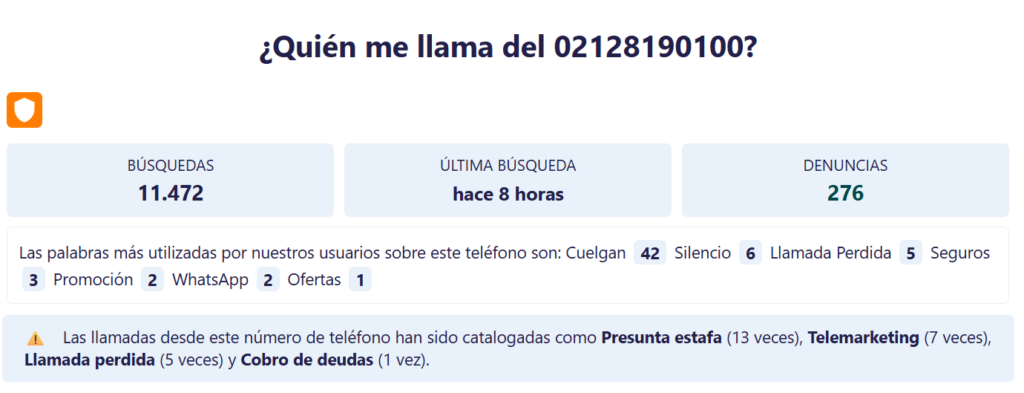
The website SpamListwhich works as a database to search and report suspicious numbers, evidence that there have been 11,472 searches for this number on its page, of which 276 are complaints:
“Calls from this phone number have been classified as Alleged Scam (13 times), Telemarketing (7 times), Missed Call (5 times) and Debt Collection (1 time),” the website details.
What types of scams may be associated?
These phone calls pretend to be trustworthy entities to request payments or personal data, which can be used for cybercrimes. phishing, vishing or extortion.
The calls of phishing They offer misleading offers such as life insurance “for less than a dollar“, as we explain in this verificationwith the aim of collecting personal data such as name, identification document number, address, and financial data such as card/bank account data to supposedly process the purchase of the supposed service they offer.
But, the reality is that they use this data to access social media accounts, banks, applications, and/or commit other computer crimes, such as selling your personal data to cybercriminals, as we have explained in other verifications in which they use this tactic, such as here, here and here.
It is important to clarify that this scam tactic is usually done through false web links that impersonate companies (such as banks) or organizations that offer false products or prizes. However, when providing personal data over the telephone, you are prone to being a victim of phishing.
There is also vishing
Another of the most frequent strategies in telephone scams is vishingwhose name derives from the words “voice” and “phishingThis is a “type of threat that combines a fraudulent phone call with information previously obtained from the Internet,” as the banking group explains. BBVA.
One of its most dangerous variants is the so-called “yes fraud”, in which cybercriminals record the user’s affirmative response during a call to later use it in financial transactions, contracts or even to impersonate. This method takes advantage of the trust of those who answer unknown calls without suspecting that a simple “yes” can be used against them.
The Internet User Security Office from Spain explains that this process usually begins with a call in which the scammer, posing as a trustworthy entity, builds trust and waits for an affirmative response from the victim. The recording of that “yes” is then used to carry out procedures on your behalf, exposing you to financial fraud and reputational risks.
CICPC warns about virtual kidnappings
Scammers also use other strategies such as telephone extortion, posing as a family member to report problems such as false kidnappings, health complications or accidents, to demand quick money.
The Corps of Scientific Criminal and Criminal Investigations (Cicpc) warned this April 2026 about a new type of crime in Venezuela called virtual kidnappingwhich its director, Douglas Rico, explains in a Facebook postas “a planned scheme”, since criminals contact sellers on the Marketplace platform and summon them to isolated locations; Then they call them, keep them under threat and extract information from their relatives.
At the same time that they extract information from the victim, they call those relatives simulating a kidnapping and demand urgent payments. The money is deposited in accounts that are then quickly dispersed to make it difficult to trace; which can lead to another cybercrime called banking mulewhich you must take into account to avoid being a victim.
Previously, telephone scams in Venezuela used to be carried out from the country’s prisons, as this article from The Pitazo and this research Insight Crime.
How to protect yourself if you receive a call of this type?
Taking into account that telephone scams are frequent in Venezuela, at Cocuyo Chequea we recommend applying basic security measures to avoid being a victim of any of these modalities:
- Avoid answering unknown numbers, In case you receive calls from phone numbers 02128190100, 0212-8194300 and 0212-8194430, hang up the call and block the number on your device.
- Do not provide banking or personal information in phone calls from supposedly known entities, since no institution to which one is attached will ask for personal information over the telephone.
- Listen first. If you answer an unknown number, it is recommended to listen to the sender before saying words, in order to avoid voice cloning.
- Create a safe word. In If you receive an emergency call due to an irregular situation from a family member or acquaintance, it is recommended to have a safe word defined to verify that the voice belongs to that person and not a clone.
Conclusion
The number 0212-8190100 has been reported by hundreds of users and indicated by a telecommunications company as a channel for possible scams, intimidation and misleading offers, as evidence also our verification method.
Although there is no official information that links it to a specific criminal organization, the patterns described coincide with common telephone fraud practices in the country, so it is recommended to act with caution if you receive calls from this number or other unknown numbers, and avoid sharing personal information or making hasty payments.
Given the persistence of these types of fraud in Venezuela, we invite you to verify before sharing and report any suspicious number to the WhatsApp auntalso available in Telegramto prevent more people from becoming victims of cyber scams.