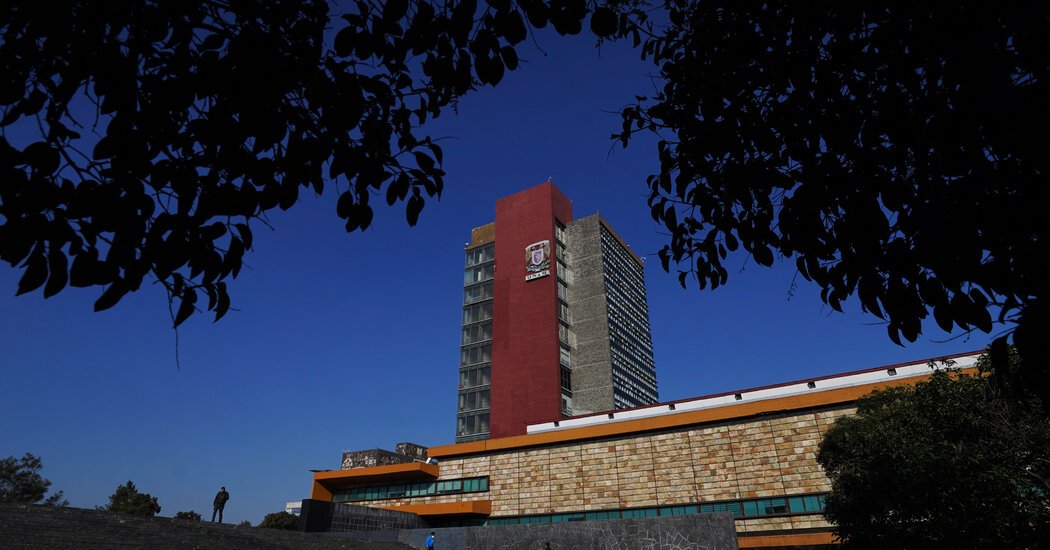
All of the applicants who passed this year’s entrance exam for Mexico’s premier public university will be required to take a new test, school officials said Friday, following an investigation into likely widespread cheating, including with the aid of artificial intelligence, during the institution’s first attempt at online testing.
As educators around the world grapple with the effects of A.I., the National Autonomous University of Mexico, or UNAM, ordered the investigation this month after a disproportionate number of applicants passed its demanding exam.
On Friday, university administrators said a commission had found that several times more applicants had passed the entrance exam than in recent years. As a result, the university was requiring that applicants who passed the exam take a new exam in person.
Earlier this week, experts who reviewed the results said they found almost half of the nearly 160,000 exams could have involved some sort of cheating. Administrators had suspended admissions while they investigated, leaving all prospective students in limbo.
It is hardly the first time A.I. has been suspected in cheating scandals. Students have been caught using A.I.-powered smart glasses to cheat on high-stakes exams in England and South Korea. In Australia, university administrators had to abandon the use of A.I.-detection tools after they falsely accused students of using A.I. at alarmingly high rates.
In Mexico, the UNAM scandal arose in mid-July after test results revealed an unusually high number of applicants had passed the difficult entrance exam, and that in competitive programs, such as medicine and law, many more students than usual had received high — even perfect — scores.
This was UNAM’s first entrance exam administered online, and it required students to use web cameras to monitor them. The university has said it moved the exam online to open up coveted spots in UNAM’s next class to more people from around the country. Only about 20,000 spots are offered each year to students other than those who attend UNAM prep high schools.
UNAM’s president, Leonardo Lomelí, said earlier this week that the university’s priority was to uncover what had happened and “stand on the side of those who studied, who prepared themselves.”
Mr. Lomelí apologized on Friday to students who had passed “cleanly” and would have to take a new exam, and he called on students and their families to resist resorting to any kind of fraud moving forward.
School officials said more than 40,000 students would have to take a new exam: both those who passed this year’s exam and those who would have passed based on average passing scores from years past. The officials did not say when the new exams would take place but that classes would start Aug. 10 as planned.
Fernanda Belém, who passed her exam in veterinary medicine — which she took this year for a second time — said she was stunned to learn on Friday that she would have to take another exam.
“This means recovering what took months in just days,” said Ms. Belém, 20, holding back tears. She had studied using voluminous folders of notes and 200 flashcards, she said, and had been relieved when she was admitted.
Raúl Rojas, an A.I. specialist and mathematician originally from Mexico who teaches at the University of Nevada, Reno, and elsewhere, said he had reviewed the results when they were released and found an improvement in scores that was “not typical.” He estimated that around half the 158,700 test takers — or about 75,000 — may have cheated.
“They may have cheated in some way,” he said in an interview, adding that during the long period that the exam was open, test questions were leaked, even sold, online. So, he concluded, it was not clear that artificial intelligence had played a central role.
The majority of cheaters, he said, probably used an old-fashioned method: “the cheat sheet.”
The university had previously said the online test would be “armored by A.I.,” which would detect any possible cheating — for example, if headphones appeared on camera, or a camera or a microphone was switched off — and trigger a warning.
A small percentage of exam results, the university said on Friday, were annulled based on such detected “irregularities.”
The company contracted by UNAM to administer the exam, Territorium Life, did not respond to a request for comment.
The scandal prompted students in Mexico to protest outside the university this week. Some said they were being unfairly penalized, with their test results potentially invalidated simply because of their high scores.
Cheating tips were circulating widely before the tests went live this spring.
Online accounts advised students to position monitors outside the web-camera frame where they could access ChatGPT or other A.I. models. Others suggested hiding earphones under their hair, or hiring someone else to take the exam, off camera.
Before the official results were released in July, UNAM filed a federal criminal complaint against companies and individuals who it said had offered such services.
Cheating schemes have been common among students and job seekers in India, where high-stakes exams can mean the difference between a path toward the middle class or long-term unemployment.
Emiliano Rodríguez Mega contributed reporting.