Collaboration, unity and transformation are central to vision 2027-2062
Text and image Edwien Bodjie
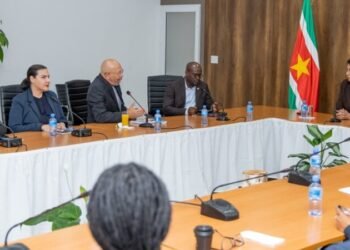
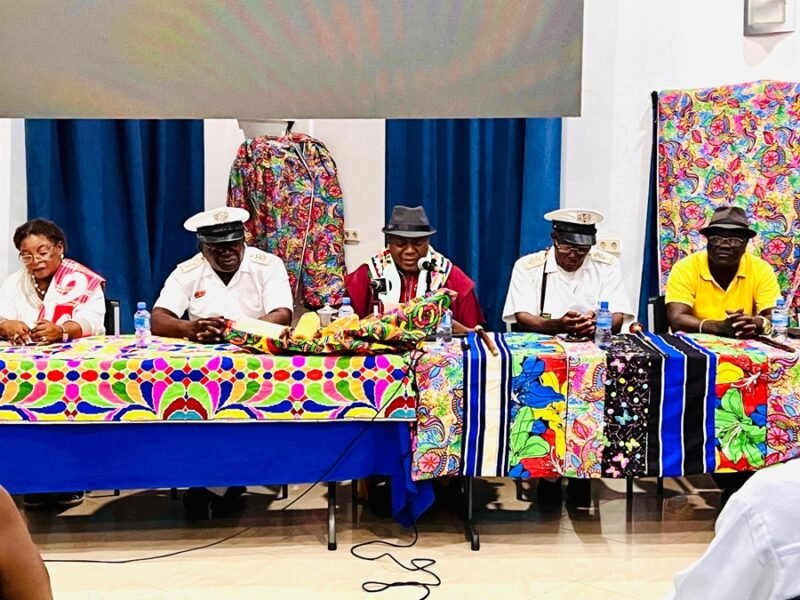
PARAMARIBO — “The Saamaka people are now looking for action and solutions. The plan provides us with a strong platform to take action.” That said granman Albert Aboikoni on Tuesday during the presentation of the Saamaka Plan 2027-2062 in the Lalla Rookh building.
His cabinet has approved the first draft of the development strategy. The plan must provide direction for the development of the Saamaka communities in Suriname and the diaspora over the next 35 years. Collaboration, unity and transformation are the three core points.
“The plan offers us a strong platform to take action“
Granman Albert Aboikoni
The vision focuses on structural challenges faced by communities, including land rights, infrastructure, employment, healthcare and education. The consequences of the migration to the city for families, the elderly and young people are also receiving attention.
Freedom and development
Aboikoni stated that the success of the plan depends on the efforts of the entire Saamaka community, both in Suriname and abroad. It should also serve as an instrument for development dialogue with the Surinamese government and regional and international organizations. He also said the strategy is in line with the United Nations Sustainable Development Goals and the ‘Second International Decade for People of African Descent’, which runs from 2025 to 2034.
The choice for 2062 as the end year of the Samaaka Plan was consciously made. Then it will be three hundred years ago that the Saamaka Peace Treaty was signed. That treaty promised freedom, but that freedom came with conditions, the granman said. He referred to the historical description Tiiki saafu, given by one of his predecessors, granman Joseph Daniel Aboikoni, also known as Gaama Agbago, was used, whom he explained as “enslaved by trickery.”
Don’t thwart the government
The 2062 vision aims to help the Saamaka people grow into a community rooted in resilience, self-reliance and working unitedly towards a better quality of life. The plan explores development opportunities in nineteen sectors. In addition to education and health care, this includes agriculture, housing, entrepreneurship, tourism, energy, sports, technology and art and culture. Land rights, mining, management of natural resources, the position of women and youth and the strengthening of traditional authority are also included.
The strategy is built around five targeted development outcomes: people-centred development, investment in economic infrastructure, environmental sustainability, innovation and digital technology and diaspora engagement.
Aboikoni made it clear that the plan is not intended to take over or compete with the work of the national government. Instead, it should stimulate development from the bottom up, with resources mobilized by the community and for the community. The implementation will be carried out on a project basis, in successive periods of three years.
Two projects in 2027
The granman announced two projects during the presentation that should start in 2027. The first is ‘Saamaka Homecoming 2027’. Villages and community organizations are called upon to organize activities from January to December to welcome Saamaka from the Netherlands, French Guiana, the United States, Canada and the Caribbean to Suriname, among others. The peak of activities is expected between July and October. Special activities will be organized on August 31 to mark the first commemoration of the late’s birthday granman Joseph Daniel Aboikoni.
The second project concerns a mobile exhibition called ‘Saamaka archives’. It should bring together researchers, publishers, creative professionals and practitioners of visual and performing arts to highlight the heritage and culture of the Saamaka. Special attention is paid to knowledge sharing and advocacy around the early period of the Saamaka settlements, from 1690.
From October 2026 to January 2027, the cabinet of the granmanvillages and non-governmental organizations hold meetings to prepare further participation and implementation. Aboikoni called on all Surinamese, regardless of their ethnic background and place of residence, to contribute to the implementation of the plan.
District commissioners, experts on Saamaka culture and representatives of ministries and the President’s Office were also present.