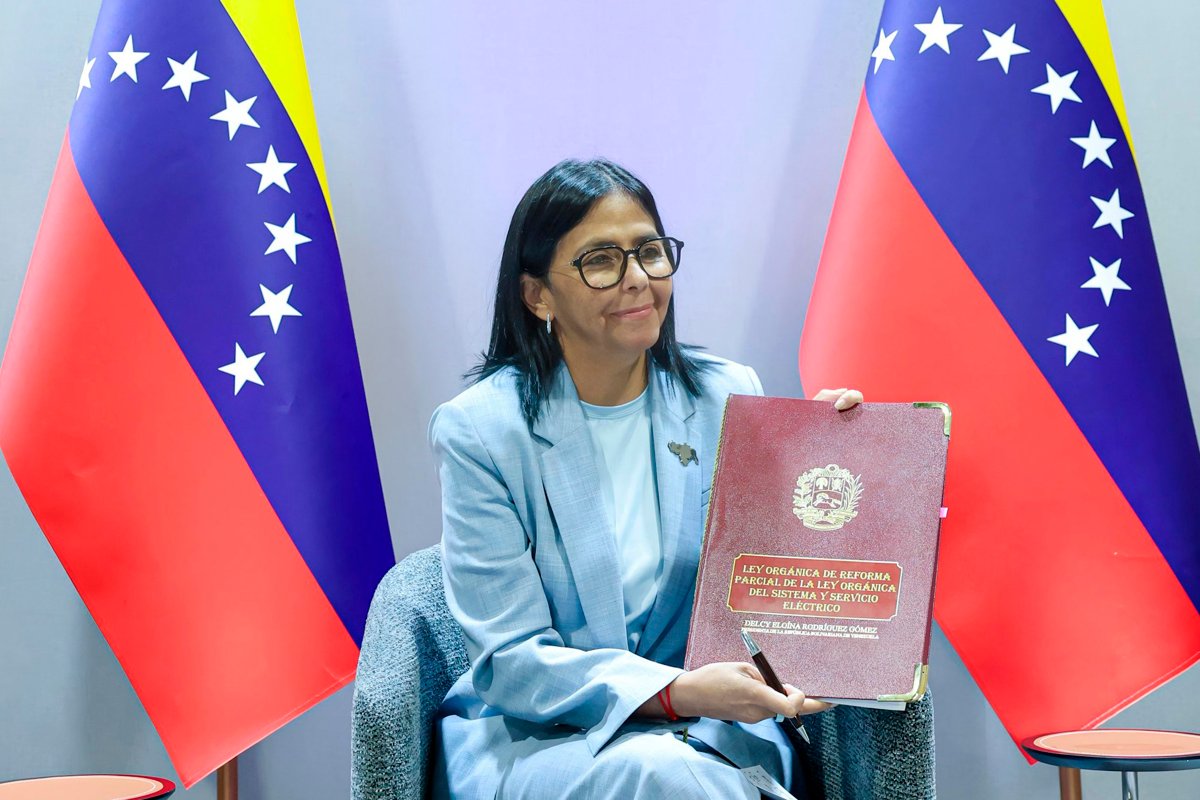
The president in charge of Venezuela, Delcy Rodríguez, sanctioned this Thursday the reform of the electricity service law approved nine days ago by Parliament to encourage private investment and foreign in the sector, whose prolonged crisis has worsened this year with the growth in demand and in the midst of the oil opening.
“This reform is very important, it will allow the participation, the intervention of the national and international private sector in the electricity generation processes to improve the national electrical service,” said Rodríguez, before the signing for the promulgation of the standard.
The president signed the law while speaking electronically at the “Expo Venezuela Energética Oriente 2026” taking place in Anzoátegui (east), one of the four states that make up the rich Orinoco oil belt.
“It is a law that takes a historic step, a step forward,” he added.
The new Organic Law of the Electrical System and Service, which joins other modifications of the Venezuelan legal framework to open strategic sectors to foreign capital, establishes that the generation activity “will be carried out by the State operating company, as well as by mixed and private companies that have the corresponding authorization.”
Concessions to private companies may be granted for up to a maximum period of 25 years, according to the standard.
Regarding oil companies, the law establishes that they must “ensure and guarantee the continuous, regular, reliable, sufficient and stable supply of electrical energy for the execution of primary activities, through self-generation, cogeneration or third-party contracting models, aimed at ensuring their operational autonomy.”
Venezuela has been suffering an electricity crisis for more than a decade, but in the last year blackouts have increased, which has generated protests in states of the country due to outages lasting several hours in a row even in medium-sized cities.
The opposition and experts argue that the failures in the system are due to corruption and lack of maintenance, although the government assures that the problem is due to sanctions, climatic phenomena and alleged sabotage.
Rodríguez, who recently promised that “soon” relief will come to the crisis, today saluted “the efforts of the Ministry of Electric Energy (…) for all the effort they are making to incorporate the megawatts that satisfy the demand” which, he assured, has increased due to the high temperatures caused by the El Niño climate phenomenon and “economic growth.”