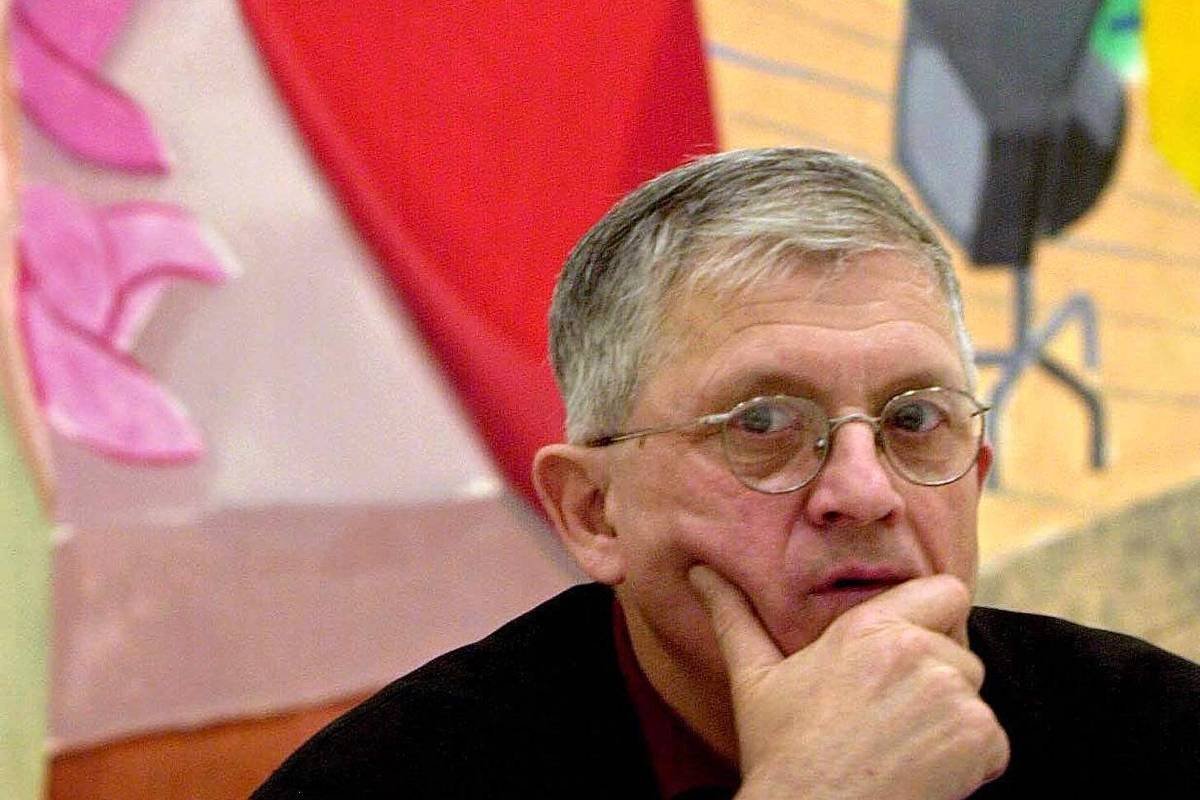
David Hockneythe English artist whose skillfully designed and elegantly colored paintings turned his attention to figurative and narrative art in the late 1950s and early 1960s after years of mastery of abstraction, died on Thursday at his home in London. He was 88 years old.
His press secretary, Erica Bolton, confirmed the death, and the cause was not disclosed.
Born in Yorkshire, Hockney lived for years in Los Angeles, long enough to define himself as an “English Angeleno” and produce images that captured the city’s sunny atmosphere as well as his prose. Joan Didion.
And, despite his art being considered conservative, he was progressive in at least one aspect: he was one of the first popular artists of his time to create works with content gay without disguise and one of the few to publicly take a stand against the censorship of homosexual images.
His death occurred nine months after the end of a large retrospective exhibition of his work at Louis Vuitton Foundationin Paris. But even at that moment, he wasn’t finished. Working in his London studio, using a wheelchair, and in poor health, he continued to paint.
“I just get on with my work,” he told The New York Times ahead of the exhibition’s opening in April 2025. “When I get back from Paris, I’m going to keep painting.”
And so he did, continuing a virtuous, graphic-based, fundamentally illustrative art that existed largely apart from changes in contemporary market fashions; that reproduced well in print and digital media; and which, in a succession of major institutional exhibitions, attracted popular attention over six decades.
David Hockney was born into a working-class family in the small industrial town of Bradford, Yorkshire, on 9 July 1937, one of five children. His father, Kenneth Hockeny, was a pram restorer and an ardent campaigner against nuclear weapons.
His mother, Laura Thompson Hockney, with whom he was very close, was a frequent subject of his portraits. David maintained close ties with his parents, returning annually to spend Christmas with them until the end of their lives. He shared their Labor Party politics and his father’s pacifism.
Seen as a talent from an early age, Hockney won a scholarship to a local art school. Faced with the chance of being drafted into the British Army in his late teens, he declared himself a conscientious objector and did two years of alternative service as a hospital orderly.
In 1959, he enrolled in Royal College of Artin London. The experience of seeing a large Picasso exhibition in Tate Gallery the following year reinforced the artist as a personal hero to Hockney.
A trip to New York in 1961 cemented his attraction to the United States, which to him seemed less sexually repressive than England. Inspired by his stay, he made engravings based on the series of paintings by William Hogarth “A Rake’s Progress” but rethought the 18th-century morality tale — about a young man’s descent into perdition — in the light of the 20th century.
Hockney made the hero flirt with runners in Central Parkdrinking in gay bars and going to jail. The episodes were portrayed in a different style: somewhat abstract, but grounded in realistic details.
When he finished the series, he himself had a striking look, with a vibrantly colored wardrobe consisting of plaid suits, striped football shirts and mismatched colored socks, round glasses and bleached blonde hair.
With a gold medal from the Royal Academy — received while the artist wore a gold lamé jacket at the ceremony — and guaranteed representation at a London gallery, Hockney was a rising British star.
His reputation spread to New York in 1963, when he made a second trip and met Henry Geldzahlerthe Met’s newly appointed curator of 20th-century art, who would become a close and influential friend.
The following year, Hockney visited Los Angeles for the first time. Some of his most famous paintings, many including images of swimming pools, were made there, identifying him as the quintessential artist of the leisure life of Southern California’s nouveau riche.
In 1966, while teaching at the University of California, he met Peter Schlesingera student who became her role model, muse and lover. The many paintings and drawings she made of him — in Los Angeles and London and on her frequent travels — constitute an ongoing chronicle of their relationship.
A 1974 Jack Hazan film, “A Bigger Splash,” named after one of Hockney’s pool paintings but edited largely without his participation, dramatized the couple’s 1971 separation.
Double portraits
Over the years, Hockney moved between studios in the United States and Europe. His prodigious output remained consistent. No matter where he was or what was going on, he worked, often experimenting with new media.
Painting was his main preoccupation in the mid and late 1960s, when he made several renowned double portraits: one of the British writer Christopher Isherwood and your partner Don Bachardy at his home in Santa Monica; another by Geldzahler and his partner Christopher Scott in New York; and a third by Los Angeles collectors Fred and Marcia Weisman in their Los Angeles sculpture garden.
Hockney strove to break away from what he considered overly realistic paintings. He used photography as a disruptive tool, which he initially used to aid his memory, taking photos wherever he went and consulting them when he painted.
Around 1970, he began gluing photos into collages, creating figures that appeared to be seen, Cubist style, from slightly different angles at the same time. Initially intended as studies for paintings, the collages became an end in themselves and grew in complexity and sophistication.
When, in 1982, Hockney was invited by the Center Pompidou in Paris to hold an exhibition of his photographs, he began experimenting with elaborate Polaroid composites—creating single images, often figures, from many individual photographs arranged in a grid.
He then moved on to photo collages made with a Pentax 110 camera, creating panoramic landscapes of the American Southwest, a part of the United States he particularly loved. He then translated the incremental approach — using many small images to build up one big one — to paintings, composing images of the rolling terrain of east Yorkshire from something like an aerial perspective in the late 1990s.
Art on stage
Hockney’s notion of painting as an immersive medium — demonstrated in a late-life digital extravaganza based on large-scale projections of his work, “Bigger & Closer (Not Smaller & Further Away)” — was also on display in his various and much-lauded theater projects.
The earliest was for a production of Alfred Jarry’s “Ubu Rei” at the Royal Court Theater in London in 1966; the others went to operas.
In 1975, the Glyndebourne Festivalin England, invited him to create the sets and costumes for Stravinsky’s version of “A Rake’s Progress”, with which Hockney was familiar. The visual effects he achieved through the use of enlarged linear hatching were stunning, and the production became one of the most admired of its time.
Hockney had another stage success in 1981 with “Parade”, a triple program of a ballet by Erik Satie and two operas by Francis Poulenc and Maurice Ravel at the Metropolitan Opera in New York. His designs for “Turandot”, by PucciniWagner’s “Tristan and Isolde” and Strauss’s “Die Frau Ohne Schatten” were extravagantly painterly, bringing his art closer to abstraction than ever before.
Increasingly opinionated about art as he aged, and temperamentally contrarian, Hockney became insistent on the importance of the human figure in art, formulating his conviction as a moral imperative.
In a newspaper statement in 1979, he criticized Tate for favoring abstract art in its acquisitions policies — confirming the view of him, widely held in certain parts of the art world, as an aesthetic reactionary.
He later advanced and vigorously promoted a highly contested theory that many of the great masters, from Renaissance onwards, they used optical aids, such as mirrors and prisms, to achieve the illusion of reality in their art. In 2001, to support his claim, he published a book, “Secret Knowledge: Rediscovering the Lost Techniques of the Old Masters.”
Despite the time he dedicated to defending these theories, they were secondary to his practically uninterrupted artistic production, which went from painting and drawing to experimental engraving and photography. Production continued without interruption as he traveled, often by car, across the United States, Europe and Asia, often in search of various light experiences, whether in Morocco or Arctic Norway.
Hockney began using computer graphics programs as early as 1985, and more than 30 years later he was making digital drawings and using painting apps on his iPad.
In the mid-1980s, he began making prints on an office copier, creating layers of color by running each sheet repeatedly through the machine, resulting in labor-intensive art produced using a supposedly effortless technology.
In 1989, he contributed a wall-sized print to the São Paulo Biennialsending the entire piece to Brazil by fax.
He is survived by his companion, Jean-Pierre Gonçalves de Lima, and his brothers Philip and John.