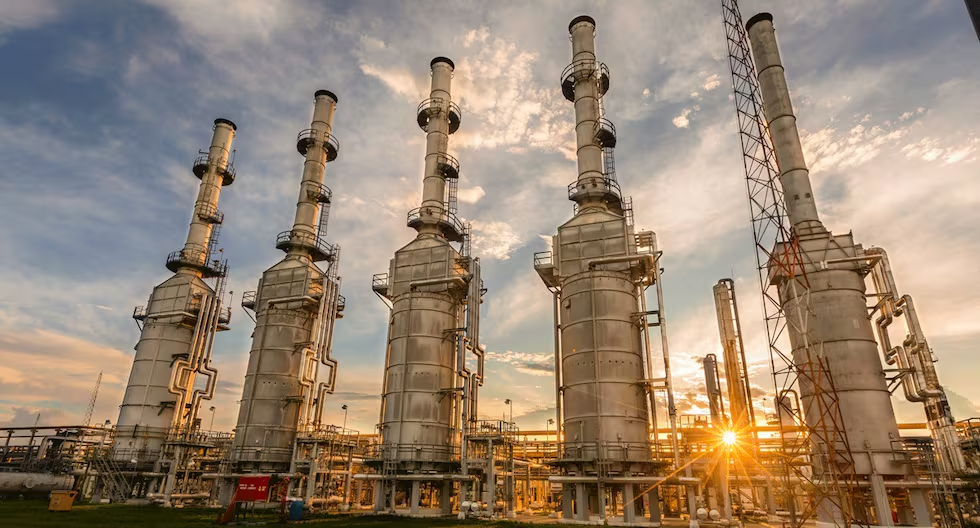

Since Camisea began operating in 2004, we Cusqueños have been waiting for natural gas to reach our homes and businesses. Two decades later, that demand remains legitimate and urgent. But perhaps the time has come to ask an even more uncomfortable question: what did we do with the wealth that gas has already left in Cusco?
The first task, of course, remains to massify gas. For years, a false dilemma was raised between building a gas pipeline or transporting it in tankers, the so-called virtual gas. Cusco needs both solutions: virtual gas in the short term and a gas pipeline in the medium term. The north understood it before: without a gas pipeline, it supplies hundreds of thousands of homes by land. Cusco can also advance through private investment in a project that, in a first stage, would serve more than 200 thousand users in seven regions.
But bringing gas to homes only answers part of the problem.
Since 2004, Cusco has received close to S/ 27 billion in canon and overcanon, more than US$ 7 billion. However, faced with such a volume of resources, it is difficult to point out a work that has decisively transformed the regional productive structure. Hundreds of projects were executed, many necessary, but few capable of permanently increasing our productivity and competitiveness. That is perhaps our greatest paradox: we are a region rich in canon, but still poor in capital.
The difference between income and capital matters. The income arrives, is distributed and is spent. Capital remains and continues to produce when the flow that originated it ends. For twenty years we have applied, in general terms, a fairly simple formula: exploit, collect and spend. The resources are distributed between the Regional Government and dozens of municipalities and end up fragmented into hundreds of interventions. Many close important gaps; Very few change the economic geography of Cusco.
If we continue under that logic, when the gas runs out we could preserve the memory of a region that received billions, but not necessarily the assets that that wealth could have built.
That is why the real challenge is to transform a part of that extraordinary income into extraordinary infrastructure: one that reduces costs, increases productivity, connects markets and generates new sources of income when Camisea no longer produces the same income.
This requires something unusual in our politics: agreeing on two or three transformative projects and maintaining them for several governments.
There are obvious candidates. The Cusco Regional Gasduct would bring competitive energy closer to homes, workshops and industries. The corridors to Matarani and Marcona would reduce our logistics costs, because whoever arrives at the port expensively ends up exporting expensively what they produce cheaply. And there is an infrastructure that our geography has been demanding for decades: the La Verónica tunnel.
With about 15 kilometers under the snow, it would be the longest tunnel in the country. It would reduce the difficult journey through the Malaga Pass and would bring the coffee, cocoa and fruit of La Convencion closer to Cusco and to national and international markets. The MTC estimates an investment close to S/ 1,350 million and is currently developing the pre-investment study. More than a road project, La Verónica could become an investment in territorial productivity: more efficiently uniting our Andes with our Amazon.
But there appears one of the great problems of our public infrastructure: the clock of works and the clock of politics do not advance at the same speed.
A work of this magnitude may require more than one government period. Our policy, however, rewards what can be inaugurated before the next election. If the final photograph will probably belong to the successor, the incentive to start big projects decreases.
That is precisely the paradigm that the next regional administration could break.
A governor does not need to inaugurate La Verónica to have made it possible. You can leave it funded, contracted and running, within a structure solid enough that the next government will have to continue it instead of starting again from scratch.
Veronica already has a name. What you need is a date, financing and continuity.
To achieve this we need to better protect the strategic infrastructure of the electoral cycle. Not to remove politics from public decisions, something impossible and also undesirable, but to prevent each election from once again putting into discussion projects that should respond to horizons of twenty or thirty years.
An alternative is to establish an infrastructure trust that receives a stable proportion of the fee, professionally manages those resources and finances a previously agreed portfolio. The trust is not a magic wand nor does it replace a good technical evaluation. Its value would be in something more important: committing resources, rules and projects beyond the government in power.
It would also allow us to introduce a logic that Cusco has used little: prudently using a part of future income to build today the assets that will produce tomorrow.
The Regional Government receives approximately S/ 400 million annually from gas canon. A conservative financial exercise shows that, by committing only a part of that flow, maintaining reserves against variations in income and respecting fiscal rules, around S/ 900 million of financing could be structured over ten years. With longer terms, the capacity could exceed S/ 1,000 million.
That would only be the first floor.
If these public resources were used as co-financing of public-private associations and private capital contributed around the other half, only the Regional Government could mobilize a portfolio close to S/ 2000 million.
Let’s think for a moment about what that figure represents.
Billions of soles progressively entering engineering, construction, transportation, services, machinery, food and suppliers. Local companies expanding capacities to attend larger scale projects. Professionals, technicians and workers finding new opportunities. And, above all, infrastructure that would continue to produce long after the term of the governor who started it ends.
The infrastructure has that characteristic: it produces twice. First, during its construction, when it mobilizes investment, employment and demand. Then, over decades, as you reduce costs, connect markets and increase productivity.
And there is still a second level.
Municipalities receive approximately three-quarters of the gas canon, around S/ 1,200 million annually. The proposed exercise shows that a participation equivalent to just 10% of these resources could take the joint portfolio towards S/ 3,200 million; With 20%, it could exceed S/ 4,400 million. At that scale it would be possible to think simultaneously about projects such as La Verónica and the Regional Gasduct.
It’s not about getting into debt just for the sake of it. Debt does not create wealth by decree and tomorrow’s resources committed today will no longer be available for other needs. Precisely for this reason this mechanism would only make sense for projects whose economic and social profitability justifies advancing these income.
Using future income to finance current spending would simply be spending before. Using them to build infrastructure that reduces the costs of energy, transportation and access to markets for decades is something very different: it is converting income into capital.
And there perhaps appears the true innovation that the Regional Government needs.
For years we have conceived of Gore mainly as a budget administrator: he receives transfers, executes projects and, when he wants to carry out a major work, travels to Lima to knock on the doors of the MEF or the corresponding ministry.
The next administration could change that relationship.
Cusco needs to go from a Gore administrator of transfers to a Gore structuring of investment and territorial capital: an institution capable of using its canon as seed capital, organizing trusts, structuring responsible financing, attracting private investment, articulating municipal resources and managing projects that survive government periods.
Regional leadership would then stop being measured solely by how much money it made in Lima. It would also be measured by how much capital it was able to mobilize from the resources that Cusco already possesses.
That could be one of the greatest institutional innovations of the next administration.
Norway offers a familiar reference. After discovering oil in the late 1960s, he understood that extraordinary income should not be confused with permanent wealth. It created institutions to save and invest an important part of that income and established rules capable of surviving different governments. The sovereign fund was the instrument. The true innovation was political: consensus, discipline and institutionality.
Cusco does not need to copy Norway. You need to understand the logic: extraordinary income should leave extraordinary assets.
History may be offering the next regional administration one of the last great opportunities to do so. Camisea will not be eternal. The income that seems abundant today will decrease one day and then we will no longer be able to decide what to do with it again.
Twenty years from now, someone will ask again what we did with the gas money.
And perhaps we don’t have to look too far to understand the magnitude of that responsibility.
Centuries ago, the Incas built roads, platforms, canals, administrative centers and hydraulic systems thinking beyond the next harvest. Part of that infrastructure continues to stand and, paradoxically, still generates value for us today. Machu Picchu, the Qhapaq Ñan, the platforms and the heritage built by our ancestors continue to attract visitors, generating employment and producing income for thousands of Cusco families.
We still live, to some extent, on the capital left by those who were here five hundred years ago. The question is what capital we will leave behind.
Perhaps that is the true measure of a political generation.
Not how much budget he executed. Not how many small works he inaugurated. Nor how many times did he get an additional transfer from the National Government. But what infrastructure he left so that those who come after can produce more, connect better and live better.
The next governor has that opportunity in front of him: to stop managing only Camisea’s income and begin to transform it into economic assets for the future. Go from the Regional Government that knocks on the doors of the MEF to the Regional Government that structures capital, mobilizes investment and leads a long-term vision.
And perhaps that is also the main merit of a well-conceived trust: ensuring that a great work stops belonging to the governor who starts it or who inaugurates it and finally belongs to Cusco.
If we do this, when our children ask again where the billions in gas went, we won’t have to open a spreadsheet to explain it.
We will be able to show you a tunnel of opportunities, La Verónica, energy reaching homes and businesses, roads connecting our production with the Pacific and a more integrated and productive region.
The Incas left us infrastructure that, five centuries later, still generates wealth for the people of Cusco. Our generation received the gas. Your historical responsibility is to decide what you will leave behind when the gas is gone.