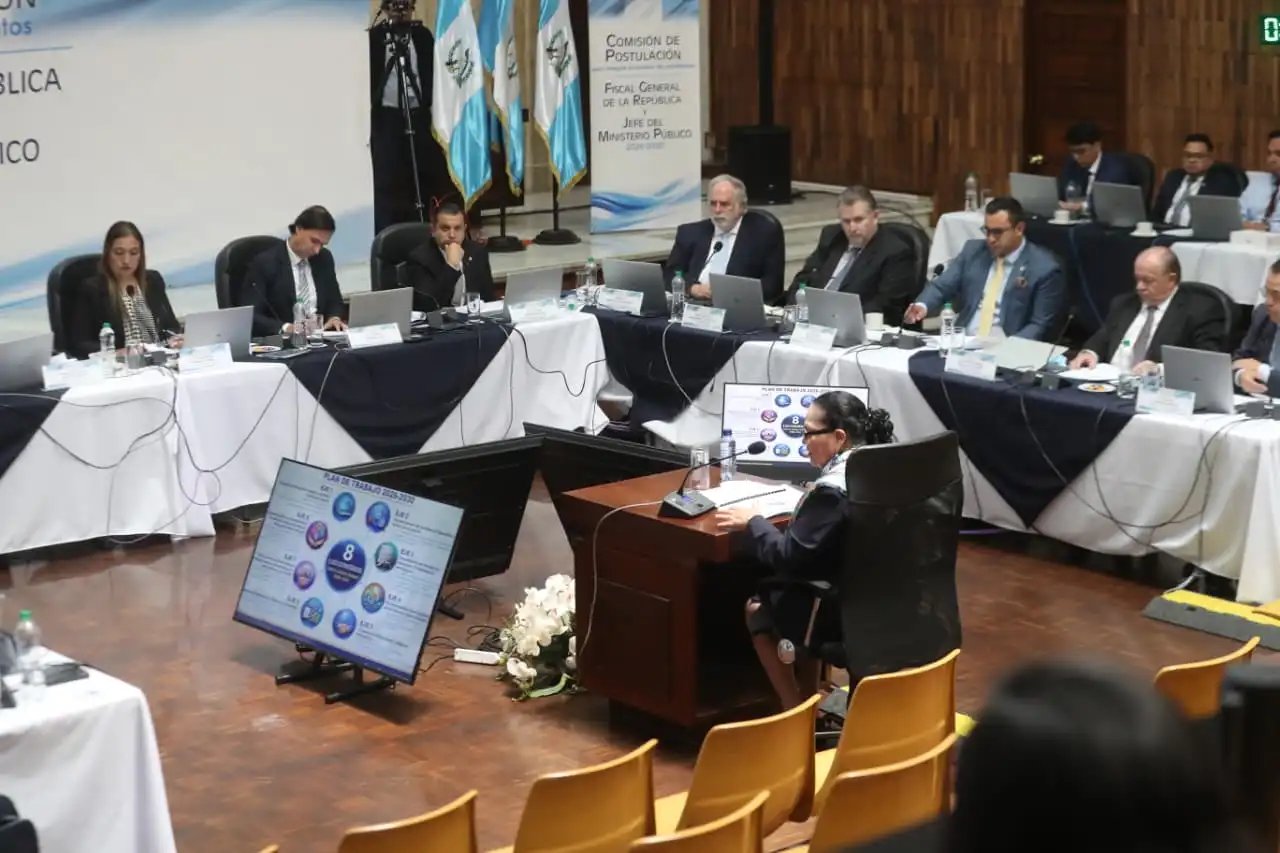
The Nomination Commission for Attorney General of the Public Ministry (MP) continued this Thursday, April 9, with the interviews of candidates for the position, and it was the turn of the current prosecutor, Consuelo Porras.
In front of the commission, Porras was given space to present his work plan and the axes he would give priority to if he were to occupy the position again.
The interview was divided into a maximum of seven minutes for the presentation of the work plan; then, in a question and answer phase, with a maximum of three minutes to answer each question.
Porras told the commissioners that he would present the MP 2026-2030 work plan. Prior to that, he indicated that he would make a “review of the institutional transformation” of the research entity.
He presented slides and indicated that his plan is a follow-up “to the continuous improvement” of the MP; However, it focused on highlighting the coverage of the investigative entity achieved on a national scale, according to the official.
She also highlighted that she has worked on the qualification of specialized agencies and that they have achieved four international certifications, which, according to her, make the service provided by the MP more efficient and allow for “accountability and transparency” in the work of the Prosecutor’s Office.
The minutes of his presentation continued and Porras continued with the presentation of the “achievements” during his administration.
He stated that they achieved a 99.7% resolution of overdue cases and a 98% resolution of new cases. According to her, the efficiency of the MP in 2025 was 116% and 95% in user satisfaction.
The time ended and the Commission told him: “excuse me, your time has ended, we are going to move on to the second phase, which is question and answer.”
One of the questions was to explain, in summary, three objectives that would organize its general policy as an institution. Porras responded that the plan would be aimed at “prompt and complete justice and access to justice for all citizens without discrimination.”
One of the commissioners told her that, when they asked her about her work plan, she mentioned “objectivity,” so they asked her to expand on whether that principle contrasts with certain actions of the MP. The prosecutor indicated that the MP’s actions do not contrast with objectivity, but rather complement it to be effective in the investigation.
Another question was why he considers that, despite the questions and social rejection of his management, he meets the conditions to continue in office. Porras responded that “perception must be differentiated from reality.”
He stated that they are audited on a national scale and that 95% of the users of the system establish “their satisfaction” with the benefits they receive from the Prosecutor’s Office.
He stressed “having all the capabilities not only in accordance with what the law establishes; in my case all the requirements of suitability, capabilities, and honorability to perform the position have always been met.”
She indicated that, if elected, her new management would be a follow-up to what has already been implemented, which entails the continuous improvement plan, since everything is installed with capacity.
He said that the people who are investigated will never agree with the MP’s actions.
Porras assured that she has been criticized because “she does not have any selection” in her actions, which have been governed “by the laws and the Constitution.”
Subsequently, the Commission thanked him for the report he provided in the interview phase, so he did not have time to present his work plan.
He defended the work of the prosecutors who handle the cases and that the MP is subject to judicial controls.
Stay up to date with the Now newsletter. Key information at the moment it happens. Subscribe here.