
All views and claims expressed in this article belong solely to the author and do not necessarily reflect those of Dominica News Online.
On June 12, 2026, Miriam Blanchard, then-Minister of Labour and the sitting parliamentary representative for Roseau North, resigned from her seat for health reasons. Under Section 55(3) of Dominica’s Constitution, a by-election must be held within three months of a vacancy arising, unless Parliament is dissolved sooner. Prime Minister Roosevelt Skerrit announced the date: Monday, September 7, 2026, with Nomination Day on Friday, August 21.
Three candidates are contesting the seat:
• Ashma McDougall — Dominica Labour Party (DLP)
• Danny Lugay — United Workers Party (UWP), and former parliamentary representative for Roseau North (2014–2022)
• Sherman Boston — Independent candidate
But behind the headlines of the campaign, a parallel and far more consequential story has been unfolding: the troubled rollout of Dominica’s most ambitious electoral reform program, occurring at the exact same time as this critical by-election.
The reform context
In March 2024, Parliament passed three landmark pieces of legislation — the Registration of Electors Act, the House of Assembly Election Bill, and the Electoral Commission Act — aimed at modernizing Dominica’s electoral system. Key reforms included:
• A mandatory voter confirmation exercise in which all registered voters must reconfirm their registration to remain on the official list of electors.
• The introduction of voter identification cards, a reform demanded by the opposition for years.
• Stricter voter registration processes.
The confirmation exercise was declared to run from September 1, 2025, through August 31, 2026 — a window of twelve months, as required by Section 50(1) of the Registration of Electors Act. New voter registration was temporarily suspended during much of this period and only resumed on March 9, 2026.
The Roseau North by-election falls squarely within this confirmation window — meaning the election is being conducted while the very foundations of the electoral register are still being rebuilt.
Issue 1: Alarmingly slow voter confirmation rates
The most prominent issue to surface is the slow pace of voter confirmation in Roseau North specifically.
UWP candidate Danny Lugay publicly raised the alarm, revealing that he had formally written to the Electoral Commission about the sluggish progress. According to Lugay, by the end of May 2026 — eight months into the confirmation period — only 773 voters in Roseau North had been successfully confirmed.
To put that figure in context, Lugay referenced historical turnout data: in the last credible general election with reasonable electoral participation in the constituency, Roseau North recorded 3,773 votes cast. The gap between 773 confirmed electors and 3,773 historical voters was stark, raising urgent questions about whether the confirmation exercise would be completed in time for the by-election, and whether thousands of constituents might find themselves unable to vote.
While confirmation rates have reportedly accelerated since Lugay’s initial complaint the episode underscored a structural concern – the confirmation process may not have been adequately planned, resourced or publicized, particularly in the key Roseau North constituency.
Issue 2: Duplicate names on the voters’ list
In June 2026, the Electoral Office was forced to publicly address concerns about duplicate names appearing on the electors’ confirmation list.
The issue was serious enough to warrant a formal press release on June 23, 2026. The Electoral Office acknowledged the problem and, by July 23, attributed it to a software issue — effectively admitting that the digital systems supporting the new registration framework had produced “a glitch” resulting in repeated entries for the same individuals.
For an electoral reform programme whose central promise was to clean up the voters’ list and restore public confidence in the register, this was a deeply damaging revelation. It provided ammunition to critics who had long argued that the existing electoral roll was bloated and inaccurate, and it raised questions about the readiness of the technology underpinning the new system.
Issue 3: Last-Minute legislative amendments
On August 7, 2026 — just one month before the by-election — the government gazetted amendments to the electoral laws. Chief Elections Officer Anthea Joseph sought to clarify the changes on August 12, explaining that:
• Prior to the amendment, only voters on the “adopted” list, those confirmed, and new voters on quarterly supplementary lists were entitled to vote during the confirmation period.
• This meant that persons who registered between the date of the last supplementary list and the date of the writ for elections were not entitled to vote.
• The amendments address this gap, extending eligibility to those more recent registrants.
While the change appears to expand voter eligibility — a positive development for inclusion — the timing drew criticism. Amending election law just weeks before a by-election creates confusion among voters and candidates alike, and raises questions about whether the rules of the game are being changed mid-match.
The Electoral Office also clarified that voters whose names appear on the electoral register cannot be turned away on election day solely for not having a voter ID card. Valid government-issued identification — such as a passport, driver’s licence, or Social Security card — is acceptable. A voter without any ID can also take an oath, or be vouched for by another voter who has shown valid identification.
Issue 4: Voter ID Card distribution and identification requirements
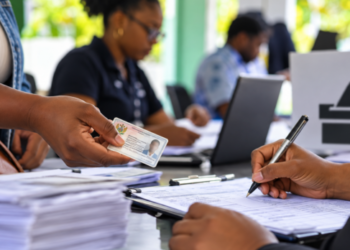
The distribution of the new voter identification cards — a signature achievement of the reform programme — began on Monday, August 10, 2026, less than a month before the by-election.
Cards are being distributed at the Electoral Office and at designated locations for Roseau North, with collection hours from 9:00 a.m. to 6:00 p.m., Monday through Friday (and some Saturday availability). However, the compressed timeline means that many voters may not receive their cards before September 7.
The Electoral Office’s clarification that the voter ID card is not mandatory for voting — any valid government-issued ID suffices — was likely prompted by public anxiety about whether voters without the new card would be disenfranchised. While this clarification was necessary and welcome, it also highlighted the gap between the promise of the reform (universal voter ID cards) and the reality on the ground (cards still being distributed weeks before polling day).
In an update statement on Q95 FM on August 28, Chief Elections Officer Anthea Joseph outlined the specific identification requirements for Roseau North voters. She said:
“The requirements for the by-election on polling day — those without voter ID cards will need some form of identification. Every voter without a voter ID card will need an ID in the form of a valid passport issued by the Commonwealth of Dominica; or a valid driver’s license and a valid birth certificate issued by the Government of Dominica; or a valid Social Security registration card and a valid birth certificate; or a valid photo ID which is notarized by a Justice of the Peace, Commissioner of Oaths, or Notary Public, along with the birth certificate.
However, for a Commonwealth citizen, if he or she does not have a voter ID card, they require a valid passport from their Commonwealth country, or a driver’s license from their Commonwealth country, or a Social Security card, or an equivalent document issued by their government. That will suffice for polling day. In addition, those without a voter ID card will have to take an oath in the form of Form 12.
Everyone without a voter ID card will have to take an oath on polling day. So we want to sensitize the voters of Roseau North — if you do not have your ID card, you need to have some form of ID, and you should start putting that together in advance, so that on the day when you get to the polling station, you won’t be denied the opportunity to vote.”
Ms. Joseph further emphasized that all documents presented must be up to date, and will not be accepted if they are expired.
Issue 5: The shadow of a general election
Adding a layer of political uncertainty, there has been persistent public speculation that the by-election may be rendered moot by a dissolution of Parliament before September 15, 2026, which would trigger a general election instead.
The constitutional provision is clear: a by-election must be held within three months of a vacancy, unless the House is sooner dissolved. Comments on social media and news outlets have speculated that the Prime Minister could dissolve Parliament by mid-September and call a general election for early December 2026.
This speculation — whether well-founded or not — has had a chilling effect on the by-election campaign. Some voters and political observers have questioned the value of a by-election that could be overtaken by a general election within weeks, potentially dampening voter turnout and engagement with the confirmation process.
Issue 6: Continued Confusion About Eligibility
The convergence of the confirmation exercise, new voter ID card distribution, and last-minute legislative amendments has produced significant public confusion about who is eligible to vote on September 7.
Key questions that have surfaced include:
• *If I registered recently but haven’t been confirmed, can I vote?* (The August 7 amendments appear to address this, but many voters remain unsure.)
• *If I don’t have my new voter ID card yet, can I still vote?* (Yes — but the Electoral Office has had to issue repeated clarifications on this point.)
• *If I missed the confirmation deadline, am I off the list?* (The confirmation period runs until August 31, 2026, but the broader registration confirmation deadline extends to October 14, 2026 — creating confusion about which deadline applies to the by-election.)
This confusion is itself a problem. Electoral integrity depends not only on clean processes but also on voters understanding their rights and the procedures. When the rules change multiple times in the weeks before an election, even well-intentioned reforms can erode public confidence.
Issue 7: Disenfranchisement on the Ground
Calling in to the popular Q95 FM “Hot Seat” program on August 28, UWP Political Leader, Dr. Thomson Fontaine, outlined what he described as systemic problems with the electoral process that the opposition is virtually powerless to challenge before polling day in the Roseau North by-election. He again explained that once the election writ was issued on August 10, legal constraints under Section 24.2 of the House of Assembly Act prevent any objections, claims, or changes to the register from being heard until after the election. This meant the opposition could not formally challenge the voters list, the four separate lists being used simultaneously, or instances where individuals appeared on different lists with conflicting polling districts. Fontaine raised specific concerns about persons appearing at addresses that “really do not exist” and have been “out of existence for over 40 years.” “We believe that the whole process appears to be favoring a particular political party, and it’s not ours,” he said.
Beyond the legal barriers, Fontaine expressed deep concern about the practical disenfranchisement of Roseau North voters, particularly those whose names on the voters list do not match their birth certificates — a problem he said was encountered repeatedly during canvassing. He revealed that in a single afternoon’s canvassing of 130 individuals in one Roseau North polling district, 30 said they lacked the correct documentation to vote. “If you are disenfranchising even a hundred people, that’s too much,” he stated.
What’s at stake
The Roseau North by-election is the first electoral contest under Dominica’s new reform framework. The issues that have surfaced — slow confirmation rates, software glitches, duplicate entries, deceased voters on the list, last-minute law changes, compressed ID card distribution, and opposition concerns about systemic disenfranchisement — are not merely technical problems. They strike at the heart of public confidence in the democratic process.
For the Electoral Commission and Chief Elections Officer Anthea Joseph, the by-election is a stress test: can the new system deliver a free, fair, and credible vote under real-world conditions? The early signs have been mixed. The office has been responsive — issuing clarifications, addressing the duplicate name issue, and amending the law to expand eligibility — but each fix has come as a reaction to a problem rather than as proactive planning.
For the people of Roseau North, the stakes are more immediate: will their names be on the list, will they have the right documents, and will their votes count?
September 7 2026 is therefore more than a simple by-election date. It is a test of whether Dominica’s electoral modernization is working in practice, not simply on paper.
The country has an opportunity to turn this difficult moment into a constructive one. A properly managed registration and confirmation process could produce a cleaner register in Roseau North, stronger voter identification and greater trust. But trust cannot be demanded. It is earned through accuracy, openness, prompt correction of errors and equal treatment of every elector.
Roseau North voters should insist on those standards—not because they favor one party, candidate or outcome, but because the right to vote belongs to every qualified Dominican citizen.
Where to vote
In alphabetical order, here are the ten Polling Stations in the Roseau North Constituency for the September 7 by-election:
N0. 1, Pottersville: A to C, Goodwill Parish Hall, station 1.
D to I, station 2. J to M, station 3. N to Z, station 4.
N0. 2, Lower Goodwill East: A to D, Alpha Center, station 5. E to J, Alpha Center, station 6. K to P, Genesis Christian Union Preschool, station 7.
Q to Z, Genesis Christian Union Preschool, station 8.
N0. 3, Lower Goodwill West: A to F, St. Alphonsus Preschool, station 9. G to M, station 10. N to Z, station 11.
N0. 4, Upper Goodwill: A to C, Red Cross Headquarters, station 12. D to I, Christian Union Primary School, station 13. J to Z, Christian Union Primary School, station 14.
N0. 5, Belle Vue Rawle: A to Z, Goodwill Primary School, station 15.
N0. 6, Fond Cole: A to E, Fond Cole Community Center, station 16. F to L, station 17. M to Z, station 18.
N0. 7, Stock Farm: A to E, Dominica State College, station 19. F to L, station 20. M to Z, station 21.
N0. 8, Loubiere: A to Z, Red Cross Headquarters, station 22.
N0. 9, Goodwill: A to C, Goodwill Primary School, station 23. D to G, station 24. H to L, station 25. M to Z, station 26.
N0. 10, Mont Daniel: A to Z, Former Chinese Embassy, station 27.