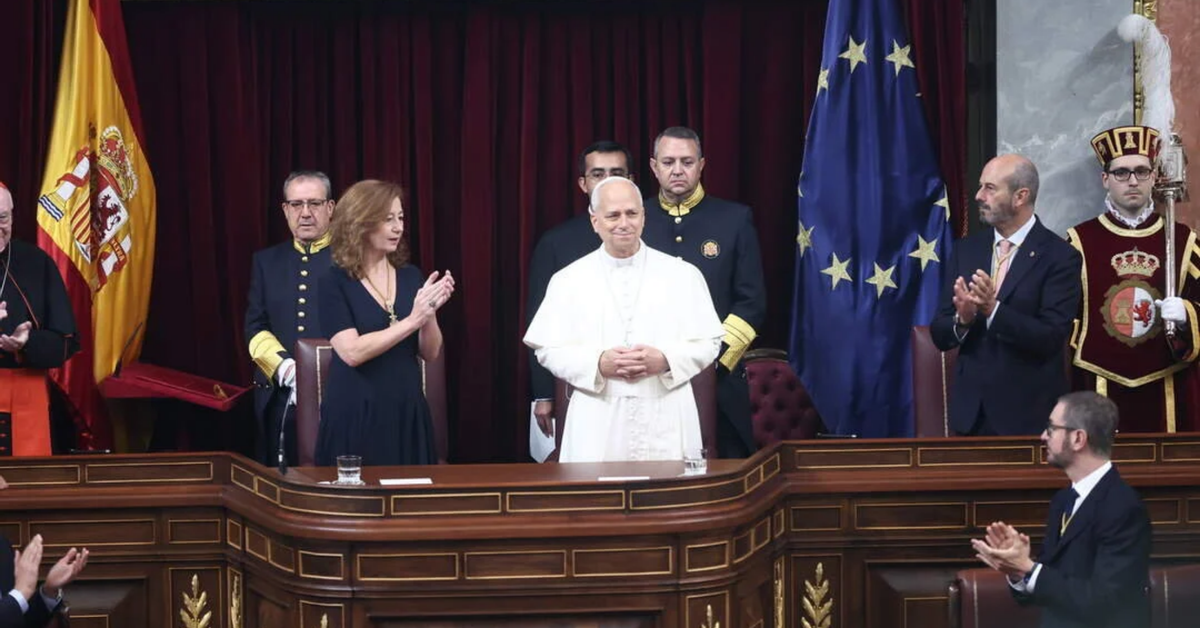
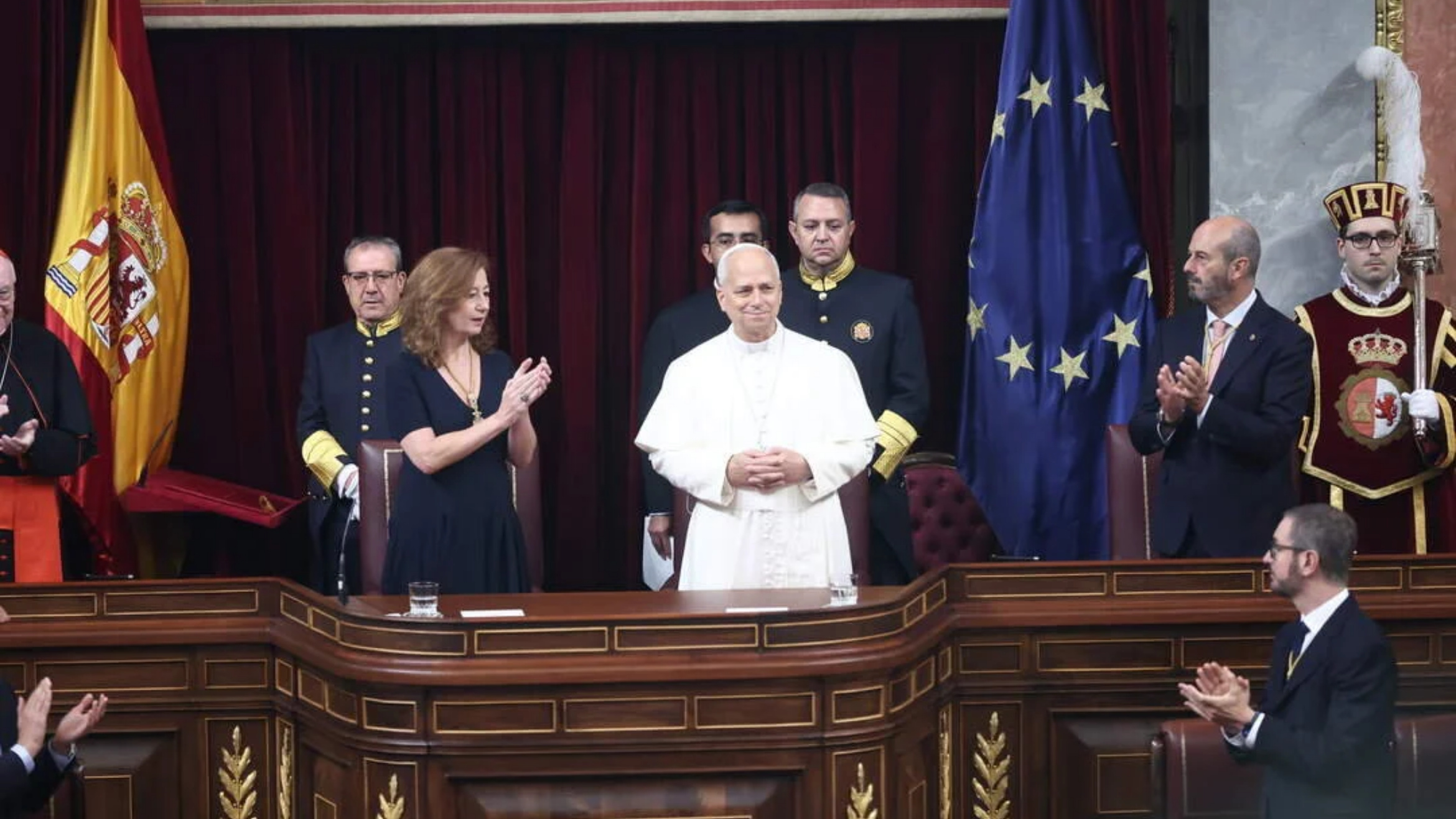
San Salvador/“Beyond the legitimate diversity of positions, every legislative task ends up encountering a decisive question: what conception of the human person inspires the laws and what type of society these laws build.”
These words were pronounced by Pope Leo XIV on June 8, in front of the chamber that brings together those who theoretically represent Spanish political diversity in the Congress of Deputies. And the pontiff added: “Faced with this question, Spain has a particularly rich memory. Its geographical and political identity has been interwoven with a history in which faith and reason, art and law, tradition and thought have been able to find each other fruitfully. In its cathedrals and universities, in its immortal literature, in its legal institutions and in the very spirit of its people, a heritage remains alive that has given shape to a way of living freedom, practicing justice and ordering common life.”
Rarely does a bishop of Rome offer such fundamental praise to the civilizing soul of a people. If he did so in Madrid, on the first stop of his vibrant tour of Spain, it is because Leo
In his speech, of course, the Pope recalled the School of Salamanca, undoubtedly one of the most astonishing temporal conjunctions of academic geniuses in the history of humanity.
In his speech, of course, the Pope recalled the School of Salamanca, undoubtedly one of the most astonishing temporal conjunctions of academic geniuses in the history of humanity. Although framed by the Hispanic Golden Age, its artistic and literary equivalent (Garcilaso, Quevedo, Teresa of Ávila, Juan de la Cruz, Cervantes, Lope, Góngora) is much better known and celebrated.
Concentrated in the 16th century, the Salamanca school was the cradle of thinkers who Joseph Schumpeter and Raymond de Roover considered the initiators of economics as a science. Francisco Suárez, for example, called the Doctor Eximiuswas the first great theorist of the sovereignty of the people, the fundamental basis of personal freedoms and modern democracy. The Jesuit Luis de Molina developed valuable analogies between nations and commercial societies, praising healthy individualism in the face of tyranny. Francisco de Vitoria, the theologian who rejected the moral condemnation that weighed on merchants for the legitimate desire for profit that animated them, is one of the pioneering humanists of free exchange. Diego de Covarrubias, the anti-slavery jurist who developed a brave apology for prices, was decisive for the much later anthropological understanding of the free market.
The Navarrese canon Martín de Azpilcueta was a notable precursor of the quantitative theory of money—several years before Jean Bodin—and intuitively expounded the measures of value that we assign to goods according to their variables over time. This doctrinal foundation of Azpilcueta will serve the Austrian School of Economics to deploy, centuries later, the modern concept of interest. Tomás de Mercado, a keen observer of the commercial reality in the Indies, formulated the distinction between the nominal value of money and its purchasing power.
If a voracious and polyglot reader like Karl Marx had studied Vitoria and Molina, Azpilcueta and Mercado in depth—and there is no evidence, by the way, that he would have even known them—we would have avoided numerous misunderstandings in relation to the theory of value. It is even possible to argue, without problems of conscience, that the wise men of Salamanca would have prevented the useless offering of millions of human beings on the “altar” of the State if their main philosophical and theological postulates had been appropriately disseminated in the 19th century.
“The theoretical principles of the market economy and the basic elements of economic liberalism were not conceived, as was believed, by Scottish Calvinists and Protestants, but by the Jesuits and members of the School of Salamanca during the Spanish Golden Age.”
Salamanca scholasticism constitutes a subject to be discovered even among liberals themselves. In the last hundred years, notable economists and political scientists committed to the defense of freedom, both in the old and the new continent, acknowledge that they have not delved sufficiently into these Iberian thinkers, among whom Juan de Mariana, Domingo de Soto, Bernardino de Sahagún and Domingo Báñez also stand out.
“The theoretical principles of the market economy and the basic elements of economic liberalism,” admitted none other than Friedrich von Hayek, “were not conceived, as was believed, by Calvinists and Scottish Protestants, but by the Jesuits and members of the School of Salamanca during the Spanish Golden Age.” And in his extraordinary work of 1954, History of economic analysisthe aforementioned Schumpeter refers to the Salamancan theorists with these blunt words: “To them, more than to any other group, belongs the merit of having founded economic science.”
Leo That work of justice and renewal will be left to future Hispanic generations, not only because that glorious past belongs to them, but because through it we could – all nations – rediscover the gigantic moral weight and the nourishing fascination that the gift of freedom has.