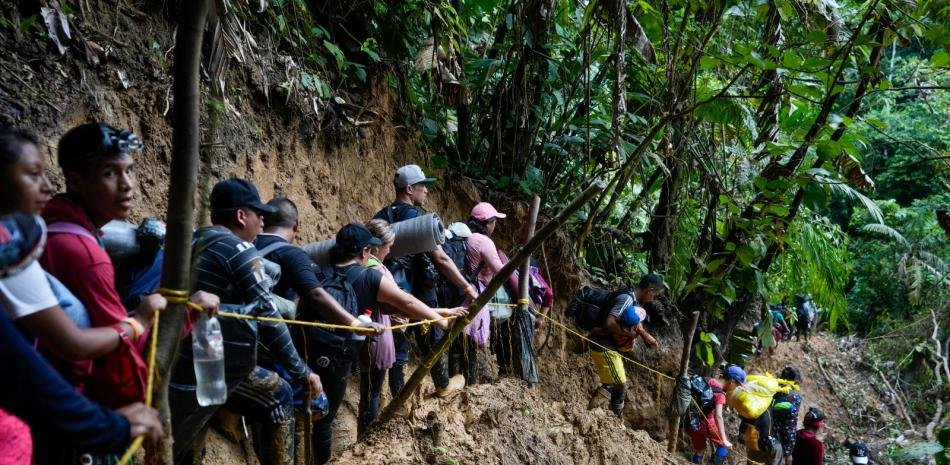
Nine alleged members of a gang dedicated to migrant trafficking across the border with Panama were charged in Colombia accused of laundering nearly 100,000 million pesos (about 29.1 million dollars) obtained from this illicit activity, the Prosecutor’s Office reported this Tuesday.
The criminal network is accused of facilitating the irregular departure of more than 800,000 migrants through the Gulf of Urabá, in the northwest of the country, through supposed tourist packages promoted on social networks that served as a facade to coordinate the transfer of foreigners to Central America, according to the investigation.
According to data from the Ombudsman’s Office, in 2023 alone, more than 520,000 migrants passed through the Darién Gapon Colombia’s jungle border with Panama, and in 2024, the last year before US President Donald Trump tightened immigration policy, more than 400,000 people crossed the border.
A prosecutor from the Specialized Directorate against Money Laundering charged the detainees with the crimes of money laundering, illicit enrichment of individuals and conspiracy to commit a crime.
The Prosecutor’s Office reported that the organization operated mainly from the towns of Necoclí, in the department of Antioquia and Capurganá, Acandí and Sapzurro, in Chocó, a department bordering Panama.
From these places, the maritime transport of migrants from countries such as Afghanistan, Iraq, Saudi Arabia, Haiti, Venezuela, Costa Rica and China was organized.
The authorities identified income exceeding 100,000 million pesos in the formal financial system during the investigated period and a good part of these resources was obtained even during the pandemic, when tourist activities were suspended, the Prosecutor’s Office added.
The investigation determined that the money was allegedly hidden through various money laundering maneuvers, including cash transactions, the creation of maritime and river transport companies used as a front, the purchase of real estate and personal property, and fractional money transfers, known as “smurfing.”
Migrant trafficking through the Darien Gap became one of the most lucrative illicit businesses in the region in recent years, driven by the exodus of thousands of people seeking to reach the United States.
The route, considered one of the most dangerous in the world due to natural risks and the presence of criminal groups, was used by hundreds of thousands of migrants of different nationalities, which favored the emergence of networks dedicated to the irregular transportation of people, extortion and other associated illegal activities.