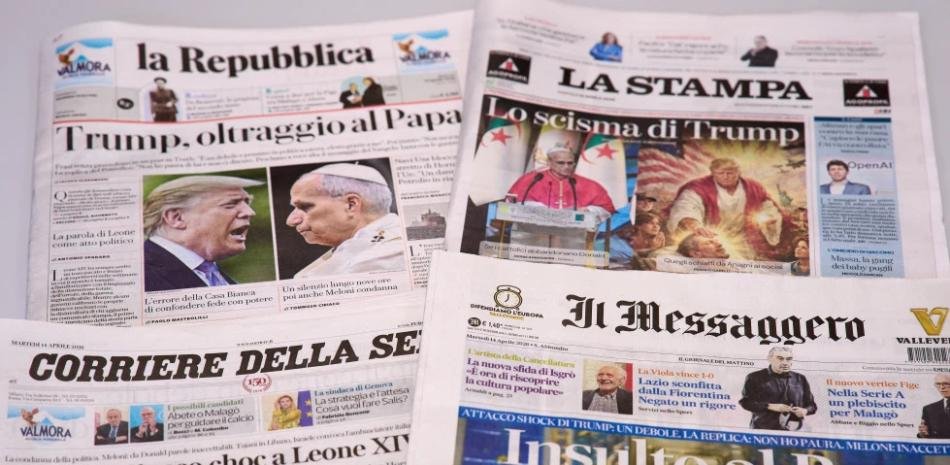
Donald Trump’s criticism of Pope Leo XIV, whom he called “weak” and “terrible”, represented an unprecedented personal attack by an American president against a pontiff, culminating months of tension.
The election, in May 2025, of the first American pope in history – a figure who has championed the cause of international law and migrants – seemed destined to provoke a confrontation, but both managed to manage their differences for a time.
However, since January, the US military operation in Venezuela, threats against Cuba and Greenland, and subsequently the war with Iran, the Vatican has issued increasingly frequent statements of concern.
On Sunday night, Trump launched a withering attack on the leader of the world’s 1.4 billion Catholics, calling him “WEAK on crime, and terrible on foreign policy.” On Monday night he insisted: “He’s wrong.”
“There are often tensions between the Catholic Church and states over various issues,” said François Mabille, director of France’s Geopolitical Observatory of Religion.
“What is unprecedented in this case is that the figure of the pope as such is attacked (…) that he is judged weak, and that the American president does this with such vehemence,” he told AFP.
– “It precipitated the controversy” –
Leo XIV, an expert in canon law, has repeatedly stressed the importance of respecting international law, including criticizing Israel’s actions in Gaza last year.
However, it is usually expressed in general terms, leaving the most direct criticism in the hands of the local clergy.
An exception was when he attacked the “inhumane” treatment that migrants receive in their native country. The White House responded with a measured comment in defense of its immigration policies.
The pontiff’s rhetoric and calls for peace have intensified as the war with Iran has spread, and as Trump threatened to wipe out all of Iranian civilization in early April. Leo XIV then declared to the press that this was “unacceptable.”
Trump’s threat “precipitated the controversy,” Mabille told AFP.
The pontiff then urged “citizens of all countries involved to contact the authorities, political leaders and congressmen to ask them to work for peace and always reject war.”
For Massimo Faggioli, professor of historical and contemporary ecclesiology at Trinity College Dublin, this was also a turning point.
According to him, Leo XIV violated a long-standing diplomatic norm: “that the pope stay out of American politics.”
– Alienate Catholic voters –
This is not the first time a pope has disagreed with the United States: John Paul II, for example, strongly opposed the 2003 invasion of Iraq.
Just weeks before he died in April 2025, Pope Francis called Trump’s migrant deportations a “serious crisis” that “starts badly and will end badly.” The person in charge of deportation policy responded to him to “focus on the Catholic Church” and let the United States government “take care of the borders.”
Many of Francisco’s critics called him anti-American, something that cannot be said of León.
Traditionally, American presidents have been cautious about upsetting American Catholics by speaking out too much against a pope.
Trump’s criticism “is unprecedented because no American president has wanted to alienate American voters,” Faggioli told AFP.
– Face history –
Last week, the Vatican downplayed speculation about tensions with Washington and denied a report that the United States had reprimanded the Holy See’s envoy in January, following comments by Leo XIV that were considered critical.
The pope responded Monday to Trump’s attack with his usual restraint, saying he had a “moral duty” to speak out against the war.
Italian Prime Minister Giorgia Meloni, a Trump ally, described the president’s criticism as “unacceptable” and considered that “it is fair and normal for (León) to ask for peace.”
“If you want to be pope, you have to face history, you can’t lock yourself in a monastery,” Faggioli agreed.
Mabille pointed out that, given how frequently Trump changes his mind, it is very possible that the controversy will pass without pain.
“Who knows, maybe the pope will give a speech that Trump likes, or maybe Trump will see an opportunity to push his own agenda and tell this pope how extraordinary he is,” he said.