BAKU, Azerbaijan, October 16. The
Azerbaijani Army launched a counter-offensive operation, later
called the “Iron Fist”, on September 27, 2020, in response to the
large-scale provocation of the Armenian armed forces along the
frontline.
The 44-day second Karabakh war ended with the liberation of
Azerbaijan’s territories from nearly 30-year Armenian occupation
and the restoration of territorial integrity.
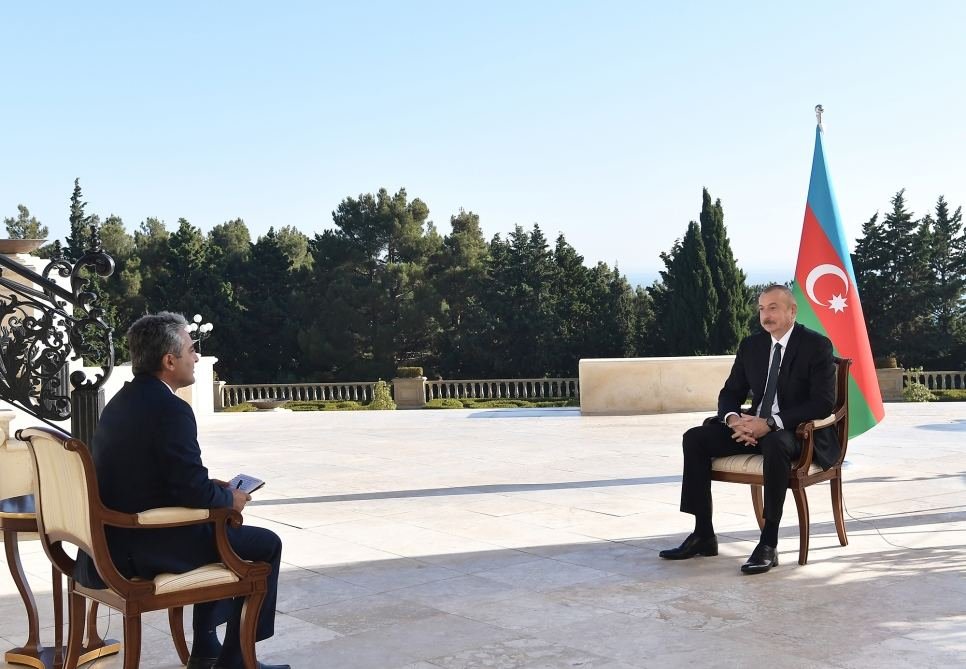
President of the Republic of Azerbaijan Ilham Aliyev has been
interviewed by Turkish A Haber TV channel on October 16, 2020.
Trend presents
the interview.
– Greetings to all from A Haber. The eyes of the whole world are
focused on the Karabakh region these days. Karabakh, which has been
under Armenian occupation for 30 years, is experiencing a great
tragedy, because despite the humanitarian ceasefire, Armenians
continue to fire at civilians and the Azerbaijani army. Naturally,
the Azerbaijani army does not leave these attacks unanswered and
dealing heavy blows to the Armenian army.
What is the latest situation in the region and what can be
expected? We will learn the opinion of the President of Azerbaijan,
Commander-in-Chief Mr. Ilham Aliyev.
Mr. President, we express our deep gratitude to you, in
particular, on behalf of A Haber. Thank you very much for receiving
us.
– Thank you.
– Mr. President, of course, we will start our conversation with
the situation in the region. Yesterday Armenia fired on civilians
yet again. In Tartar, a cemetery was fired on and three of our
Azerbaijani brothers became martyrs. What is your assessment of
this attack?
– This is yet another manifestation of Armenian fascism.
Usually, whenever they are defeated on the battlefield, they fire
on civilians. We saw this during the first Karabakh war. It was our
loathsome neighbors who committed the Khojaly genocide.
This time, seeing their helplessness in front of the Azerbaijani
army on the battlefield and their inability to resist us in the
occupied lands, they started targeting civilians again. Our
citizens died as a result of this dastardly attack, both in Ganja
and at the cemetery in Tartar yesterday… This is a place where
people go for funerals, it is considered sacred to any person. But
apparently there is nothing “sacred” for our loathsome neighbors.
This is a crime against humanity, which once again demonstrates the
predatory nature of Armenia. It also shows that such dastardly
attacks cannot force us to deviate from our path, they cannot break
the will of the Azerbaijani people. We will continue to restore our
territorial integrity.
– Of course, Azerbaijan acts very carefully and accurately in
the issue of civilians. Until today, not a single civilian has been
hurt among the Armenians. However, up to now 46 of our Azerbaijani
brothers have become martyrs. Why does the West remain tight-lipped
over these massacres?
– Unfortunately, civilian casualties are continuing, there are
already 47. A total of 222 civilians have been injured, about 2,000
houses have been either completely destroyed or seriously damaged.
I have already said that we will avenge these people on the
battlefield. We have never opened and are still not opening fire on
civilians despite the fact that there have been attacks on Ganja
and Tartar. Today, from 6 to 8 am – it is 9:10 now – more than 220
shells fell on Tartar, Aghdam, Goranboy and other districts. So
these heinous attacks continue. Their main goal is to kill
civilians, sow panic and fear among the population of Azerbaijan,
stop us and achieve their dirty intentions. But they are seeing
that this does not work out, and no matter how many shells fall,
the citizens of Azerbaijan proudly live on their land and endure
all these difficulties. They are united around one goal – to return
Karabakh, to raise the flag of Azerbaijan in all the occupied lands
and to restore our territorial integrity.
As for your second question why the West is silent, we saw this
during the first Karabakh war too. Armenia unleashed aggression
against us, occupied our lands, committed genocide against our
people, but sanctions were applied against Azerbaijan. At that
time, in 1992 and 1993, the Western media formed such a perception
that Azerbaijan was an occupier and aggressor, while Armenia was a
victim of aggression. We are seeing this even today on a smaller
scale, because it is no longer possible to deny and hide the
truth.
– Mr. President, at that time, in 1993, in particular, in
November, a ceasefire was also announced. And it was also violated
by Armenia, which massacred people. Today Armenia wants a ceasefire
again. What is the purpose of the ceasefire – to stop the advance
of the Azerbaijani army?
– You know, this is their tactic. Armenia requested a ceasefire.
Convinced that they could no longer defend the occupied lands on
the battlefield, to hold on to them, they requested a ceasefire. We
also received such an appeal – you know that Russia has undertaken
this mission – and said that a ceasefire could be declared for
humanitarian purposes, for the exchange of bodies and prisoners.
However, at the same time, the Moscow statement indicated that it
was necessary to resume negotiations on the substance of the issue.
In addition, the format of the negotiations should remain
unchanged. But apparently they wanted to take advantage of the
ceasefire. Less than a day later this dastardly attack on Ganja was
carried out. After that, they began to strike at our other cities
and, in fact, grossly violated the ceasefire. So this is their
tactic. Obviously, they needed a ceasefire in order to gather
strength, take mobilization measures and launch new attacks on us,
because after this ceasefire, they tried to occupy the settlement
of Hadrut again and attacked it three times. And they were defeated
all three times. Their intention is to return the lands they lost
that do not belong to them and to continue their aggressive
policy.
– By the way, false propaganda is currently being conducted.
They claim that Hadrut is still with them, they cannot accept
it.
– Yes, they are still engaged in this false propaganda. The
Azerbaijani flag has been flying in Hadrut for several days now.
The vast majority of the hills adjacent to Hadrut are under our
control. If Hadrut had not been taken, it would have been
impossible to take the villages of Khojavand district. We moved
there only from the Hadrut direction.
– Mr. President, since the announcement of the humanitarian
ceasefire, transport planes have been constantly delivering
missiles from Russia, in particular, to the Yerevan airport. This,
in essence, is a crime. In particular, you talked about the closure
of borders with Iranian President Rouhani and about the delivery of
missiles with Russia. These weapons are provided free of charge.
What would you like to say to Iran and Russia in this regard?
– We do not have any information about the shipment of weapons
from Iran to Armenia. On the contrary, I can say that Iran and
Georgia have closed their airspace and land roads for the
transportation of weapons to Armenia. In this regard, we would like
to reiterate our gratitude to the Governments of Iran and Georgia.
According to our information, weapons are being smuggled across
Georgian territory by commercial and cargo planes.
Armenia has recently purchased one plane. According to our
information, it bought it for $30-40 million. It was purchased by
wealthy Armenian businessmen living in Russia – Karapetyan,
Abrahamyan and others. They are sending Armenians living in Russia
to fight against us as mercenaries. At the same time, the purchase
of this aircraft, Il-76, allowed Armenia the opportunity to smuggle
weapons into its country. Every time you send military products,
you need to declare them. Their statements indicate that this is a
civilian cargo but the plane transported anti-tank weapons “Kornet”
and “Konkurs”, air defense systems “Igla”. At the same time,
according to the information we have, they are smuggling the
missiles purchased in Russia. Therefore, we addressed the
International Civil Aviation Organization and asked it to
investigate this issue and stop it. This is considered an
international crime. Smuggling weapons to Armenia is
unacceptable.
Russian authorities have also told us that Russia does not send
weapons to Armenia. Therefore, we think that Armenian businessmen
living in Russia, wealthy people illegally acquire these weapons at
some military factories and send them to Armenia. The investigation
in this direction is ongoing.
– And now, Mr. President, let’s “go” to the frontline. Of
course, the peoples of Azerbaijan and Türkiye look forward to good
news from the frontline. I want to show this on the map. Here we
are talking about an area of 18,000 square kilometers. This
territory has been under occupation for 30 years. How many thousand
square kilometers of this territory have been liberated so far? At
present, the Azerbaijani Army is advancing and delivering crushing
blows. We are saying that the Armenian army has lost half of its
strength to date. How much in terms of figures did the Armenian
army lose? Can you provide any figures in this connection, Mr.
President?
– It is not so difficult to calculate the area of the liberated
lands even though the figure changes every day. I informed the
Azerbaijani people about the liberation of six new villages
yesterday. More villages were freed on the previous day. This
process continues. We can say that we liberate new territories and
new strategic heights every day. Therefore, these numbers are
changing. But the information provided to date gives grounds to say
which districts have been liberated.
This map, for example, doesn’t specify Hadrut. Hadrut is already
with us. The vast majority of villages around Fuzuli are with us.
Now we see Fuzuli in front of us. In addition, we have moved
forward in the southern direction. In the north, we also have
positions on Murovdag. We have Sugovushan. So we have made great
strides in all areas, and this process continues. I believe and am
sure that the Azerbaijani people are closely following this,
especially the residents of the villages we are liberating from
occupation. For them, these are historic days, of course.
– So how much in square kilometers on average?
– I would not want to say that because this is a figure that
changes daily. Our goal is to fully restore our territorial
integrity and hoist the Azerbaijani flag in all occupied lands.
– Can you name the losses of the Armenian side in figures?
– These numbers are also changing on a daily basis. More than
200 tanks have been destroyed and 33 tanks have been taken as
booty. They are in good condition and they are with us. Thirty-five
units of “OSA” air defense systems have been destroyed. In
addition, two very modern “S-300” systems have been destroyed.
– They are very expensive.
– Yes, they are very expensive. Another very expensive air
defense system, “TOR”, has also been destroyed. Approximately 170
trucks have been disabled or are in our possession. Also, 16
command centers have been destroyed. According to our calculations,
during these days the Armenian army suffered damage worth almost $2
billion, and it keeps on growing. I appealed to the leadership of
Armenia: observe the ceasefire, provide us with a timetable and
leave our territories so that this war stops and you can keep the
remaining weapons. Otherwise, if it goes on like this, we will
destroy all their weapons.
– How many human losses does Armenia have, Mr. President?
– Their human losses – I mean the data published in the press –
are over 600 people. But according to our data, their losses are
several times greater.
– So Armenia is hiding its losses.
– Of course.
– But the situation at the front is different.
– If 200 tanks have been destroyed to date, then you can see
what figure it comes to by counting their crew. In addition, count
the losses on the battlefield, the personnel of the command centers
and the crews of other installations. There is footage of the
destruction of their equipment, so I would not like to give any
specific figures. I am always in favor of providing exact figures,
not unverified data. But their losses are surely above 600.
– Mr. President, can we talk about the destruction of about half
of their weapons?
– We don’t know how many weapons they have. But the question
arises as to where they get the money for the weapons. Everyone
knows the budget and foreign exchange reserves of Armenia. In just
17-18 days, their weapons worth $2 billion have been destroyed, and
they have more. This is the statistics of weapons destroyed in the
occupied territories alone. How many more weapons are there in
Armenia? Notice how many weapons they have. Where did they buy it?
Where did they get the money? Of course, they don’t have so much
money. So they were given it for free.
– Mr. President, 18 October is an important day – Independence
Day of Azerbaijan. The people of Azerbaijan expect good news from
you on this day, Inshallah. Will you announce any good news about
Karabakh? Would you like to share it with our Turkish and
Azerbaijani brothers on A Haber?
– You know, this is a truly historic day because Azerbaijan
gained independence for the second time in the 20th century. The
first years of independence were very difficult and tragic for us.
We could have lost our independence – as we did in 1920 when
independence lasted only two years and the Azerbaijan Democratic
Republic fell. This time, Armenia’s aggression against Azerbaijan
and, at the same time, civil strife within the country led to a
major crisis. Only after national leader Heydar Aliyev came to
power in 1993 did the situation stabilize and Azerbaijan
confidently embarked on the path of development.
Therefore, 18 October is a very significant date for us. But
during this period, during these 17-18 days, I have never set the
task for the army to take this location on this or that date.
Because war has its own rules, its own laws. The key thing for us
is to restore our territorial integrity. It doesn’t really matter
when we share the good news – on the 17th, 18th or 19th. It is
important that we do this, that we achieve this. At the same time,
we can and we probably will provide information about the liberated
villages today, but the most important thing is to occupy strategic
heights. Because by taking these heights, we gain control over a
wider territory, which creates conditions for a more successful
counter-offensive operation by the Azerbaijani army in the
future.
– The heart of Karabakh, the apple of its eye is Shusha. The
Azerbaijani people are waiting for news about Shusha. Inshallah,
are you heading for Shusha?
– We are headed for all the territories. Every inch of the
occupied lands, every city is dear to us, it is native for us. For
me, all villages and cities are equally valuable. But you know very
well that Shusha occupies a special place in the hearts of the
Azerbaijani people. This is our historic city, a hotbed of ancient
culture. Shusha gave the Azerbaijani people many very talented and
outstanding personalities. Of course, without Shusha our mission
will be half done. Naturally, this issue has always been on the
agenda in the course of discussions.
You know, there were many questions at the negotiating table in
the previous period. Some suggestions were that Azerbaijan should
get back five districts and be content with that, while the rest
should stay with the Armenians. In other words, we were told that
we want everything at once, but this can’t happen and that there
must be a compromise and so on. But I never agreed to that. It
would be completely wrong to get five districts and leave the rest
for later, indefinitely. Therefore, at different stages, mediators
and some international organizations wondered why Ilham Aliyev did
not agree to this. We are telling him that five districts are being
returned now, although Armenia, as it turns out now, did not want
to return these five districts either. But there have been such
proposals. However, my position has always been that without Shusha
our mission would be half done. Therefore, of course, the
liberation of Shusha occupies a special place among our goals. We
must aspire to this. We must achieve this. When will that
happen?
– Soon, Mr. President?
– The near future will show.
– Inshallah. Your late father probably bequeathed to you to
liberate Karabakh. By the way, I would like to learn about his
will. You are actually fulfilling it now. On behalf of the Turkish
people, we congratulate you and the Azerbaijani people. What do you
want to say about your father’s will?
– You know, I have always tried to be true to my father’s path.
In 2003, when the Azerbaijani people trusted me for the first time,
I said before the election that if you trusted me, I would remain
committed to the political course of Heydar Aliyev and would follow
his path in all spheres. I am glad to have kept my word. Today, the
rapid and successful development of Azerbaijan, the great respect
we enjoy in the international arena, the solution of social,
economic and other problems within the country, the implementation
of large projects are, of course, a continuation of Heydar Aliyev’s
path.
The world is changing, of course. The balance of power in the
world is changing. Today’s world cannot be compared to what it was
in 2003 but our strategic goals remain unchanged: to strengthen the
independence, to remain committed to an independent policy, never
to depend on anyone, not to bow our heads to anyone, to preserve
and protect our dignity, and to restore our territorial integrity.
This was my father’s will in a nutshell.
Of course, the restoration of territorial integrity is our
number one goal. In order to achieve this, we have made great
effort – political, economic, diplomatic and military. Our army has
actually been formed anew. The whole world can see the potential of
our army today. According to the information provided to me,
military specialists from some developed countries are already
studying our experience. I am sure this experience will be
reflected both in books and in research papers. Therefore,
remaining committed to my father’s path, we are fulfilling this
honorable mission. Inshallah, we will complete it to the end.
– Azerbaijan has created a very strong army. There was not even
an Air Force in the first Karabakh war but now there is a powerful
air force, a strong army. Of course, TB2 strike drones have become
a major force in the region. You purchased them from Türkiye and
are currently using them. How did the attack drones change the
course of the war?
– They changed it a lot. You know, in 30 years Armenia built
very powerful engineering fortifications along the entire contact
line in the occupied territories, carried out major engineering and
strengthening work. In some places, they have four lines of
defense. Large trenches were dug and other engineering work was
carried out. There are large concrete slabs, shelters and bunkers
there. The terrain of the region is such that it a natural
fortification is itself because this is a mountainous area, we are
going from the bottom up. It is very difficult for any army. It is
a very difficult and risky task. Therefore, the work we have
carried out in this direction required great heroism, of course.
Precise destruction of enemy equipment required unmanned aerial
vehicles. We are very glad that the developed military-industrial
complex of fraternal Türkiye has begun the production of these
excellent attack and conventional UAVs. Azerbaijan is the first
foreign state to have acquired them from Türkiye. As I have already
said, Armenian military equipment worth $1 billion has been
destroyed with the help of Turkish drones alone. Another billion
worth of equipment has been destroyed by our other military
facilities. So this has greatly changed the course of the war.
– You have also talked about tunnels in the region, about
echeloned defense. In fact, we saw this during the operations in
Syria. These are the methods used by PKK and PYD. The same methods
have been used in this region for 30 years. From this point of
view, does the opposing side receive any support from PKK and
PYD?
– Maybe. Even before these clashes, we had information that PKK
had set up a camp there because, as you know, Nagorno-Karabakh was
an uncontrolled territory. There was no international control
mechanism there. Both Armenia and Azerbaijan are members of many
international organizations. There is a control mechanism and
monitoring, but this is a gray area, i.e. an uncontrolled
territory. Therefore, smuggling and drug trafficking thrived there,
exercises of illegal armed groups were held, and there were PKK
camps. It is not ruled out that they have also played a role in the
construction of these fortifications.
– How many RKK camps are there in the region?
– We cannot say this because they do not stand in one place,
they are always on the move. But there were quite a few of them. In
any case, we had this information even before the latest clashes.
Today, there are suspicious persons among those who were killed on
the Armenian side. There are people with Canadian and Lebanese
passports. There are people who cannot be identified. But it is
certain that they are not Armenian soldiers. In other words, they
are mercenaries.
– Armenia is carrying out missile attacks from its territory. If
it continues to attack from its territory, do you have the right to
conduct operations on the territory of Armenia?
– No, we are not thinking about that. I have repeatedly said
that we have no military targets on the territory of Armenia. We
have no intentions of moving the military operation to the
territory of Armenia. We do not set our sights on the lands of
other countries. We simply carry out these operations within the
borders of the country, within the framework of Azerbaijani lands
recognized as such by international organizations and the world
community. So far we have not crossed into to the territory of
Armenia.
I must also say that an attack was launched on us on the
Armenian-Azerbaijani border in July. The armed forces of Armenia
managed to penetrate into Tovuz district and some of its
territories. We threw them out of there and were able to defend our
lands. We threw them back. After that, we could have crossed the
border. In other words, there were no serious obstacles in front of
us. These battles already show that if we have managed to break
through from here, it would have been much easier to do it there
because there are no such fortifications there. But we didn’t do it
because we thought it would be wrong. We defend ourselves on our
lands and must expel the occupiers from our lands. But if they
continue to use such dangerous weapons as “Tochka-U”, “Iskander”,
“Scud” and others from the territory of Armenia, just as they
struck at Ganja from the Vardenis region of Armenia, then this will
become a legitimate military target for us. Everyone should know
this.
– You are receiving messages of support from Türkiye and
Pakistan. In particular, President Recep Tayyip Erdogan has said,
“We are ready to provide any support.” In this context, will you
ask Türkiye and Pakistan for military support?
– No. We have no such thoughts. Türkiye and Pakistan are the
first countries to support us. After them, the number of such
countries began to grow. Following this, Afghanistan expressed its
open support. Support was also voiced by Bosnia and Herzegovina and
other countries. Fraternal Türkiye provided the biggest support.
From the very first hours, my brother, dear President Recep Tayyip
Erdogan stated very clearly and decisively that Azerbaijan is not
alone and Türkiye is next to us. This encouraged us even more. But
there can be no question of military support. It is not necessary.
The false information invented by the prime minister of Armenia is
intended to mislead the international community, of course. For
example, he said in an interview with Russian television yesterday
that Türkiye, Pakistan, soldiers from Syria and Lebanon were
fighting on the side of Azerbaijan. All this is a lie. It is not
too difficult to expose it.
On the first day of the clashes, they claimed that a Turkish
F-16 plane had shot down an Armenian Su-25. We said – provide
evidence. They could not. Then everyone was convinced that it was a
lie. They are not talk about it any longer. Now they have invented
a new lie that Pakistani and Turkish soldiers are fighting for us.
Let them produce evidence. There is none. The Armenian side is
primarily trying to diminish the strength of the Azerbaijani army,
to suggest that Azerbaijan could not have done it alone. Secondly,
another of his lies is that these clashes allegedly have already
gone beyond the region and turned into a more global confrontation.
This is also a lie. We receive only moral and political support
from Türkiye, Pakistan and other fraternal countries.
– Mr. President, who is worried about the friendship and close
ties between Türkiye and Azerbaijan?
– Those who don’t like us, those who are not interested in the
power of Türkiye growing.
– Who?
– This is well known. There are such circles in many countries.
These are Islamophobic circles. Unfortunately, Islamophobia is
growing in Europe today. The attitude towards refugees from poor
countries is also obvious. Therefore, Islamophobic parties are now
receiving parliamentary seats in several European states. Radical
fascist parties are getting more votes. This is a very dangerous
trend, first of all for Europe, because this is a tendency that
paves the way for racism, discrimination, xenophobia and
Islamophobia. At the same time, along with Islamophobic forces,
there are circles concerned about Türkiye ‘s strength. Erdogan’s
Türkiye is not the Türkiye of 20 years ago. We and our brothers
living in Türkiye know this. Türkiye enjoys great authority in the
world today. No-one can dictate anything to Türkiye or force it to
do anything. Türkiye defends its interests in the world, the
interests of its allies, builds its security the way it wants and
enjoys authority in the international arena. Not a single issue in
the region can be resolved without the participation and consent of
Türkiye. Syria, Libya and the Mediterranean have demonstrated this.
So these are the forces that are not interested in the power of
Türkiye growing and are worried about it. This is natural.
– Mr. President, you said that unity gives brings about
strength. Why is it important for Türkiye to be strong?
– It is important for the Turkic world because it is a great
power that makes us stronger too. I have spoken about this many
times – both in Türkiye and in Azerbaijan. When my dear brother
President was here, I said that the Turkish-Azerbaijani unity
brings stability to the region. If these exact messages had not
come from Türkiye in the first hours of the clashes, then perhaps
others would have intervened in these matters. Türkiye ‘s messages
stopped everyone: Azerbaijan is not alone. Türkiye will be next to
Azerbaijan until the end. Of course, the Azerbaijani-Turkish unity
has already turned into a very serious geopolitical factor, and
this is a positive factor. Our unity is not aimed at the interests
of any country. We simply defend our interests and going our own
way. Let no-one interfere in our affairs and don’t poke their nose
into our internal issues. This is what we want. Where did Türkiye
interfere before? Nowhere! Whose affairs did Azerbaijan interfere?
No-one’s! We are simply saying: don’t touch us, step aside. We will
be friends and partners, we will cooperate, but let everyone go
their own way. We want this and we have the right to do so.
– Is it possible to find a way out in the settlement of the
Karabakh problem at the negotiating table without Türkiye ‘s
participation?
– Türkiye is already de facto at the negotiating table. I have
already said that. This is a reality. Türkiye is discussing this
issue with countries located in another region today. You also know
that a telephone conversation took place between the presidents of
Russia and Türkiye. There were negotiations between the ministers
of foreign affairs and defense. At the same time, high-ranking
officials of Türkiye have been in contact with their colleagues
from Iran and other countries. Therefore, Türkiye is de facto here.
When the Minsk Group was established in 1992 – Türkiye is already a
member of it – it did not become a co-chair for reasons I don’t
know. In other words, we wanted Türkiye to be a co-chair from the
very beginning. But Türkiye itself did not go for that at the time.
If it had wanted to do that, I think it could have become a
co-chair. This is why I am saying that there is a great difference
between today’s Türkiye of Erdogan and the then Türkiye. If it had
been a co-chair, this issue would have been resolved long ago.
Therefore, we are saying that this issue cannot be resolved without
Türkiye. I am not saying that the Minsk Group should be consigned
to history. No, let them work too, even though they have not
reached any result in 30 years. But to leave Türkiye outside this
process is both wrong and impossible.
– Mr. President, how would you assess the position of France, a
co-chair of the Minsk Group?
– You know, I think the latest statements of France have been
positive. At the same time, my last telephone conversation with the
President of France was also very positive. Of course, France as a
co-chair should be neutral. I have already said that. Any country
can have special ties with another country. In other words, at the
national level any country is free. No-one can object to that but
co-chairmanship is a different mechanism. This imposes a great
responsibility on co-chair countries. Therefore, within the
framework of this mandate, they must be neutral. I think that the
actions and approaches of France today are positive.
– Russian Foreign Minister Lavrov made a statement saying that
they could send military observers to the Karabakh region. Would
you agree to this?
– You know, at the same time the office of the President of
Russia stated that this was possible with the consent of both sides
– Azerbaijan and Armenia. In other words, this is something that
speaks for itself. First, both parties must agree to this.
Secondly, the fundamental principles – and I have already expressed
my position on this matter – do provide for the dispatch of
peacekeeping forces to the region but only at the last stage. The
lands must be freed from occupation, five districts must be
returned to us, then two more, and then the Azerbaijani population
must return to Nagorno-Karabakh and Shusha. After all this
peacekeeping forces may come. Therefore, it is too early to talk
about it today. Third, what countries will be represented in this
peacekeeping force? This must also be agreed by both parties.
During the negotiations, there were no discussions on this issue. I
believe that the statement of the office of the President of Russia
is fully justifiable. Both parties must agree to this. You must
agree to this and provide a timetable. Today, when there are active
clashes, it is a little too early to talk about it.
– Sure. There are ample minerals in Armenian-occupied Karabakh.
We know that there are gold deposits in Kalbajar. These gold
deposits are actually the main concern for Armenia.
– True but the most important thing is their eternal hatred of
us. Armenia is pursuing a policy of fascism. They instill hatred
for Türkiye and Azerbaijan, describe Turks as enemies to his
children. They poison the brains of their people. So this is what
lies at the heart of Armenia’s occupation policy. This is the main
issue. In other regions too, there are fertile and excellent lands
for both crop and livestock production. They are exploiting them.
There are gold deposits in Kalbajar. They are illegally exploiting
them. We have sent letters to all the companies that help them in
this matter and invest there.
In my statements before the start of these clashes, I said that
we are warning all these foreign companies for the last time –
either cease your activities or we will sue you where we will have
the final say. Because their activities are illegal. Armenia sells
the gold mined there abroad and makes money. They transport the
natural resources extracted there, the products of our land to
Armenia. Therefore, there are many objectives here. The main thing
is to preserve these lands forever under the yoke of Armenia. But
they could not achieve this either.
– Mr. President, you said that Soros is Pashinyan’s father.
– Yes, this is true.
– It turns out that Azerbaijan is also fighting with Soros in
the region.
– With Soros too. In fact, as I said earlier, when I talk about
Soros, I mean not only George Soros. This is a concept. This
movement is destructive and predatory. This is a colonial movement.
Look at the photo of Pashinyan with Soros. What a disgusting photo.
It is on the internet. They stand there, their bodies pressed
against each other. A shameful photo. They both laugh, both have a
smile on their faces. This photo actually shows who Pashinyan is.
Because Soros groups played a big role in organizing the coup in
Armenia and Pashinyan always took an anti-Russian position. The
name of his party in Armenian is “Elk”. When translated, it means
“Exit”. Exit from where? From the Collective Security Treaty
Organization (CSTO) with Russia and from the Eurasian Union. When
he was a deputy, he always spoke out against Russia, took an
anti-Russian position. Therefore, I am surprised when some
political circles in Russia still take his side. After all, he made
a revolution against pro-Russian forces, imprisoned pro-Russian
presidents, as well as the chairman of the main opposition
pro-Russian party. He did everything against Russia, started
criminal cases against Russian company “Gazprom” and the railway
company of this country. He arrested the chairman of the CSTO, a
NATO-like organization, who was of Armenian origin. So this is a
person who is ruled by Soros. Also, look at his team – they are all
representatives of the Soros Foundation, Open Society Institute,
Amnesty International. So Soros came to power in Armenia, but he
suffered a fiasco.
– Mr. President, did you ask Türkiye to station a military base
in the country? In this regard, you made a statement in which you
said that a Turkish military base could be located on the territory
of Azerbaijan. Have you had any negotiations on this matter?
– No, no negotiations on this issue have been held. This has
never have been discussed and such a question does not arise today
either. Our cooperation with Türkiye in the military sphere is
getting stronger every day. I have already spoken about this, and I
want to say again that 10 military exercises were held last year.
Exercises involving air defense forces, special purpose troops and
others. Therefore, cooperation in this area is at the highest
level, and the deployment of a base in Azerbaijan has never been a
subject of discussion.
– Mr. President, you said that Azerbaijan had changed the status
quo at the frontline. What was the status quo and what will the new
status quo be like for Azerbaijan?
– The status quo is gone. I have already spoken about this, and
this is a reality. What was the status quo? It meant the
preservation of lands under occupation. And this was despite the
fact that 10 years ago the Minsk Group co-chairs made a very
positive statement on this matter. It said that the status quo was
unacceptable. But no tangible steps were taken afterwards. We have
been waiting for a change in the status quo for 30 years to achieve
this through negotiations. But that did not happen. Therefore, we
destroyed it on the battlefield. It is gone. The city of Jabrayil
is with us, most of the villages of Jabrayil district are with us.
The vast majority of villages in Fuzuli district are also with us.
Now we already see the city of Fuzuli. Hadrut is with us,
Sugovushan is with us.
– Can you see the center of Fuzuli now?
– We can see it, of course.
– So can we hear good news from there in the near future,
Inshallah?
– Inshallah. So what kind of status quo can we talk about. There
is no status quo or a line of contact. We broke through it as well.
So over these days we did what we could not do within the framework
of the negotiations.
– Mr. President, I want to ask you one more question. The war is
still going on. I would like to ask you about the events that
saddened and delighted you the most. By the way, the symbolic photo
is of 4-year-old Bakhtiyar from Ganja who is smiling despite the
injury. This photo has become a symbol for the whole world. We have
interviewed him. And you know what he said, this four-year-old
child? He said, “Karabakh is ours, Karabakh is Azerbaijan!”
– Yes.
– Mr. President, what impressed you the most, saddened and made
you happy?
– Our losses sadden me most of all. Both civilians and soldiers.
Our young soldiers, having demonstrated selflessness and valor,
become martyrs in the name of their native lands. This is a great
tragedy – for our people, for their relatives, a great tragedy for
their parents. Therefore, the death of every Azerbaijani – whether
civilian or soldier, it does not matter – is the greatest suffering
for me. They are all our compatriots, our sons, brothers.
And what pleases me most of all is the unbreakable will of the
Azerbaijani people because people living under fire do not move.
Armenia wants to turn Tartar into Stalingrad, into the second
Aghdam, Fuzuli. Why are you shelling this civilian city? Take that
funeral ceremony. More than 200 shells were dropped this morning in
the course of two hours. Why? What is there in Tartar? People live
there. So this is Armenian fascism. They also want to intimidate
us. In addition, they think that we are living in the 1990s when
they attacked us, our army could not resist them and our citizens
left those regions, became refugees and internally displaced
persons. They have these ideas. But they should know that the
present-day Azerbaijan is not what it was before. Today’s
Azerbaijan is a strong state capable of defending itself. Our
citizens live under shelling but do not leave these places. Their
houses are on fire, all property is lost, but they say “Long live
the Motherland!” This makes me happy the most. And also to see our
flag on the lands liberated from occupation. This is what makes me
happy.
– Mr. President, 83 million people in Türkiye pray for
Azerbaijan every day. Do you feel these prayers? What would you
like to say in connection with this to the Turkish people? What
message do you have?
– Of course, I do. These prayers and the prayers of the
Azerbaijani people, our friends and brothers living in other
countries are saving us because our cause is a cause of justice. We
are fighting for our lands. Armenia’s war is a war of evil forces.
We have always seen and felt Türkiye ‘s support. In recent years,
the leaders of Türkiye and Azerbaijan have tied our countries to
each other with such strong ties that this unity and this
brotherhood is unshakable. I receive many letters from Türkiye
these days. People write, “Mr. President, I am also ready to come,
I am ready to help”. This is very touching and makes us happy. Our
unity manifests itself once again during this difficult time.
Therefore, I express my deep gratitude to all our Turkish brothers.
We feel and see their support, it gives us additional strength and
reinforces our determination. My dear brother, dear President Recep
Tayyip Erdogan said, “Azerbaijan is not alone, Türkiye is next to
Azerbaijan”. This, in fact, is the most beautiful expression, the
best saying that reflects our unity.
– Mr. President, in conclusion I would like to ask how you would
describe Recep Tayyip Erdogan.
– Recep Tayyip Erdogan is my brother. We have a very close
relationship. Both as presidents and as two people. I have deep
respect for him. He is a world leader. He has raised Türkiye to
high peaks. He has elevated Türkiye. Thanks to him, the whole world
knows Türkiye as a worthy and proud state. Both some countries and,
unfortunately, some political forces in Türkiye itself are showing
great injustice towards him. I cannot interfere in these matters,
of course, but as a person, I cannot remain indifferent to this
because he has done a lot for Türkiye. There is no-one else in
Türkiye today who would love it so much, protect its interests, be
ready to do anything for it. Everyone should know this. Everyone in
Azerbaijan knows this. Many people in Türkiye also know this but I
want to tell those who don’t. Political strife takes place
everywhere but there is also a national question. There should be
no political struggle in the national question. In the face of
danger, we must unite. Türkiye is being attacked from all sides
today. To endure this, to withstand these attacks takes tremendous
courage. It requires great professionalism, knowledge and
determination. This is the kind of person my brother is. I can say
this absolutely sincerely because I know him well. I would like to
wish him continued success. His words, his actions, his life are
very important for the entire Turkic world, and we will continue to
make great effort to unite and deepen cooperation of the Turkic
world.
– And last question, Mr. President. You said about the need to
be together with Türkiye. In this context, have you received
messages of support from the Turkish opposition?
– Yes. Such messages have arrived. You know, I am the kind of
person who says everything as it is. There is no need for diplomacy
in this matter. The main thing for me in Türkiye is the attitude
towards my brother. Someone who treats him well has a place in my
heart. Those who treat him unfairly, oppose him, there is no place
for them in my heart. Of course, I express my gratitude to everyone
who wants to provide support. However, I believe – and everyone
should know this – that if Erdogan wasn’t there today, Türkiye
could be faced with a big disaster. Let everyone know and
understand this. I say this as an ordinary citizen of Azerbaijan.
You can hear it today from 10 million citizens of Azerbaijan. The
Turkish-Azerbaijani unity is strengthening. Therefore, people who
ensure this unity should receive the necessary support everywhere,
in national issues. As for questions between parties, this is a
different matter. There is a national issue in which everyone
should be a patriot.
– Mr. President, thank you very much for taking the time to
answer our questions.