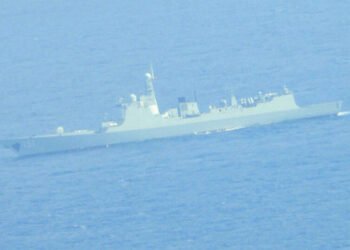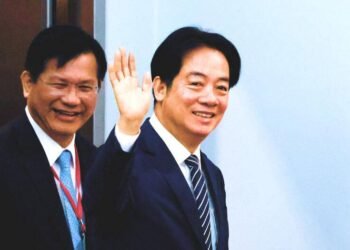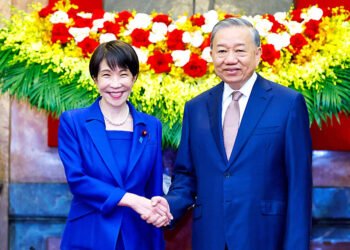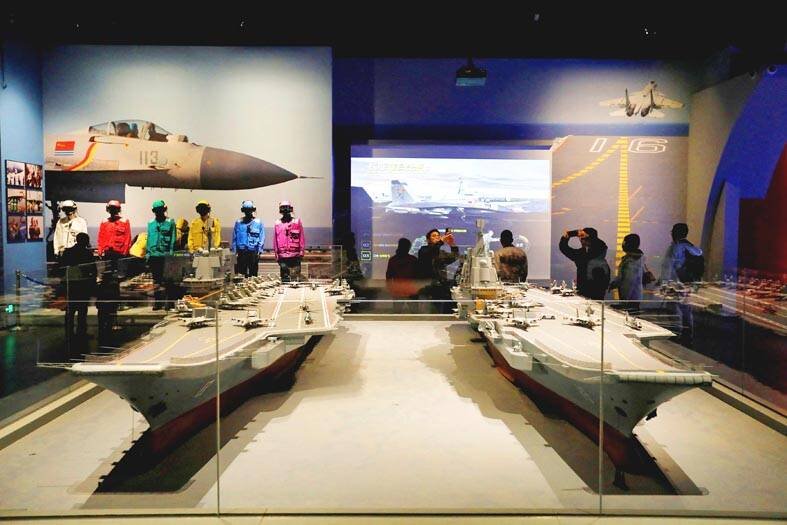
China on Wednesday teased in a video an aircraft carrier that could be its fourth, and the first using nuclear power, while making an allusion to Taiwan and vowing to further build up its islands, as it looks to boost maritime power, secure resources and bolster territorial claims.
The video, issued on the eve of the 77th founding anniversary of the Chinese People’s Liberation Army Navy, featured fictional officers with names that are homophones of three commissioned aircraft carriers, the Liaoning (遼寧), Shandong (山東) and Fujian (福建).
Titled Into the Deep, it showed a 19-year-old named “Hejian” (何劍) joining the group, sparking public speculation that it was referring to a nuclear-powered aircraft carrier, as the navy recruit’s name is a homophone of “nuclear vessel” (hejian, 核艦) in Mandarin.
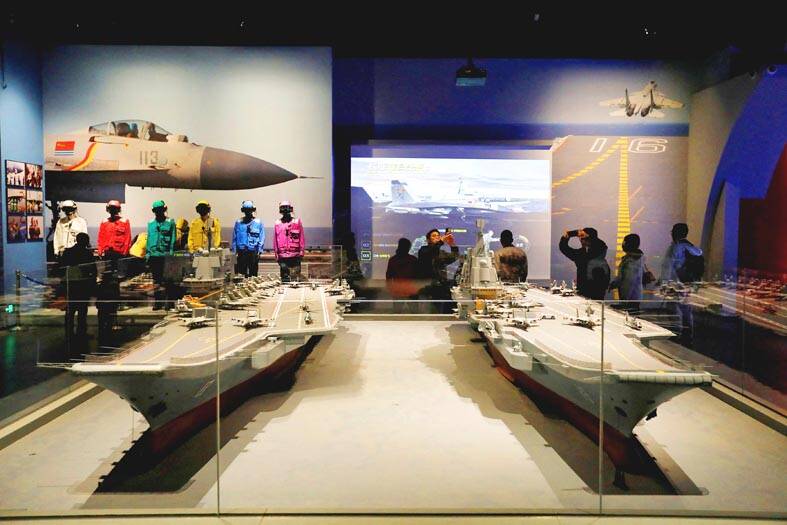
Photo: Reuters
The three aircraft carriers in service are all conventionally powered, carrying sequential pennant numbers 16, 17 and 18. The new recruit’s age, 19, suggests “Hejian” would conform to the numbering convention.
The Chinese Ministry of National Defense did not immediately respond to requests for comment on the video.
Beijing is spending billions of dollars to build a “bluewater navy” allowing it to project power far from its shores, a goal dating from 2012, when Chinese President Xi Jinping (習近平) became leader of the Chinese Communist Party.
Action sequences in the video featured military drills and strikes in the Pacific, but it also sent a message to Taiwan.
The video showed an exchange between a naval officer and his son “Xiaowan” (小灣), the latter’s name an allusion to Taiwan.
“I don’t want to go home just yet. I want to play out a little longer,” the boy says.
His father responds: “Xiaowan, don’t be difficult. Mom is waiting for you at home. Let’s go home.”
The Chinese Ministry of Natural Resources, in an article published in the official People’s Daily, urged greater efforts to “protect” the more than 11,000 islands China claims.
The vast majority of them are within 100km of the coast, with nearly 60 percent in the East China Sea, about 30 percent in the South China Sea and the rest in the Bohai and Yellow seas, an official Chinese tally showed in 2018.
China has built artificial islands, airstrips and military facilities during extensive land reclamation efforts over the years in disputed waters in the South China Sea.
Beijing in September last year declared a national nature reserve at the disputed Scarborough Shoal (Huangyan Island, 黃岩島), claimed by Taiwan and the Philippines, to assert its claim to the atoll, a long-time flash point with the Philippines.
“The facilities on its artificial island bases have allowed Chinese law enforcement, naval and militia vessels to spend every day of the year patrolling the waters of its neighbors up to 1,000 nautical miles (1,852km) from the Chinese coastline,” said Gregory Poling, director of the Southeast Asia Program and the Asia Maritime Transparency Initiative at the US-based Center for Strategic and International Studies.
The Philippines, the US and partner nations started military drills this week, including maritime operations, across the Philippine archipelago.
The exercises project a multinational front against China in a region that is a conduit for more than US$3 trillion in annual ship-borne commerce.
“Beijing seems to have hit a point of diminished returns,” Poling said.
“It has not succeeded in stopping a single Southeast Asian energy project, resupply or construction mission, or the like, in at least four years,” he said.