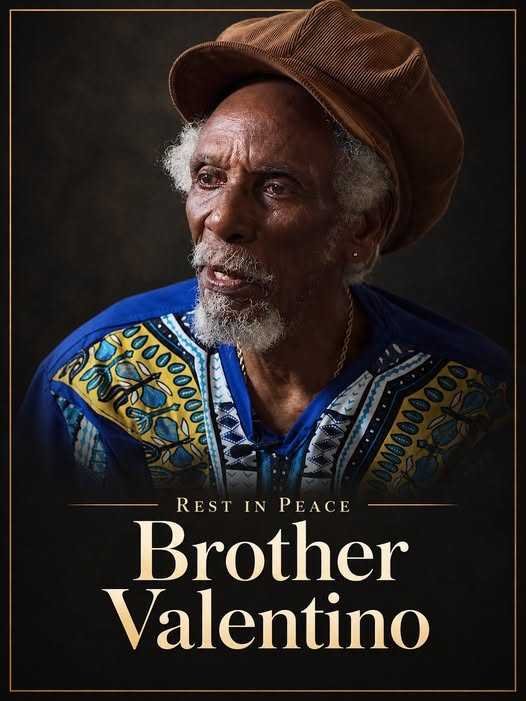
Brother Valentino, whose songs made a forceful case for equality, Black identity and the concerns of ordinary people, died yesterday. He was 85.
Born Emrold Anthony Phillip in Cherry Hill, Grenada, on July 7, 1941, he moved to Trinidad as a young person and made the island his home. Calypso was part of his childhood: his parents listened to the music and collected records by artistes including Lord Kitchener and Lord Cristo. After his father’s death interrupted his education, Phillip tried several trades before music took hold. He later recalled that listening to calypso on the radio while working in a tailor shop helped turn his interest into a calling.
Inspired by Mighty Sparrow, Phillip began performing in the early 1960s. At an audition for Lord Kitchener’s Caravan tent, he arrived without a stage name. Kitchener supplied one: Valentino. The name became associated with a distinctive kind of calypso—thoughtful, socially engaged, and unwilling to look away from injustice.
The political upheaval of the 1970 Black Power movement deepened that commitment. Valentino wrote about racial inequality, poverty, political authority and the search for dignity and self-knowledge. His 1971 song “No Revolution” brought him wider notice as a voice for Black consciousness. “Life Is a Stage,” “Barking Dogs” and “Dis Place Nice” became defining works, while “Stay Up Zimbabwe,” his 1979 anti-apartheid anthem, carried his message across the Caribbean. He followed it with “Ah Wo (Brand New Revolution)” in 1980.
His music was rooted in political conviction, but also in a performer’s instinct for melody and a composer’s craft. In 1975, his solo production “Poet and Prophet” sold out eight shows. He toured and performed in the United States, and appeared alongside fellow calypsonian Black Stalin in “Blood Brothers.” He also became a founding member of Kaiso House, helping sustain the calypso tent tradition and the art form’s role as a forum for public commentary.
Valentino’s achievements included the 2005 Veterans Calypso Monarch title for “Where Kaiso Went,” a Sunshine Award, recognition for 50 years as a performing artist and the Hummingbird Medal, Gold. He never won Trinidad and Tobago’s national Calypso Monarch crown, but he regarded his enduring title, “The People’s Calypsonian,” as a greater honour.
He continued to speak up for calypso as a living cultural tradition, calling for young people to learn its history and for the music to retain its power to tell people’s stories. His songs and example leave a legacy of calypso as both art and civic voice: a music capable of entertaining, questioning authority and insisting that the lives of ordinary people be heard.
In a statement yesterday, the Trinbago Unified Calypsonians’ Organisation (TUCO) said the calypso fraternity mourned Valentino’s passing and described his fearless voice and powerful social commentary as an expression of generations’ struggles, hopes and experiences. The organisation extended condolences to his family, loved ones, fellow artistes and all who were touched by his music, saying his contribution would remain part of T&T’s cultural legacy.