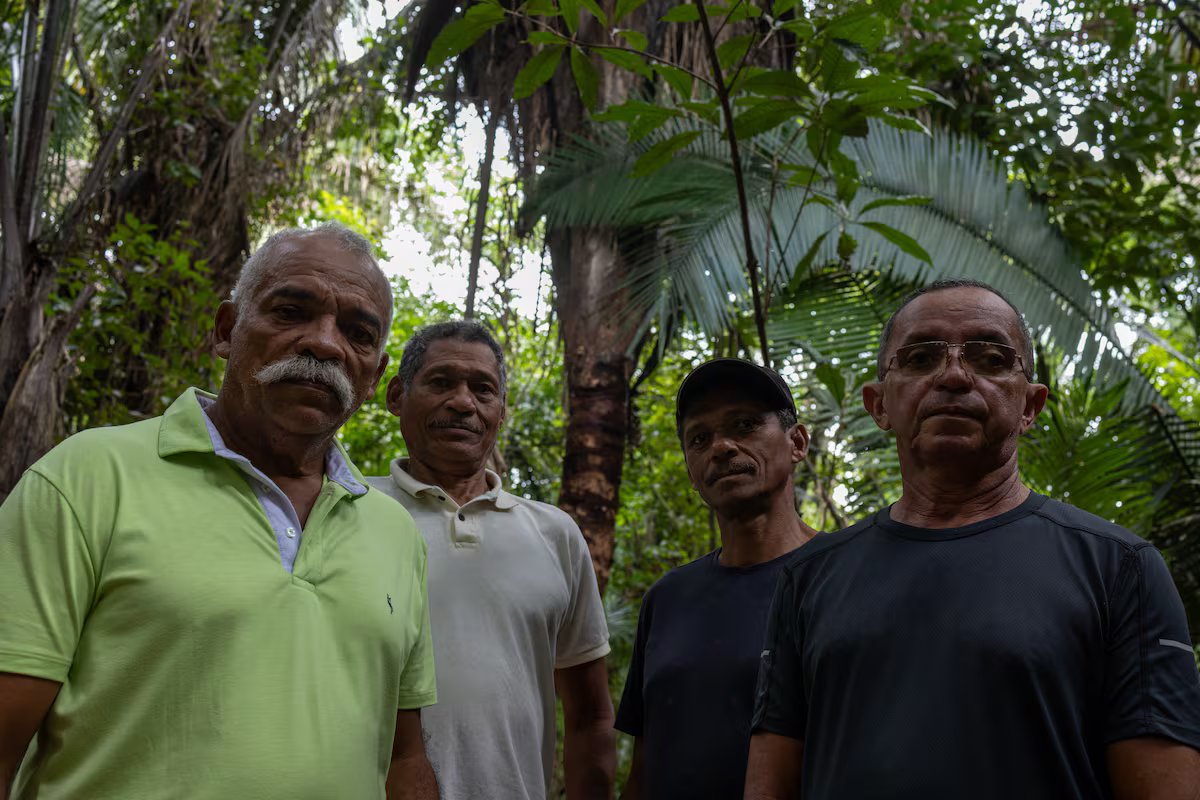
Mr. Raimundo Batista de Souza apologizes because the internet connection comes and goes and the call takes a while to connect. Things that happen when you live in the heart of the Amazon. He speaks from Porto Nacional (Tocantins), on the shores of the lake where he fishes for a living. Mr. Raimundo, 57 years old, shares on the phone a temperate joy and some of the memories that have haunted him for four decades, since he worked with his brothers at the Volkswagen farm. “God took us out of there because, if we stayed, we would have died,” he confesses. “My brother was lost in the jungle for nine days. My other brother and I walked three days to return home, 90 kilometers,” he remembers.
The Brazilian subsidiary of the German multinational has just been condemned by a judge for enslave laborers on a livestock farm in the seventies and eighties. He must compensate four former laborers (including the fisherman Souza and his brother Raul) with two million reais per beard (390,000 dollars, 340,000 euros) for subjecting them to jobs analogous to slavery. It is the largest economic reparation for forced labor issued in Brazil, explains Andréia Silverio, from Coletivo Veredas, the group of popular lawyers that defended the complainants. “It is a very important precedent because it establishes that this crime does not prescribe,” he explains. That opens the door to new complaints. “The State has the duty to prosecute these crimes and hold accountable those who profited from slave labor.”
The judge handed down the sentence on the 11th in a court in Redenção, 200 kilometers from the Volkswagen farm, where hundreds of day laborers were taken by deception. If this case came to court with evidence it is thanks to the patient detective work carried out by a priest, Ricardo Rezende, 74 years old, and his team from the Pastoral Land Commission of the Catholic Church in an extremely hostile environment, in a vast and violent territory. in the middle of the dictatorship (1964-1985).
José Ribamar Viana Nunes, 60 years old, another victim who won the lawsuit, says that he was a 17-year-old boy when he embarked on what seemed like a seductive adventure. He wanted to visit Pará, the neighboring state, then almost unexplored land, earn some money, and he dreamed of playing soccer on a real grass field. He left in 1983 with four colleagues, a ball and some soccer shoes. Brazil had won three of its five World Cups. The Pelé’s retirement was still fresh in national memory.
Mr. Souza, the fisherman, avoids giving details of the hell he suffered, it hurts too much. But each victim digests trauma in their own way. Nunes, a farmer, recounts the horror of those months with solemnity and details from his home in Porto Alegre do Norte (Mato Grosso). He remembers by name and two surnames the four friends he traveled with, the nicknames of the gunmen, the cats (the intermediaries). Describes brutal scenes. It is noted that he has testified in several trials.
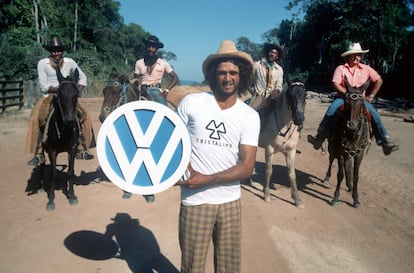
“On the weekend, if you want, you can play on the field” of the farm, he remembers the recruiter telling them. Lie, the first of many. “The night we arrived (at the Volkswagen farm) one of the laborers had a fit (of madness), we didn’t know him. A gunman shot him in the feet and tied him up in front of a shack. We never saw him again.” It details other violent attacks, disappearances, deaths from malaria… “At that time many people disappeared, it was not easy.”
Before crossing under the Volkswagen logo that presided over the entrance to the farm, they were trapped in a labyrinth called debt bondage. They owed the cost of the trip. In the canteen, they opened an account for each one. Forced to buy food, canvas for the hut and the tools necessary to clear the jungle and open pastures at exorbitant prices, the bill grew fat, remembers the fisherman Souza.
They discovered the trap at the end of clear the trees of the first plot they were awarded. “We went to collect and they told us: ‘There is no balance. You have to clear another 20 acres.’ “Yes, we were very children.”
The conditions were inhumane. They worked from dawn to dusk, lived in shacks, surrounded by snakes and spiders that they kill, according to lawyer Silverio. The threat of punishment was constant. Guarded by armed men, fleeing was extremely dangerous. That’s why Nunes and his colleagues turned to ingenuity.
As three of them had to report to the ranks, they managed to convince their captors to let them go. It took some persuading, but they managed to return home. Those gunmen who were holding them captive did not want to anger the military.
From time to time, the Pastoral Land Commission or the unions received complaints about mistreatment, about men being swallowed up by the Volkswagen farm, but little was known with certainty. Therefore, when Father Rezende heard that a group had managed to escape, he took the first plane and stood there to collect their stories. Then, they gave a press conference at the Episcopal Conference in Brasilia, a group of deputies visited the farm and made a report, they located more victims and witnesses, gathered documentation…
And what was Volkswagen doing raising cattle in the Amazon? The generals, fearful that The United States invaded the Amazon In the name of anti-communism, they undertook a colonization project. Clear the jungle in for the sake of civilizational development. The military persuaded large companies to join the national effort. In exchange for investing, they received tax breaks. For this reason, the German multinational ended up as the main shareholder of a farm in Santana de Araguaia (Pará), a livestock farm somewhat larger than the city of New York. To open pastures the jungle had to be cut down, and that required labor.
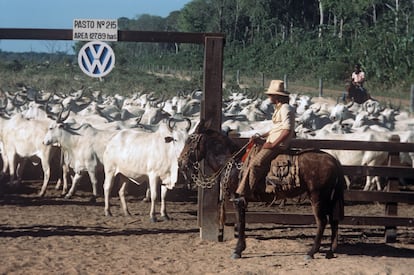
Asked about the recent conviction, the company responds in a note: “Volkswagen of Brazil will not comment on ongoing legal processes (…) With a legacy of 73 years (…) it condemns any form of forced, degrading or slavery-like labor and reiterates its historical commitment to promoting a dignified, ethical and responsible work environment.”
Father Rezende, a quixotic detective, recognizes from Rio de Janeiro that patience was crucial. “Historic patience was necessary, and also obstinacy. When you fight for human rights you know that it is a fight for life.”
Debt bondage may sound anachronistic, but it still exists. And forced labor too. Brazilian authorities rescued more than 2,700 victims in 2025, two-thirds in cities. The dirty listan official list of companies and employers that have subjected their workers to slavery-like conditions, includes 169 names.
A year ago, Father Rezende and those who have accompanied him in this fight won another momentous victory in a collective civil action over the same matter. The German multinational was ordered to pay compensation of 165 million reais (32 million dollars, 28 million euros). The company appealed to higher authorities.
The priest regrets that volksas those involved familiarly call her, will always refuse to negotiate an agreement to close the lawsuit because the years go by “and people die,” she emphasizes. After working in the Amazon for years, he entered academia. Coordinates the research group on contemporary slave labor at the Federal University of Rio de Janeiro.
He emphasizes that “compensations do not cure the pain, but they give hope that companies will not commit these crimes again.” He would like individual authors, such as the manager, Friedrich-Georg Brugger, who lives in Switzerland, to be held accountable. “I don’t want him to go to jail, I want him to recognize the damage and ask for forgiveness.” Brugger and all the links of the machinery. In this case history also appears. Few countries have examined his past with such zeal like Germany, headquarters of Volkswagen.
At trial, Volkswagen put forward the thesis that it did not hire the day laborers. “How did you not know how they treated your workers? Why didn’t you find out?” complains lawyer Jamyla Pereira de Carvalho, from the Pastoral Land Commission. “It is a responsibility of any company,” he points out. The judge rejected the attempt to hide behind the subcontractor.
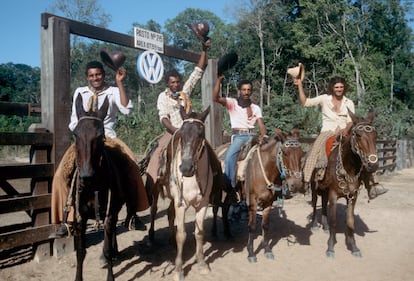
Other large companies had similar farms in the Amazon, but the Volkswagen case is the best documented, despite the difficulties entailed in the Amazon, a colossal kingdom of landowners and chieftains. In dictatorial Brazil, the police, the judges, and public power in general were weak or viewed with distrust. The most vulnerable turned to the Catholic Church, which, embracing Liberation Theology, was dedicated to defending human rights, the right to land and decent work. For the military regime, those priests who They documented complaints and raised awareness among the poor They were the enemy, dangerous communists who stirred up the hornet’s nest.
He points out to Father Rezende that, if there was money, personnel could be dispatched to investigate other complaints. Lawyer Carvalho emphasizes that the conflict over land persists. Agriculture advances through the south, entering the Amazon. “The soybeans are arriving and, with it, the poison. They want to buy more and more land.”
For the two victims interviewed, the sentence leaves a bittersweet taste. The fisherman Souza says he is “happy, although I will not forget what happened, I hope it all ends in peace.” Farmer Nunes trusts that his effort to preserve the memory of the horror will not be in vain. “If everything is judged and goes well (in reference to the appeals), it will be a victory. But if we have been giving testimony for 40 years for it to end in nothing, it would be bad, right?”