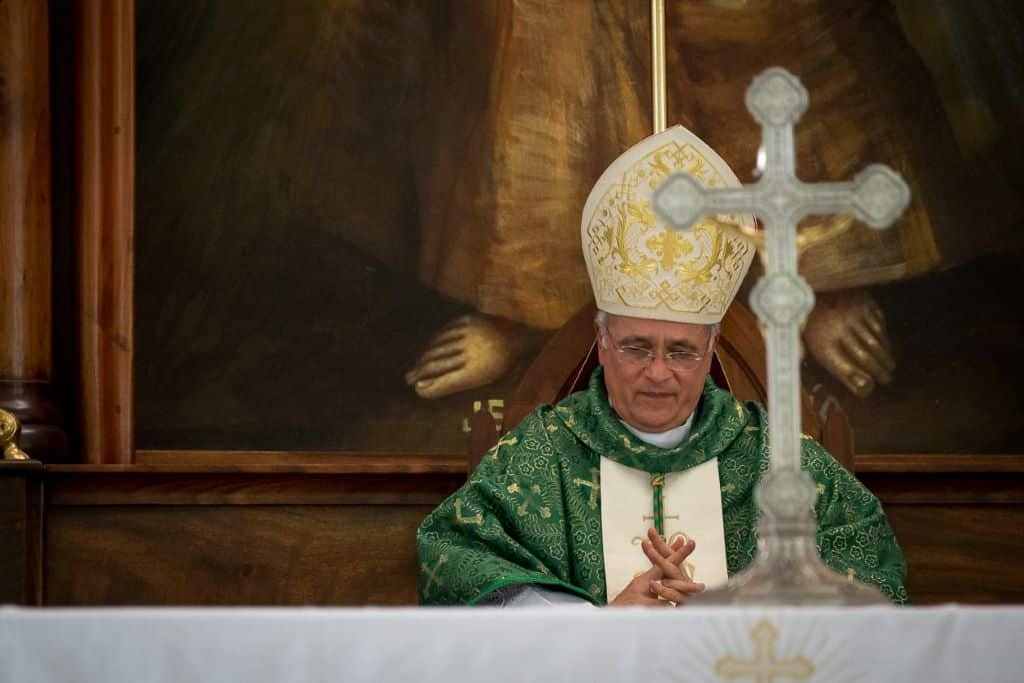
The denationalized Nicaraguan bishop Silvio Báez, very critical of the Government co-chaired by the couple, Daniel Ortega and Rosario Murillo, affirmed on Easter Sunday that God resurrects the crucified and conquers injustice, which is why he encouraged Catholics not to surrender to evil.
“Today love has been resurrected because it is stronger than death; good has been resurrected because it cannot be defeated by evil,” said the Catholic leader, who is in exile, in his homily from a church in the United States, on Sunday, April 5, 2026.
The auxiliary bishop of Managua, whom the late Pope Francis ordered to leave Nicaragua in 2019 for security reasonssaid that “doing good to others is already resurrecting,” so one should not get tired of doing good.
He recalled that Jesus spent his time doing good, they killed him but God resurrected him, so he called believers to announce forgiveness, justice and hope, without fear of evil or unjust systems.
“With the resurrection of Jesus, God reveals himself as a God of the living, not of the dead. He desires life, not the death of human beings. God puts life where men sow death. Men destroy, but God resurrects,” continued the leader, prior to the anniversary of the anti-government demonstrations that broke out in Nicaragua eight years ago.
In Nicaragua, on April 18, 2018, a popular revolt broke out over controversial social security reforms that later became a demand for the resignation of President Daniel Ortega after responding with force.
Silvio Báez: Who are we on?
The protests, described by the Executive as an “attempted coup d’état,” left at least 355 dead, according to the Inter-American Commission on Human Rights (IACHR), although local organizations raise the figure to 684, while Ortega acknowledges that there were “more than 300” and that it was an attempted coup d’état.
For Bishop Silvio Báez, “Jesus died unjustly accused by the powers of this world” and God gave him justice through the resurrection.
“By resurrecting the Crucified, God reveals not only the triumph of his strength over the destructive power of death, but also the victory of his justice over the injustices of men,” highlighted the religious, who maintained that God “does not abandon the victims.”
“A liberating God who does not accommodate the pretensions of the powerful nor does he follow the paths marked by the owners of the world. Before the Risen Lord, we must ask ourselves whose side we are on: on the side of those who crucify or the crucified?” he asked.