Senior Reporter
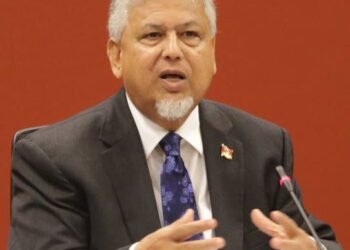
Homeland Security Minister Roger Alexander says the Government will reintroduce a programme requiring convicted prisoners sentenced to hard labour to participate in public clean-up exercises as part of its crime prevention strategy.
Announcing the initiative during a community clean-up exercise by workers of the National Programme for the Upkeep of Public Spaces (NPUPS) in Tunapuna yesterday, Alexander said inmates serving hard labour sentences would once again be deployed to assist in maintaining public spaces, arguing that the current system does not reflect the true meaning of hard labour.
He said, “You know what is hard labour in the jail right now? A man smoking, on his phone and on the internet and all these things, that’s not hard labour.”
Asked when the programme will begin, he replied, “We are about movements. Let me use these words, movementations, but don’t google it.”
He argued that the programme could also support rehabilitation by allowing inmates to demonstrate positive behaviour before returning to society.
“We are allowing persons to do their job, clean the community, beautify the place again so everybody could see. It’s about environmental design, which is part of the crime issues because if there’s bush here and large bush here, people hiding and jumping out at you, so it’s about fixing the environmental design of the place.”
The minister added that the nation’s prisons represented “one of the largest labour forces” that was not being properly utilised.
When Guardian Media reached out to Acting Commissioner of Prisons Elvin Scantlebury on the matter, he said the Trinidad and Tobago Prison Service stood ready to support the Government’s plans, but explained that formal discussions on the initiative will have to take place.
Speaking to Guardian Media via telephone yesterday, Scantlebury said, “The service stands ready to assist wherever we can. We have a long history of helping in different areas in public clean-up exercises, so we’re no stranger to this effort. We’re looking forward to working with the minister and accomplishing the objectives.”
Scantlebury said inmates selected for any public work programme would undergo careful assessments before being approved.
However, the Prison Officers’ Association of Trinidad and Tobago (TTPrS) said any expansion of inmate work programmes beyond the secure confines of correctional facilities must be approached with caution.
In a statement yesterday, TTPrS said, “The Association recognises that meaningful work is an important element of rehabilitation. Properly structured work programmes can help inmates develop practical skills, foster discipline, and better prepare them for successful reintegration into society. However, any expansion of inmate work programmes beyond the secure confines of correctional facilities must be approached with caution and guided by established correctional principles. Only carefully selected convicted inmates who have been medically certified fit, have served an appropriate portion of their sentence, and have successfully completed comprehensive medical, security, and behavioural risk assessments should be considered for such duties. Public safety must remain the foremost priority.”
It added that such an initiative requires specially skilled prison officers, transportation and proper equipment for execution.
Meanwhile, chairman of the Emancipation Support Committee, Zakiya Uzoma Wadada told Guardian Media she’d like to see inmates occupied in a positive way.
Guardian Media also attempted to reach out to Commissioner of Police Allister Guevarro on the programme, but received no feedback up to press time.