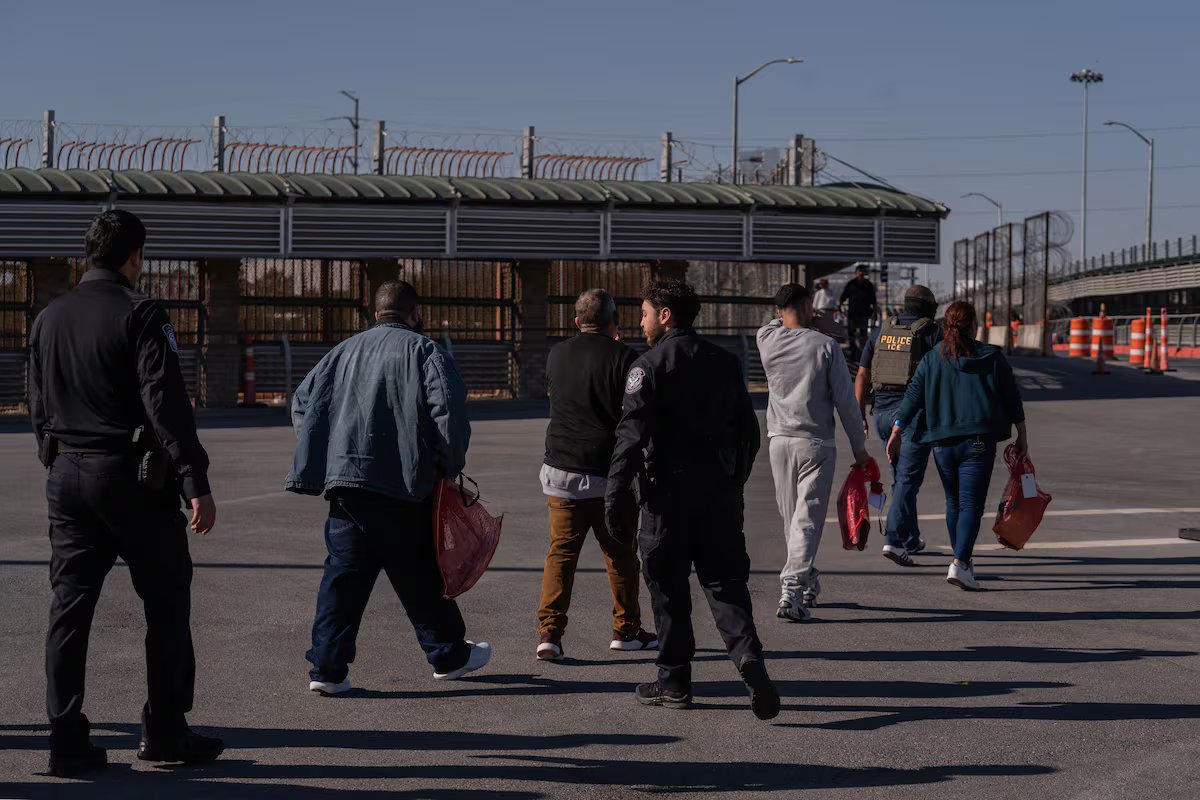
The granting of permanent residences (green cards) in the United States has fallen precipitously under Donald Trump’s government by barely half, disproportionately affecting Cubans, asylum seekers and refugees, according to an analysis from the Cato Institutea think tank Washington-based conservative. The analysis indicates that the Trump Administration “has almost put an end to the approval of permanent residences for Cubans,” a group historically favored by United States immigration policies. At the same time, the arrests of these citizens by Immigration and Customs Enforcement (ICE) have skyrocketed.
According to the study, the approvals of green cards for Cubans — which exceeded 10,000 in October 2024 — plummeted to just a few dozen at the end of last year, a drop of 99.8%, while arrests went from less than 200 to more than 1,000 per month in the same period, an increase of 463%. David Bier, Cato’s immigration director, told EL PAÍS that the slowdown in residency processing “is part of a broader strategy to deport or otherwise force immigrants to leave the United States.”
In South Florida, where the largest Cuban community in the country is concentrated, many who previously would have been able to benefit from the Cuban Adjustment Act, which allows them to apply for residency after one year in the country, They are in limbo, with their cases paralyzed and without a clear path towards regularization.
The Cuban vote was key in the Republican turn in Miami-Dade County in the 2024 presidential elections, but Trump’s immigration policy has dented support for the president. Although the majority of Cuban Americans continue to support the Trump’s hard line towards Cubathe majority rejects the deportations of Cubans without criminal records and supports legal migration routes, according to recent polls.
Cato’s report also notes that family residency approvals fell by 54% between July 2025 and January 2026, and that refugee approvals fell by 99%, despite an increase in applications. The analysis documents cases of spouses of US citizens whose residency applications were pending, who have been detained upon the expiration of their status while awaiting a decision. It also cites the case of a Cuban who entered legally in 2024 and remained detained in 2026 despite having a residency application in process, and other cases of asylum seekers and people with parole or temporary status who have been arrested.
The Trump Administration, which has promised the largest deportation in history, has promoted a series of measures to restrict legal immigration. At the end of last year, it suspended all immigration procedures — including applications for citizenship, residency and asylum — for citizens of a list of countries that has been expanding to include Cuba and Venezuela. Some estimates indicate that one million Cubans would be affected by the measure.
Trump has also ended temporary protection and humanitarian programs that allowed hundreds of thousands to live and work legally in the country for up to two years, and revoked their work permits. Cubans who entered through a Biden-era program known as CHNV canIn theory, apply for permanent residence after completing one year and one day in the country, taking advantage of the Adjustment Law. However, many have not been able to advance in this process and, given the uncertainty, have chosen to request asylum as an alternative route, but even so they have been detained, despite having pending applications. The Administration has limited access to asylum, with a significant drop in approvals.
Authorities have arrested people during their immigration court hearings, as well as in complex operations with local police forces on highways and workplaces. Trump has ordered massive deployments of immigration agents in cities governed by Democrats that have left at least three dead, dozens injured and thousands detained. The policies have led to a cascade of litigation in federal courts.
Asked by this media about Cato’s study, a spokesperson for the Department of Homeland Security said in an email that the United States Citizenship and Immigration Services (USCIS) “is ensuring that all foreigners from high-risk countries are subjected to the highest possible levels of verification and control.”
“USCIS is conducting a comprehensive review of anyone, anywhere, who poses a threat to the United States, including those identified in the president’s most recent proclamation to restore order and the rule of law in our immigration system,” he added.