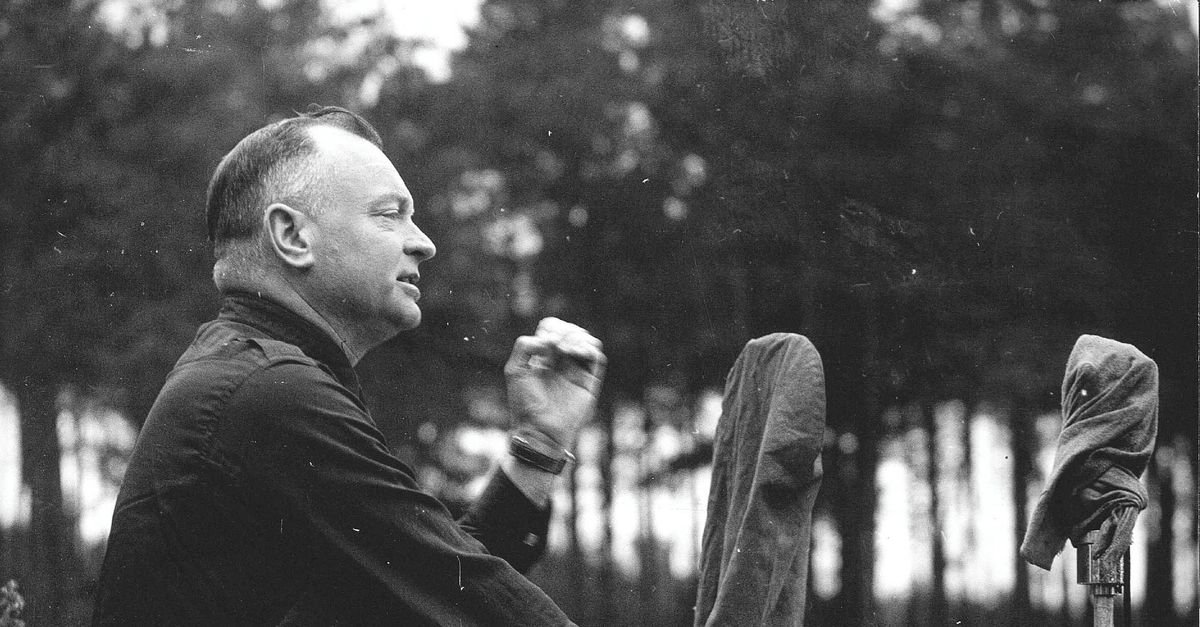
Anton Mussert (1894-1946) would go down in history as the ultimate traitor. The leader of the National Socialist Movement (NSB) symbolized the ‘wrong’ part of the Dutch people that had actively collaborated with the German occupier during the Second World War.
Yet the image of Mussert in historiography is not so clear. Loe de Jong saw him mainly as a typical Dutch petty bourgeois who cheerfully played the role of fascist leader, but had no ideological drive. Biographer Jan Meyers came to a similar conclusion in 1984 about the – also in his case – ‘bourgeois’ Mussert.
Later NSB experts modified this slightly trivializing image. They stated that Mussert, who married his aunt and had an affair with his grandniece, was by no means a bourgeois type. In fact, from the start he was a convinced fascist, who would express himself in a severely anti-Semitic manner from the second half of the 1930s. Moreover, he enriched himself and his family exorbitantly during the war, including by buying up the houses of deported Jews at bargain prices.
It was therefore easy to understand and applaud that Auke Kok decided to sink his teeth into a new biography, which he wanted to base not only on the latest insights but also on a load of barely explored archival material at the NIOD. Kok is a narrative historian par excellence, who knows better than anyone else the art of writing down complex histories in such a way that it seems as if he is telling you a colorful story in the pub that continues to fascinate you until the end. Finally the definitive Mussert biography would be written. Or, in Kok’s words, “as true a portrait as possible of the man who thought he had to save his country with a National Socialist Movement.” Don’t look down on Mussert, but take him seriously.
Cold-blooded
Kok begins his biography Mussert. Journey into evil strong and surprising, with a visual description of Mussert’s flight to the Dutch East Indies in 1935. De Leider was in a winning moodbecause just before he had achieved a resounding result in the Provincial Council elections by winning no less than 8 percent of the votes from nowhere. The trip was a success for Mussert in every respect. He remained admirably cool in the face of adverse weather during the flight, was twice granted an audience with the Governor General and was enthusiastically cheered by crowds of supporters in all corners of the colony. Here he saw with his own eyes the power of an authoritarian system of order and discipline, and how beneficial it was for the Netherlands to maintain a large colonial empire.
Kok then goes back to Mussert’s youth in Werkendam, dominated by God, Fatherland and Orange, to his student years in Delft and to his comet-like career as a civil (chief) engineer at the province of Utrecht. We get to know Mussert as an unpopular, but exceptionally headstrong and ambitious young man, with a tendency towards pomposity. Although not at all tactful or empathetic, he manages to get things done and put himself on the map through original, almost ridiculous actions. This is most prominently expressed in the resistance he initiated against the Belgian Treaty, which would improve the water connection with Antwerp – a connection that, according to Mussert, would be at the expense of the position of Rotterdam, and therefore of the Netherlands. He manages to mobilize such opposition that the Treaty does not go through. His name is established.
‘Well-born gentleman’
In the meantime, Mussert starts a relationship with his aunt Rie Witlam, who is eighteen years older. Kok quotes beautiful letters from the early days of their relationship, which show that the two family members (pet names: ‘Boems’ and ‘Dar’) were actually madly in love with each other. And: that it took some time to come to terms with each other’s idiosyncrasies. When Rie addresses a letter to “Mr AA Mussert”, her cousin becomes furious: it should have been “the well-born Mr AA Mussert”. Does she really take him for granted?
Unfortunately, in the rest of the biography – about Mussert as leader of the NSB he founded – Kok is much more economical with the use of contemporary archive material, even though so much is available at the NIOD and other archives. Rather, he bases himself on literature, newspapers and post-war testimonies of Mussert and the people around him.
These testimonies were made with a clear purpose – namely: to exonerate themselves – and should therefore be treated with caution, but Kok surprisingly often includes them without any critical commentary. As a result, he largely confirms the frame with which Mussert wanted to convince his judges after the war: that he had not been an enthusiastic National Socialist or fascist (let alone an anti-Semite), that all his actions were motivated by the desire to achieve the autonomy of the Netherlands within a Greater Germanic confederation of states, and that he had courageously dared to resist the undermining measures of SS boss Himmler and his Dutch extension Rauter.
Fond of flag display
Kok, for example, suggests that Mussert “acted out fascism”; the Leader was not a bookworm and would not be exceptionally versed in fascist ideology. But Mussert had included the cancellation of elections and the ban on strikes in his first election manifesto, was fond of flag displays, symbols and rituals, and was supported by an armed gang: the WA. How fascist do you want it to be?
Kok also assumes that Mussert “knew virtually nothing” from 1942 on about the gruesome fate that awaited the Jews in Eastern Europe; After all, the plan for mass murder devised during the Wannsee Conference was secret, and the Nazis would only have spoken to him in terms such as “evacuation” and “labor camps.” But it is almost inconceivable that someone so close to the fire would not have had more information. Kok’s assumption is also refuted a few pages later by Mussert’s advisor Robert van Genechten, who, shortly after the Liberation, confessed to having spoken to the Leader about “the way in which the Germans were liquidating the Jews that came to our attention.”
Kok’s loose narrative style offers many advantages: you are drawn into the story, it is fast-paced and the denouement – Mussert’s execution, with his head held high in a dune pan of the Waalsdorpervlakte – is indeed very thick, but excitingly described. The downside is that inaccuracy lurks and some formulations take on a condoning or even heroic aftertaste. For example, Kok talks about Mussert’s “war adventures”, he recalls that Mussert “rarely says something nice about the Jews” at the time of the mass deportations, and he writes that Jews “perish” in the Eastern European camps. That is veiled language: they were murdered there.
In several respects, this book is reminiscent of its predecessor from 1984, which also wanted to show the person behind the symbol, was descriptive in nature and relied heavily on post-war testimonies. The difference is that the ‘bourgeois’ Mussert has now made way for the ‘brutal’ Mussert. We continue to wait for the definitive Mussert biography.
Also read
‘Mussert has often been portrayed as a bourgeois man, but he was not afraid to deviate’
:format(webp)/s3/static.nrc.nl/wp-content/uploads/2026/04/28141955/300426BOE_2033213362_2.jpg)