Rising anti-immigration rhetoric in Australia has sparked misinformation about who is allowed to settle in the country, with recent posts inaccurately claiming a treaty signed in 2024 grants citizenship to people from the Pacific island nation of Nauru. While a separate accord with low-lying Tuvalu includes provisions on permanent visas, no such clause is present in the Nauru agreement, which aimed to stymie China’s growing regional influence. A migration expert told AFP the circulating claims are “clearly false”.
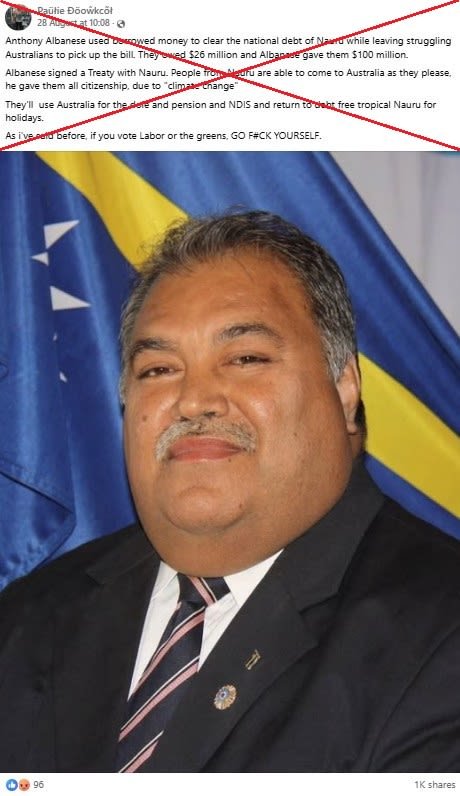
“Albanese signed a Treaty with Nauru. People from Nauru are able to come to Australia as they please, he gave them all citizenship, due to ‘climate change’,” reads part of an August 28, 2026, Facebook post, referring to Australian Prime Minister Anthony Albanese.
The post was shared about 1,000 times and includes a photo of former Nauru president Baron Waqa.
“They’ll use Australia for the dole and pension and NDIS (National Disability Insurance Scheme) and return to debt free tropical Nauru for holidays,” adds the post, which includes an expletive in reference to people who vote for Albanese’s Labor Party or the Greens.

Screenshot of false post captured on September 15, 2026, with a red X added by AFP
Similar claims also circulated in Facebook and X posts as Australia sees a rise in anti-immigration rhetoric — illustrated in part by a series of marches held across the country since 2025 — and criticism of Albanese and his centre-left Labor Party (archived here and here).
The posts incited outrage from social media users, with one commenter writing: ” This is absolutely preposterous and must be reversed by the next government.”
But the claim, which was also tackled by the Australian Associated Press, is untrue ( archived link).
An AFP review of the full text of the treaty — uploaded on the Department of Foreign Affairs and Trade website — found no provision about granting Australian citizenship to the people of Nauru ( archived link).
Related terms such as “residency”, “visa” or “citizenship” do not appear anywhere in the document.
‘Security partnership’
The treaty was signed December 2024, with Albanese announcing Australia would provide Nauru Aus$100 million (US$71.2 million) over five years to support its economic security and resilience, due to the Pacific island nation’s vulnerability to climate change risks ( archived link).
The deal also stipulates that Nauru will seek Australia’s agreement before it signs any bilateral accords on maritime security, defence and policing.
“Both countries will mutually agree on any engagement by others in Nauru’s security and key critical infrastructure sectors and have agreed that critical infrastructure shall not be used by any third party for security purposes,” Albanese said at the time ( archived link).
Nauru earlier that year severed diplomatic ties with Taiwan in favour of Beijing, which claims the self-ruled island as part of its territory ( archived link). It joined a growing list of Pacific nations moving closer to China’s orbit, a development that has rattled Australia and its ally the United States.
“I can confirm that the treaty does not offer Australian citizenship to Nauruans,” Jane McAdam, an international refugee law and migration expert, told AFP in an email on September 18, 2026 ( archived link).
She pointed to other bilateral agreements that Australia has with other Pacific nations that include “mobility provisions” ( archived link).
One of them is the Falepili Union with low-lying Tuvalu, one of the most vulnerable nations due to rising sea levels ( archived link). The accord, ratified in 2024, commits Australia to helping Tuvalu tackle climate change-related impacts, and also offers up to 280 Tuvaluans permanent resident visas to live, work and study in Australia ( archived link).
Daniel Ghezelbash, director of the Kaldor Centre for International Refugee Law at the University of New South Wales in Sydney, told AFP the claim about the treaty with Nauru “is clearly false” ( archived link).
“The Nauru–Australia Treaty does not give Nauruans Australian citizenship, permanent residency, visas, or special access to any specific migration pathways,” he said in an email on September 17.
“It is a treaty framing an ‘integrated economic, social and security partnership’, with operative articles covering economic resilience, banking access, governance and transparency and security cooperation.”
The Department of Home Affairs website outlines the ways someone can become a citizen of Australia, with separate rules for permanent residents, refugees and those born overseas to Australian parents ( archived link).
There is no mention of Nauruans getting Australian citizenship through the treaty.
More of our reporting on misinformation circulating in Australia, including falsehoods about migration, can be found here.