It brings to mind the concept of hybrid warfare and the fifth and sixth generations:
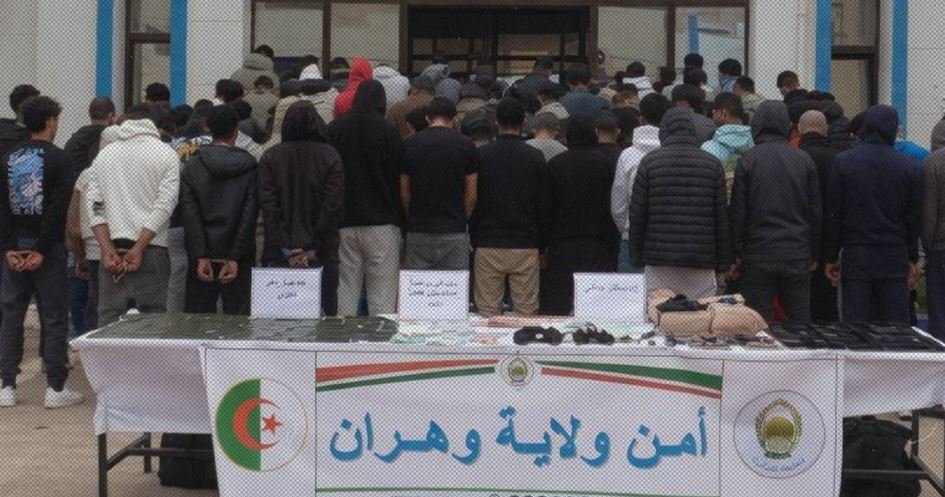
Some Moroccan voices downplayed the seriousness of the news that the Algerian police had arrested an international criminal network that included 61 Moroccans, who were planning to carry out acts that harm security and public order inside the country.
They considered that the matter and its contents were merely desperate young men who tried to immigrate illegally through Oran after the Moroccan doors became blocked.
These Moroccan fallacies can be refuted in many ways. The first is that even assuming that these are merely illegal immigrants, it is known that Algerian law criminalizes this act and punishes it. It fights it by various means in fulfillment of the Algerian state’s obligations and responsibility towards international laws, which make it respected and appreciated by its neighbors and partners. The state’s tolerance of these activities harms its national security and affects its reputation.
Secondly, this group entered Algeria illegally from its far east to its west. In all of this path, it needed logistical support, and given the developments witnessed by wars in this era, it is not unlikely that this group and others fall within a medium to long-term plan, the goal of which is to create support and support networks by weaving relationships with organized crime networks that initially operate within the framework of illegal immigration, but through financial temptations and consolidation of relationships, they are later exploited to carry out criminal acts directly or at least provide support and other matters whose true dimensions may not be known at all.
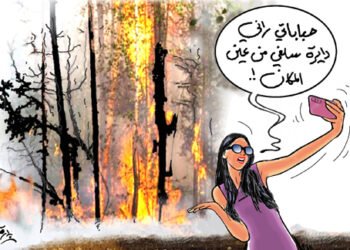
In this context, it is not unlikely that these networks have a relationship with the drug trade, which has become classified as a war in Algeria. What is even more dangerous is that there are fires planned for next summer.
Moving all this distance from flatness was limited to transitory movement. Rather, as previously mentioned, its goal may be to consolidate relations with organized crime networks inside Algeria in order to turn it into a tool to strike Algerian national security.
It is worth noting in this context a cognitive paradox in defining the concept of security and danger, as a country that legalizes the production and export of drugs cannot be compared with another country that tightens laws and procedures for preventing and preventing them by various means in order to preserve its youth.
Here it must also be remembered that the country that sent thousands of its sons and daughters on a wave of illegal immigration to serve the agenda of other countries to pressure the Spanish government has no problem trading in dozens of its young people for the purposes of least of all marketing the image that Algeria is also a source of illegal immigration. Perhaps it will erase that image that took root after the events of Ceuta late last July.
Therefore, in reading this event, one must not stop at the traditional concepts of security, but rather invoke the concept of hybrid wars and the fifth and sixth generation of wars, because the traditional balance of power makes Morocco far removed from confronting Algeria, and all it can do is try to weaken it by trying all possible means to harm the internal front and social cohesion.
This explains the Algerian narrative of this event with its future dangers, and not the belittlement and simplification that the Moroccans are trying to include in it to reduce its importance.
Algeria is not an open space In front of criminal and hacking networks
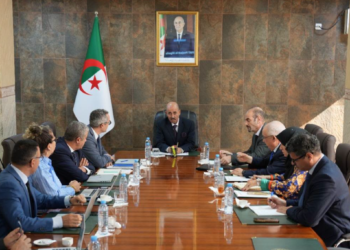
In the same context, the Algerian expert, Ahmed Mezab, highlighted that Algeria is like a strong, solid wall against which all conspiracies, intrigues, and various hostile methods targeting the country’s stability and national security are destroyed.
Mizab, a specialist in political affairs and an expert in geopolitical and security issues, stated in a statement to “Waj” that “the Moroccan Makhzen regime, with the hostile bets surrounding its regional policy and worrying security intersections, cannot expect Algeria to deal naively with threat indicators or to turn a blind eye to any networks or interfaces used to undermine its sovereignty.”
He continued, saying: “If the Makhzen regime is betting on multiple tools, changing interfaces, and circumventing the rules of dealing between countries, then the Algerian bet is based on strategic vigilance, sovereignty in decision-making, and the ability to transform security data into evidence and decisive measures,” pointing out, “Countries that base their bets on destabilizing their neighbors are only sowing factors of tension in their surroundings, while Algeria’s strength remains in its institutions, the cohesion of its internal front, and the independence of its national decision.”
This security operation, through which the national security services in Oran were able to dismantle a Moroccan international criminal network that was preparing to commit acts of sabotage inside the country, comes in the context of a series of successes achieved by the security institutions in dismantling criminal networks and thwarting sabotage plans, which highlights – according to the same expert – the importance of “a strategic reading that goes beyond the limits of the security incident, to raise serious questions about the nature of the tools that are being employed to target Algeria and attempt to undermine its security and stability.”
Mizab stressed that this operation is a strategic message that Algeria “is not a space open to criminal networks or attempts at infiltration and sabotage, and its national security is not an area for bargaining or experimentation, and that everyone who plans to target the safety of citizens, property, or state institutions must realize that such actions will be confronted with the state’s legal and security tools, and that the cost of betting on penetrating the home front will be high in terms of prosecution, investigation, and judicial accountability.”
Also, as he added, Algeria “is not a permissible arena, and its national security is not a card that can be used in the accounts of the Makhzen regime or the bets of its allies,” stressing that “the Algerian state, with its security and intelligence institutions, possesses the experience and readiness that qualifies it to detect threats, neutralize them, and thwart attempts at infiltration and sabotage before achieving its goals.”
The failure of the hostile plan reflects the high level of security vigilance And geopolitical
According to Mr. Mezab, this qualitative operation represents an indicator that reflects institutional vigilance, the effectiveness of proactive security work, and the ability of the Algerian state to protect its security and national sphere.
He added that this operation represents, from a security and strategic perspective, “an indicator of the high level of institutional vigilance, the effectiveness of proactive security work, and the ability of the Algerian state to protect its security and national sphere and deal with threats before they move from the planning level to the implementation level.”
He explained that “in modern security doctrine, success is measured by the extent of the ability to detect the threat in its early stages, identify its possible extensions, and neutralize its ability to implement,” highlighting that the investigations indicated that the elements of this network were planning to carry out sabotage acts, and therefore the operation demonstrated “the real importance of professional and proactive security work based on monitoring, analysis, investigation, coordination, and timely intervention.”
This process also reflects – as he said – “the importance of intelligence preparedness,” noting that the deserved praise for security institutions “should not be limited to the success of the intervention only, but must include the value of analytical and proactive work that allows the transition from suspicion to identifying elements of danger, and then neutralizing its ability to harm the security of the state.”
The same expert highlighted in this regard that “the strength of the state is not only evident in the loud reaction after the attack occurred, but in its calm and disciplined ability to detect and disrupt risks, while maintaining the continuity of institutions and the confidence of society.”