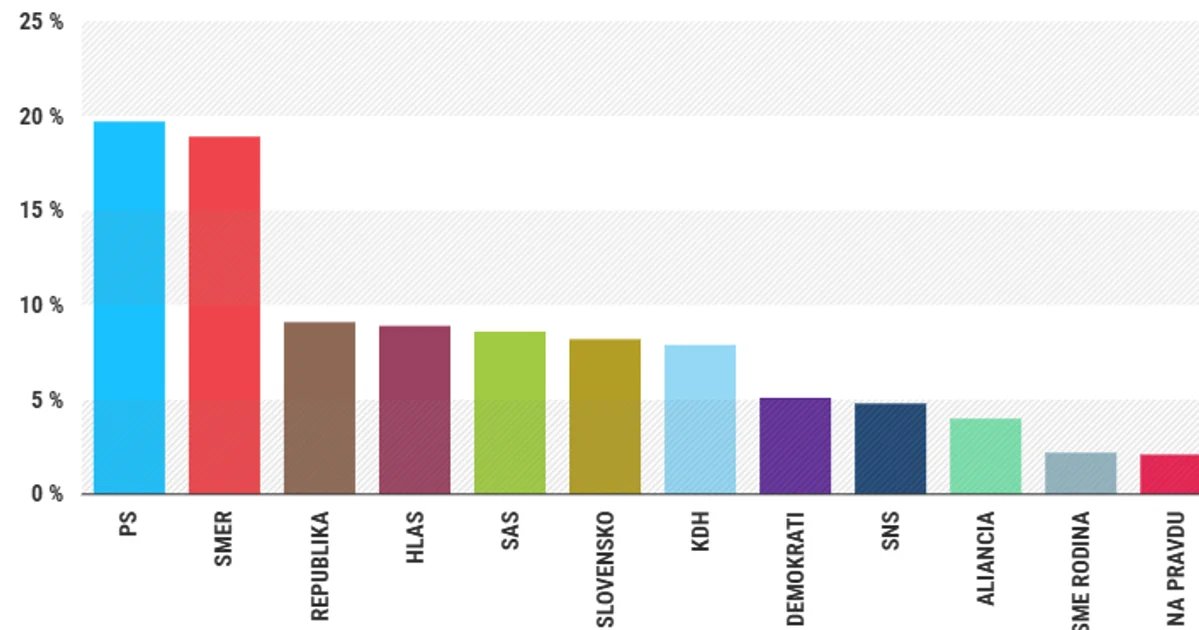
If you would elections to the National Council of the Slovak Republic held in May 2026, the opposition would be the winner Progressive Slovakia with a gain of 19.7 percent of the vote. However, the movement recorded a decrease of 1.1 percentage points compared to April.
The government would finish in second place Directionwhich 18.9 percent of potential voters would vote for, while this party improved by 1.1 percentage points month-on-month.
The third place was occupied by the Republika movement with a gain of 9.1 percent, which represents an increase of 1.1 percentage points compared to the previous month.
Koaličný Hlas took fourth place and remains stable at 8.9 percent, i.e. no month-on-month change.
It follows from the latest survey of preferences agencies AS for news television JOJ 24.
In the May measurement, there were also movements in the middle part of the political spectrum. The party reached the fifth position Freedom and Solidarity (SaS) with a profit of 8.6 percent (an increase of 0.4 percentage points).
He follows her Igor Matovič with its Slovakia movement, which would vote for 8.2 percent of respondents, which means a month-on-month improvement of 0.5 percentage points.
It finished in a close second behind him KDH with a gain of 7.9 percent (an increase of 0.3 percentage points).
The list of parties that would exceed the five percent electability threshold is closed by the non-parliamentary Democrats with a gain of 5.1 percent, which means for them a significant month-on-month drop of 0.9 percentage points.
For now, the coalition would remain at the gates of the legislature CIS with a profit of 4.8 percent, which was two tenths of a percent short of entry. The Hungarian Alliance fared similarly with a gain of four percent of the vote.
The movement also suffered a loss of voter support We are familywhich fell to 2.2 percent, and Zoroslav Kollár’s Pravo na pravda party closes the list of parties above one percent with the support of 2.1 percent of voters.
Converted to mandates, Progressive Slovakia would occupy 34 seats in the parliament, Smer would have 33 and the Republic would have 16 mandates. Likewise, 16 seats would go to the Hlas party.
The SaS party would send 15 representatives to the parliamentary benches. The Slovakian Movement would occupy 14 seats, the same as the KDH, and the bloc of elected parties is closed by the Democrats with eight mandates.
This distribution of forces would significantly complicate the situation of the current government. The parties Smer and Hlas would have a total of only 49 mandates. Since the SNS would not get into the parliament, even the support of the Republic, with which they would have only 65 votes in a three-way coalition, would not be enough for a majority.
The current opposition parties consisting of the PS, SaS, KDH and the Democrats would together reach 71 mandates, which means that they would need cooperation with Igor Matovič to govern, thus achieving a majority of 85 mandates.
According to the survey, the total potential voter turnout would be slightly lower than in April. Willingness to vote (they know who they would vote for) was expressed by 64.5 percent of respondents. 21.2 percent of respondents were undecided (don’t know who to vote for) and another 10.3 percent declared that they could not vote at all. The remaining four percent of respondents refused to answer the question.
The AKO agency collected data from May 14 to 21, 2026.
What to watch out for when reading party popularity surveys:
How to read election graphs without false conclusions:
-
Pay attention to the optics of the graph.
A narrow axis or a graph that does not start at zero can exaggerate small differences. -
Tenths of a point should not be overestimated.
A change of 0.2 or 0.5 percentage points may just be statistical noise. -
One poll is not the result of an election.
It is a snapshot of the mood at the time of data collection, not a forecast. -
A trend is more important than a single measurement.
What is important is whether the movement is repeated for a longer period of time, not what one month will show. -
The close order of the parties may not be a clear order.
If the sides are close together, the difference can be within a deviation. -
Percentage points are not percentages.
Growth from 5 to 6 percent is an increase of one percentage point, not one percent. -
Be especially careful with small pages.
A party with 4.8 or 5.2 percent is still around the threshold of electability. -
Mandates are just a recalculation of the model.
The number of seats also depends on the limit of electability, forfeited votes and the counting system. -
Electoral preferences and electoral model are not the same thing.
The model can work differently with undecided voters or the probability of participation. Among the relevant agencies, the election model is made by NMS and Ipsos. Focus and AKO issue electoral preferences. -
Do not mechanically compare different agencies.
Differences can be caused by methodology, type of data collection, question wording and collection time. -
Track when data was collected.
A survey released after a major event may have been collected before it. -
Note the sample size.
The smaller the sample, the greater the uncertainty of the result. -
Subgroups are even less certain.
The results among young people, regions or voters of one party have a bigger error than the entire survey. -
The graph does not automatically indicate a shift of voters.
If one party is going down and the other is going up, it doesn’t mean that voters have gone straight between them. -
An average of several surveys can help.
It reduces the impact of a single swing, but can mix different methodologies. -
Also look at undecideds.
A large proportion of undecideds means that the actual result may be more open. -
Participation can change the outcome.
A party may have high preferences, but it also determines whether its supporters come to vote. -
The survey provider is an important context.
You need to know who ordered the survey and who paid for it. -
The methodology should be public.
A serious survey lists the agency, the sample, the date of collection, the method, and the wording of the question. -
Even good research can be wrong.
In addition to statistical error, late swings in sentiment, turnout, campaigning and the behavior of undecided voters are decisive.