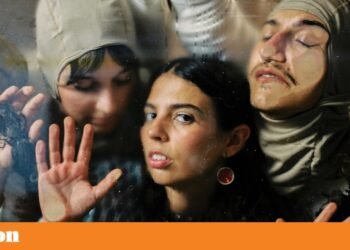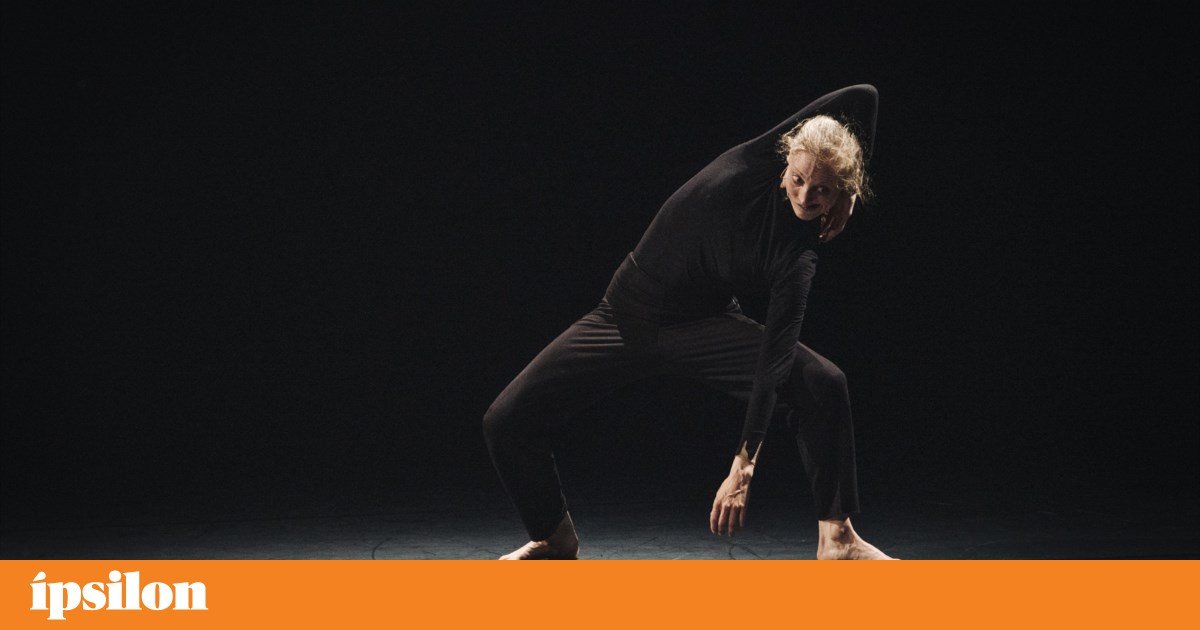
Taking place this weekend, 7th and 8th November, is the 12th edition of The Museum as Performance, which, as is its prerogative, aims to occupy a series of different spaces (including some more unusual ones) of the Serralves Foundationin Porto. The program, which moves, through a series of hybrid projects, between visual arts, music, dance and performancethis year brings together artists who “explore the ways in which violence and resistance coexist, seeking to reveal tensions and open spaces for dialogue”, writes Serralves in a press release. Bringing together, collaborating, de-hierarchizing or resisting are, in the words of curators Cristina Grande, Ricardo Nicolau and Pedro Rocha, programmers at the institution (Cristina in the areas of dance and performanceRicardo in visual arts, Pedro in music), some of the key verbs of this edition.
The kick-off will be Ivan Cheng. The Fountain (7th, at 2:30 pm and 7:50 pm, in the galleries of Serralves Museum) is, in its original version, a “staged dialogue between a public and a private computer, presented by two dancers”, summarizes the synopsis of the work, which in Serralves will be converted into a “monologue about property, memory and the act of letting go”. The work invites the public to “reflect on what we choose to preserve”, it reads. “What files on our phones and computers do we consider valuable?”
The Portuguese-Slovenian dancer Sofia Kafol will present, at the Contemporary Gallery of the Serralves Museum (7th, at 3:10 pm, and 8th, at 2:45 pm), Voracewhich means “voracious” in Italian. The project’s presentation text features words from the creator herself: “I want to rescue my body, soaked in ballet classic, still struggling with parameters of unattainable perfection — the body of a 30-year-old woman daily bombarded by anti-aging protocols. How can I be the body that I really want to be and that goes beyond what I am allowed to occupy?”
Samir Kennedy, whose practice encompasses choreography, performancesound and video, and Sean Alexander Murray, who works in dance, cabaretdesign and performanceare the authors of It’s Got Legs!!!!!! (7th, at 4:10 pm, in the auditorium of the Serralves Museum). “What other forms emerge when we subject Broadway, the cabaretmusical theater and jazz forms to postmodern choreographic approaches? Can the camp exacerbated and minimalism share the same stage?” These are some of the questions that serve as the basis for the performance.
It’s Got Legs!!!!!!created by Samir Kennedy and Sean Alexander Murray
Simon Courchel
Multidisciplinary artist Mário Afonso appears in the program with Ermo, on a provisional basis (7th, at 5:15 pm, in the museum garage), choreography for three bodies that proposes a “reflection on human relations in current societies, crossed by technological mediation”. Also on Saturday, pianist Joana Sá will present Body: territory — variations on restlessness (6:50 pm, in the museum galleries). “Rooted in the eruptive geology of the Azores”, the work “explores restlessness as a planetary condition”, and is also marked by the memory of the “traumatic fire” that broke out, in the summer of last year, in Serra da Estrela Natural Park. This solo piece includes several field recordings, captured in different locations and contexts: recordings of the moments of the fire, made in the village of Frádigas, coexist with others from demonstrations in Lisbon and Ponta Delgada, for example.
On Sunday (11:30 am and 3:50 pm), Bruno Humberto presents the multidisciplinary project at Parque de Serralves Encyclopedia of Stairs. Time later for Sham3dan (5:15 p.m., at hall museum), the dance collective Nasa4nasa, founded in Cairo by dancers Noura Seif Hassanein and Salma Abdelsalam. Centered on the Egyptian dance that gives it its name — a belly dance whose distinguishing feature is the fact that the dancer balances a chandelier while performing it —, the performance It also departs from the “transformations it has undergone over the years”, evoking its “founding figures such as the mothers who brought it to this day”.
Composer Fredrik Rasten follows, with Six Moving Guitars (the 8th, at 6:10 pm, in the museum galleries), which explores the “sound characteristics of microtonal harmony” of the instruments — six acoustic guitars, as the title suggests — through the movement of the musicians through the space. The program comes to an end with Blast!by dancer Ruth Childs, a solo focused on “the painful, suffering, strange, explosive and violent body”. “I have felt for some time the need to respond to violence, incorporating and transforming it into my work”, writes the artist. “Not necessarily my own violence, but that which surrounds and surrounds us, that which runs through the history of humanity and haunts us with images and stories, the violence of our imagination or our nightmares.”