The world tends to forget the sins of the past, especially when they are buried thousands of miles from civilization under a layer of concrete. But in the heart of the Pacific Ocean, on Enewetak Atoll, there is a monument that does not allow us to look away.
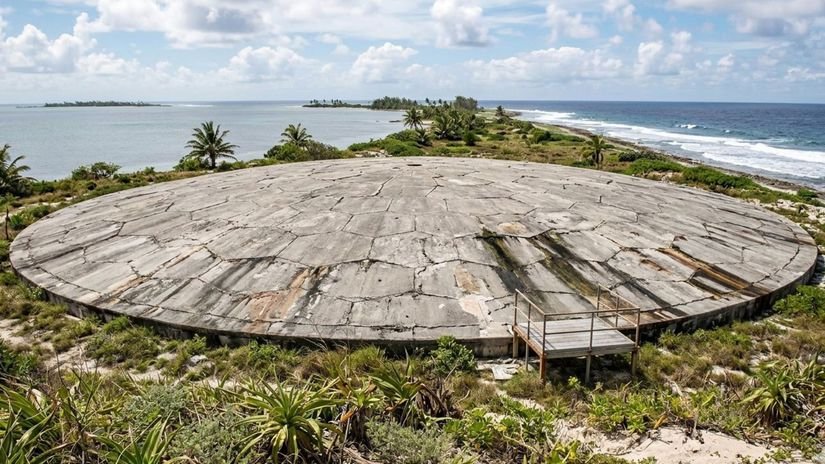
It’s called Runit Dome, but the locals call it simpler and more chilling: Tomb. Built on the site of a nuclear crater, this concrete dome contains more than 73,000 cubic meters of radioactive waste – a legacy of the Cold War that is turning into a global environmental concern due to climate change. a threat.
Birth of a Monster: When Heaven Turned to Hell
It all started in 1958 as part of Operation Hardtack I. The United States then detonated a bomb codenamed Cactus. The explosion created a crater less than ten meters deep on Runit Island.
During the 1940s and 1950s, the US conducted a total of 67 nuclear tests in the Marshall Islands, the power of which was equivalent to the daily explosion of a Hiroshima bomb for 12 years.
When the testing ended, the US faced a logistical nightmare: what about the contaminated soil and radioactive ash? The solution was “temporary”. After the Cactus explosion, radioactive material from the surrounding islands, including the deadly plutonium-239, was poured into the crater. The crater was subsequently covered with 358 concrete panels with a thickness of 45 centimeters.
But what the army engineers “forgot” to do at the time was to concrete the bottom of the crater. Only porous coral rock separates the waste from the ocean…
Current status: Cracks in the system and a rising level
Today, after more than four decades, Hrobka is falling apart. Columbia University scientists and independent experts have repeatedly warned that the concrete dome is not airtight. Cracks appear on its surface, through which gradual erosion can be seen. However, the real danger comes not only from above, but from below and from the side.
With global warming, ocean levels are rising. Salt water penetrates through the porous bottom of the crater and literally washes out the radioactive sludge directly into the lagoon. The Marshall Islands, a country whose highest point is only a few meters above sea level, found themselves in an unenviable position. If a stronger typhoon or further upwelling ruptures the dome, it threatens to release a concentrated cocktail of radioisotopes into the Pacific Ocean that could contaminate the food chain throughout the Pacific.
Who will bear the responsibility?
The issue of the solution is the subject of sharp diplomatic disputes. The Marshall Islands government says the US has a moral and legal obligation to secure the dome. However, Washington refers to the 1986 agreement, according to which the responsibility for the environment passed to the local government.
This position is criticized by the international community as unfair, since the small Pacific nation has neither the finances nor the technology to remediate nuclear waste on such a scale.
Possible solutions include building a new, more durable containment layer or completely transporting the waste to a safe repository in the continental US – but that would cost billions of dollars.
They’re Not Alone: The Planet’s Nuclear Scars
Runit Dome is not the only place where humanity has “swept radioactive dust under the rug”. Similar time bombs are ticking around the world:
- Novaya Zemlya (Russia): Arctic archipelago where the Soviet Union tested the most powerful bomb in history (Czar). The bottom of the surrounding seas is literally littered with containers with nuclear waste and wrecks of nuclear submarines.
- Mururoa Atoll (French Polynesia): France conducted nearly 200 nuclear tests here. Scientists warn that the structure of the atoll is weakened and is in danger of collapsing, which could trigger a local tsunami wave and the release of radioactive substances.
- Semipalatinsk (Kazakhstan): Once the main Soviet training ground, nicknamed the “Death Training Ground”. The area is still heavily contaminated and its residents suffer from birth defects and cancer, with remediation of the vast area in sight.
The tomb on Runit Island is a memento of an era when scientific progress overtook our responsibility. Today, this quiet concrete monument reminds us that nothing really disappears in nature – it just hides for a while. And in the age of the climate crisis, this “moment” is running out of time. If the world does not begin to act in a coordinated manner, the Pacific may witness a tragedy that knows no national borders.