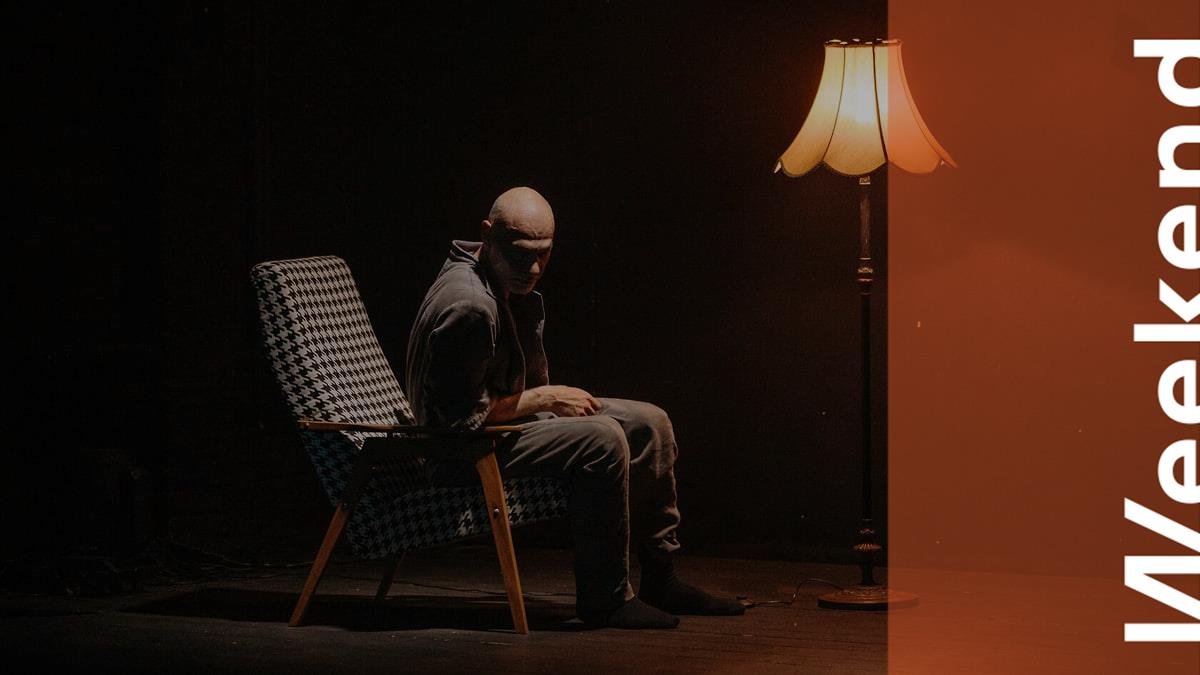
Weekend attended the premiere of the performance-research about how the body speaks to the sick.
The play “Point 64. Parkinson” is built around one character – a man who learned that he has severe and incurable Parkinson’s disease. She can come to anyone. And anyone who reads these lines and thinks: “This won’t happen to me” is a priori wrong.
The production is based on Igor Kazachkov’s autobiographical book “Parkinson’s Disease. A form of survival.” The author, who has been diagnosed for more than 15 years, was personally present at every screening in the theater for a long time. However, this time Igor was not in the hall: he broke his ribs and is undergoing treatment. “Everything is fine with him now, he is recovering, but today we are playing without him for the first time,” the only actor of the play and choreographer Alexander Chelidze addressed the audience from the stage before the show.
In a further conversation with the audience, Chelidze joked that the production would last eight hours, and then added that in fact it was only an hour, because there were people with Parkinson’s disease in the hall, and for them it was not easy to spend even an hour in the audience’s chair. He also suggested motor games with raising certain fingers – this was difficult even for healthy people. Alexander Chelidze thus suggested to the audience the idea that the body does not always obey us and that it is sometimes difficult to control it.
The performance itself is unusually bright, touching, plastic – about the fact that the body is a gift, and a temporary gift. So you should appreciate every minute of movement, even when it seems that the disease is taking you away from you.
For an hour, while Chelidze masterfully interacted on stage with his shadow, light and objects, the viewer could take a fresh look at the nature of movements, listen to his body, and feel himself in someone else’s body.
The play reflects all the phases of the hero’s (non)acceptance of the disease. Once a preliminary diagnosis is made, the world collapses. “It’s me?” – the hero asks himself, looking at his awkward, poorly moving shadow. Stage of depression, the hero does not want to live. He suddenly realizes that now every object in the house is his enemy. Any door is an insurmountable obstacle.
And then the realization comes: there is a disease, but it does not kill immediately and you can live with it. And how he will live with her depends on himself. On stage, a horizontal board swings on cables. This is the table at which the hero stands. He cuts salad on a moving, rocking table. Hands do not obey well, tremble, cling unnaturally to devices. And the viewer experiences within himself this painful battle of the brain and body, separated by illness. But now the salad is prepared and the hero experiences the triumph of victory over the table, over the food, over the weakness of his hands – and the viewer feels the same.
“It’s me?” – the hero asks himself again, but this time he feels differently than at the very beginning. After all, he accepted that he was ill and decided to live – and learned how much he could still do. And I realized that there was still a whole life ahead, and it could be different, including very interesting.
“I haven’t changed,” says the hero. “I’m the same as before.” I still love the sea, ice cream, reading, I love my dog, I love my wife, thanks to her.” And he adds that he and his wife are going to the sea.
The play “Point 64. Parkinson” was created with the support of the Federal Scientific Center for Neurology: doctors advised the creators and even allowed the play to be produced within the walls of the institution. The producer of the project, Vitaly-Mark Gladyshev, thanks the doctors from the stage, as well as the “Team +1” company for their help in popularizing Parkinson’s disease. And the project is not limited to the stage: in addition to the performance, a thematic exhibition has been created at the Museum of Moscow, and discussions are held with the participation of patients with Parkinson’s disease and scientists.
This is not the first social project of the Museum of Moscow. Recently there was a photo exhibition about psychoneurological boarding schools, which was visited by more than 20 thousand people in four and a half months. The fact that museums are becoming a platform for discussing important social issues – disability, vulnerability in society, otherness – is a very important trend. Cultural institutions have enormous potential, and it is finally being used not only for leisure, but also for informing and educating on “inconvenient” issues.