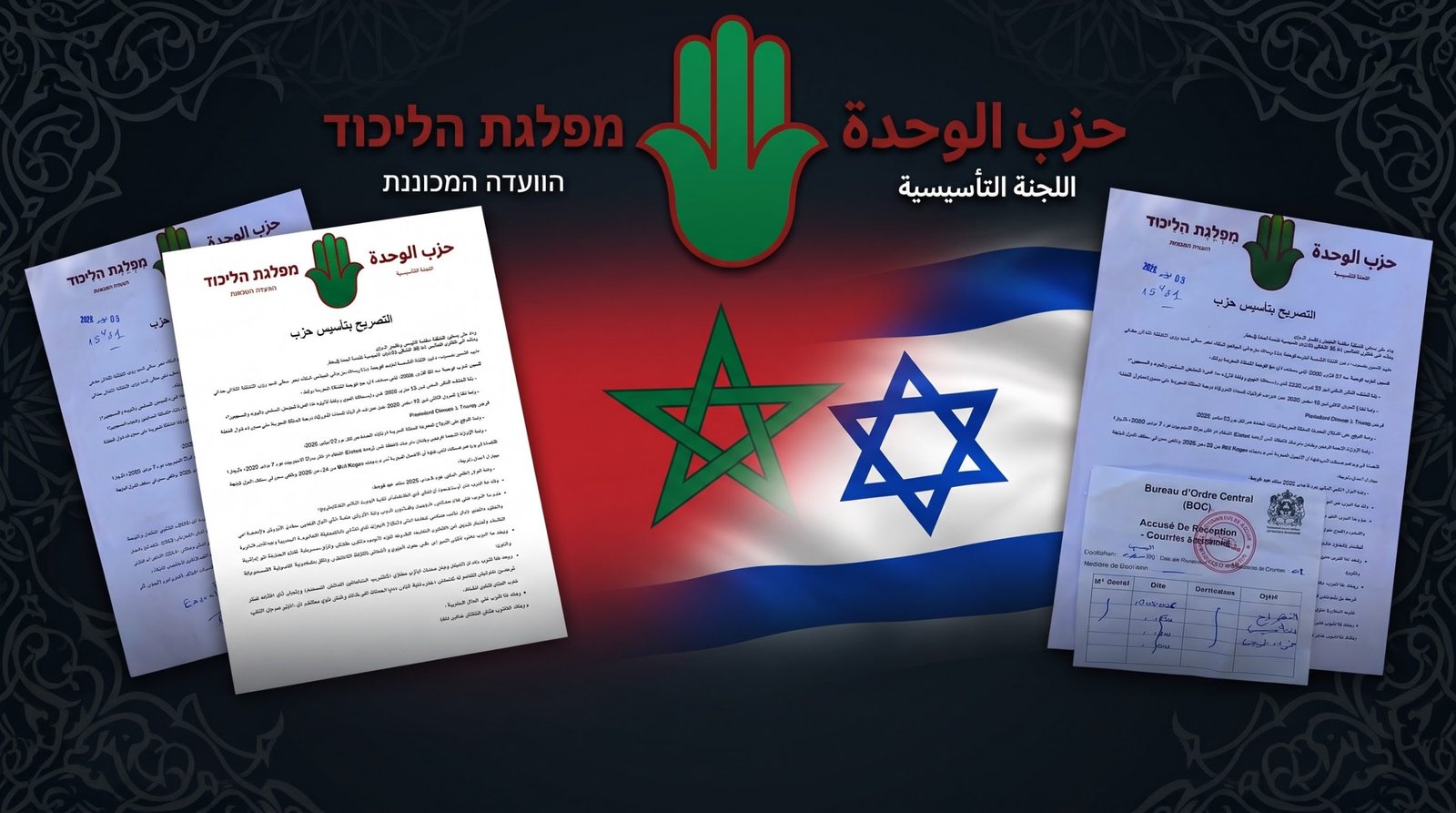
The project to establish a political party with a Jewish reference in Morocco ignited the fuse of anger and controversy, especially with its evocation of the experience of the Zionist “Likud” party, which opened the door to questions about the backgrounds of this step and its political dimensions, amid warnings of paving the way for a “new Andalusia” in the Kingdom, the repercussions of which go beyond the path of normalization to the political scene and cultural identity of Moroccan society.
In the most recent episode of this process, a circulated document addressed to the Moroccan Minister of the Interior revealed that Hussein Ben Messaoud submitted, on October 31, 2026, a file to declare the establishment of a political party bearing the name “Unity Party with democratic foundations and a Jewish reference,” and taking the Jewish religion as its reference, while adopting a Hebrew name, “Likud,” which is the same name that the ruling party in the Zionist entity bears.
In its endeavor, the Founding Committee relies on the Moroccan Constitution and Organic Law No. 29.11 relating to political parties, especially its sixth article, without the document including anything proving that the party has obtained an official license.
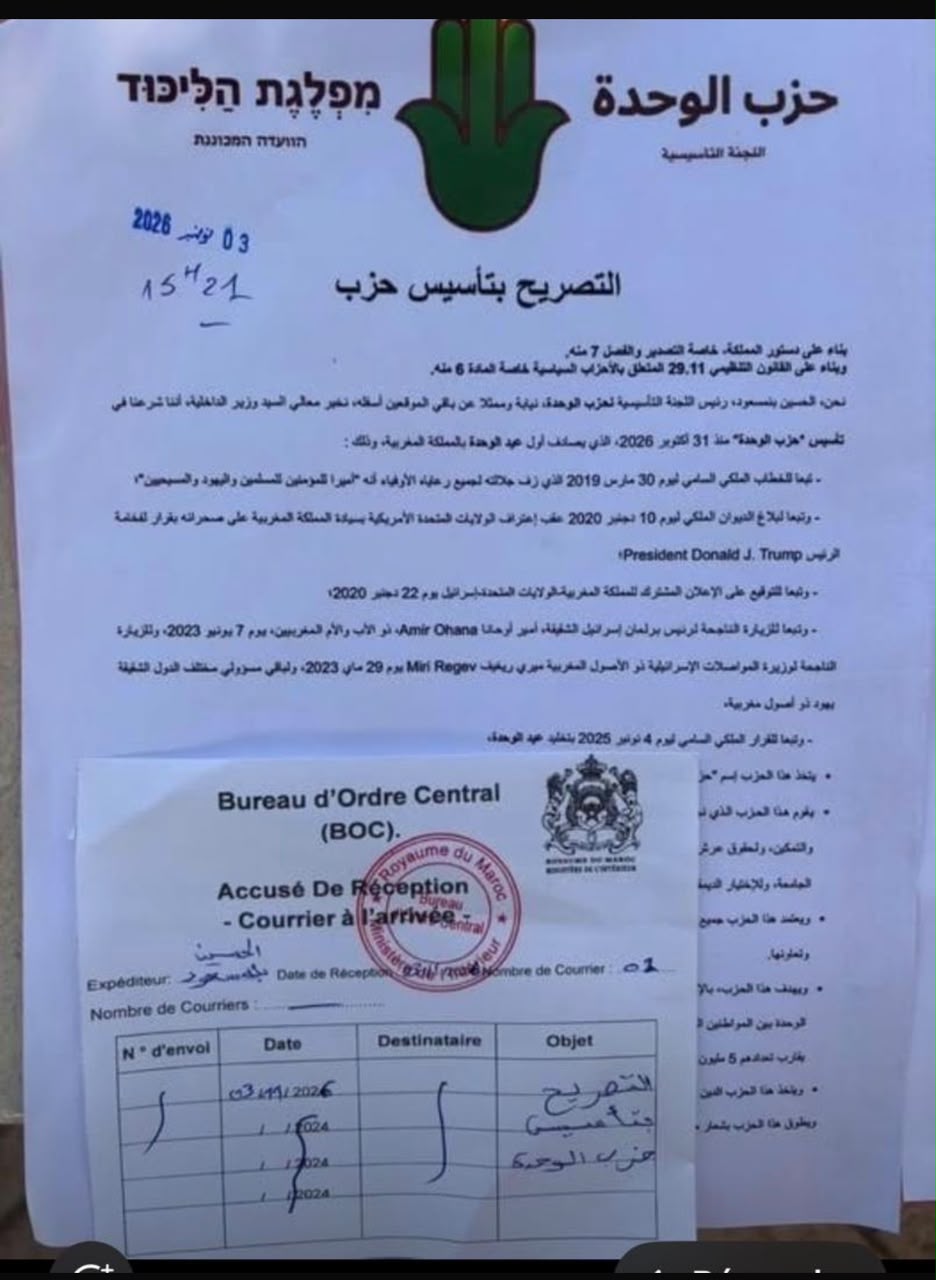
The document does not hide the initiative’s connection to the normalization process, as it recalls the Royal Court’s communiqué issued on December 10, 2020, following US President Donald Trump’s announcement of recognition of Morocco’s sovereignty over Western Sahara, and then the tripartite declaration signed between Morocco, the United States, and the Zionist entity on December 22 of the same year. It also cites the visits of two Zionist officials of Moroccan origin to the Kingdom: Minister of Transportation Miri Regev on May 29, 2023, and Knesset Speaker Amir Ohana on June 7, 2023.
The document links the naming of the party to the commemoration of “Unity Day,” which was approved by a royal decision on November 4, 2025, and recalls the royal speech issued on March 30, 2019 regarding the king’s status as Commander of the Faithful and the values of coexistence among followers of religions, declaring the party’s loyalty to King Mohammed VI, its connection to the institution of the Emirate of the Faithful, and its adherence to what he called “the territorial unity of the Kingdom.”
The founding committee says that its project aims to strengthen unity among Moroccan citizens, strengthen the role of Moroccans and their grandchildren abroad, with special attention to Jews of Moroccan origins, and strengthen external ties.
But what gives this initiative political dimensions that go beyond the announcement of the establishment of a new party is the nature of the reference contained in its name, and the questions it raises about the relationship between the declared religious authority and the political references of the Israeli occupation, especially since the name Likud is linked to a Zionist party known for its political positions towards the Palestinians and the Palestinian issue.
From diplomatic relations to influence within institutions
Since the resumption of relations between Morocco and the Zionist entity in December 2020, these relations have entered a new phase that includes multiple areas, from economic and technological cooperation to security and military coordination. This path was accompanied by widespread controversy within Morocco, as the normalization steps faced criticism from political and civil forces and popular sectors that adhere to a position that rejects relations with the Zionist entity in light of the continued occupation of the Palestinian territories.
Today, the initiative to establish a party with a Jewish reference opens a different discussion, related to the possibility of the effects of normalization being transferred from the external sphere to the internal political sphere. The issue is no longer limited to the nature of the agreements concluded by governments, but rather it raises questions about the references that enter into partisan life, the choices that may affect the public debate, and the limits of overlap between national affiliations and cross-border political connections.
This is not just a matter of announcing the establishment of a new party, but rather a step that reveals the extension of the Zionist infiltration into Moroccan political life and institutions, and exposes public opinion to the necessity of holding the project accountable regarding its program, its references, its positions on regional issues, and the extent of the independence of its political decision.
Normalization…from a political agreement to a test of identity and sovereignty
The sensitivity of these developments lies in the context in which they occur. Morocco is a socially and culturally diverse country, and it has a Moroccan Jewish component that has contributed to its history. However, employing this heritage in a party project that invokes a name associated with a Zionist political party raises completely different questions about the issue of religious diversity and coexistence within Moroccan society.
It is necessary to distinguish between the political rights of Moroccan citizens, regardless of their religion, and the nature of the political projects and references adopted by party organizations. Respect for religious diversity does not negate the right of society to discuss any external political affiliations, nor does it exempt initiative holders from providing clarifications regarding their programs and positions.
From this standpoint, the fear raised by critics of normalization is that diplomatic openness will gradually turn into a broader path of presence and influence within the political, cultural and economic fields, which raises the problem of the independence of national decision-making and the limits of external influence.
“New Andalusia”… a warning against a path that deserves accountability
In light of these developments, the expression “New Andalusia” emerges as a symbolic warning against the dangers of the gradual erosion of national privacy under the influence of accumulated political and cultural transformations. It is an evocation of a deep historical memory, especially with the correspondence between historical facts and the current Moroccan reality, such as the cases of expropriating real estate properties from their owners and giving them to Jews returning from abroad with unfair judicial rulings, according to what was reported by Moroccan media.
Countries do not necessarily lose the independence of their political choices with a single decision, but rather they may face cumulative transformations that make the discussion about identity, sovereignty, and references more urgent. Therefore, the importance of this initiative lies in its threat to the future of the Moroccan people, and imposing new options on them that they cannot face in light of systematic obfuscation, ignorance, and propaganda.
The question facing Morocco today
These developments are gaining regional importance given their potential repercussions on Maghreb balances, on the future of political positions on the Palestinian issue, and on the nature of relations between the countries of the region in light of the rapid transformations.
The most important question for Moroccan public opinion remains: Will normalization remain confined to the framework of official relations between countries, or is its path heading towards a broader presence within the political, social and institutional sphere?
Announcing the initiative to establish a party is sufficient to prove the existence of an external infiltration project, and opens a legitimate discussion about the nature of this trend, its limits, and its potential repercussions. The right of Moroccans to know the truth about the political projects proposed in their name, and to discuss their references and positions on issues of sovereignty and Palestine, remains an essential part of their right to determine the future of their country.
When normalization moves from the table of diplomatic agreements to the threshold of the internal political sphere, the question becomes bigger than just relations between two countries. It is a question about the limits of external influence, the future of national identity, and the independence of political decision-making.