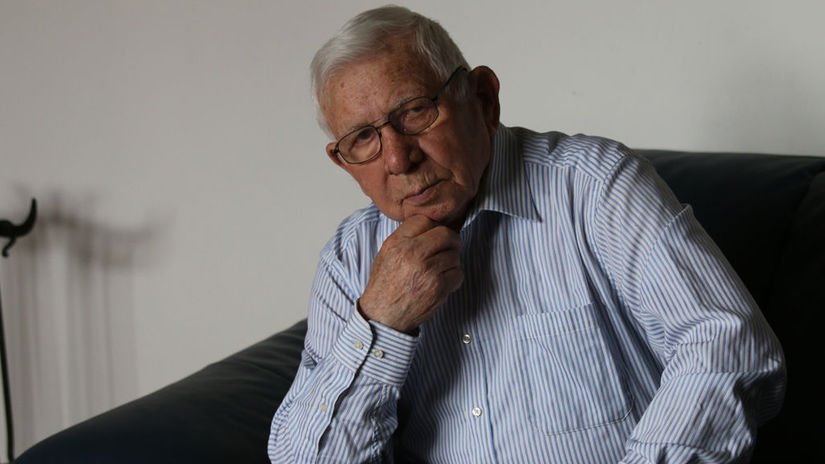
A Slovak, when he had at least a little land, survived. This legacy was left to us by the founder of modern soil science in Slovakia, academician Juraj Hraško. Let’s take a look at how we’ve been managing the land for the last 80 years. The statistics are inexorable: in the last 80 post-war years alone, we have lost almost 400,000 hectares of land in Slovakia.
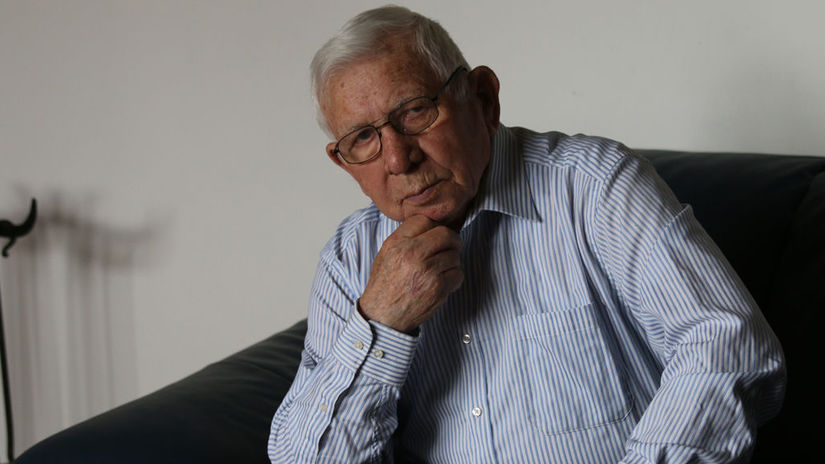
Photo: Jozef Sedlák, True
“Car plants, industrial parks, and other residential satellites where the houses are surrounded by walls like prisons have grown on the best land,” warns academician Juraj Hraško in recent years.
Can we imagine how big that territory is? Well, the largest district in Slovakia is Levický and it covers an area of 1,551 square kilometers or 155,100 hectares. Since the end of the war, according to statistics carefully kept by Slovak soil experts, we have built up 387 thousand hectares of arable land with roads, industrial buildings, housing construction in cities and towns, which is the area of two and a half Levice districts.
This district is in many ways symbolic for Slovakia. It has fertile plains and foothills, everything from fruit, vegetables and wine to wheat and corn can be grown here. By losing this territory, we lost an unprecedented amount of food, but also precious biodiversity, because Slovak agriculture has completely changed.
In the aforementioned year 1946, Slovakia’s economic focus was predominantly an agrarian country. More than half of the population was engaged in agriculture. The fields were small, often narrow seams of fields, meadows. From the end of the 19th century, thousands of residents went to America, and during the first Czechoslovakia to France. They toiled in mines, steel mills, on Belgian and French estates, saved dollar for dollar, franc for franc, returned home and bought the desired land.
 Read more Whose ground is on fire? Slovakia. How to save Slovak agriculture?
A concrete future
The year 1948 brought a change of political regime, collectivization, establishment of cooperatives, industrialization and building of heavy industry. American peasants, as well as those who toiled at home on small farms, faced a reality that they had never imagined in their dreams. The country and its agriculture, the countryside have undergone an unimaginable change.
After almost a century, we see a completely different Slovakia in front of us. We have agriculture that is hard to find anywhere else in Europe, perhaps only in the former GDR and the Czech Republic. It is predominantly large-scale production, but hundreds of smaller farms, including micro-farms, have also been established. In the ruins of the old, the new is painfully born.
When we look at the present-day countryside with a number of satellite settlements that surrounded the villages not only in Bratislava, Košice, Nitra and other regional or district cities, we will probably not be far from the truth when we say that territorial development has never taken place as spontaneously as it does today. He cheerfully takes up the land, as if we have it to give away.
Whether in socialism or capitalism, we approached the soil like the hero of Balzac’s short story Shagrin Skin. We exchanged it for projects promising a better tomorrow. That’s how Niklová huta stood up for socialism near Seredi, and half a century later huge warehouses for retail chains. We concreted our own soil and we import food from abroad, that is the paradox of the Slovak 21st century!
How many such shots of the most fertile land would we find in our country?. How much more will we steal from our descendants?
It does not excuse us that the land was greedily occupied by investors all over Europe, in Germany, and in the overpopulated Netherlands, where they raise ten times more cattle and pigs than in Slovakia. Now we are puzzled (some of us) how to preserve the remains of that Shagreen skin, because we cannot live without soil. We need to learn to manage it better, to value it more.
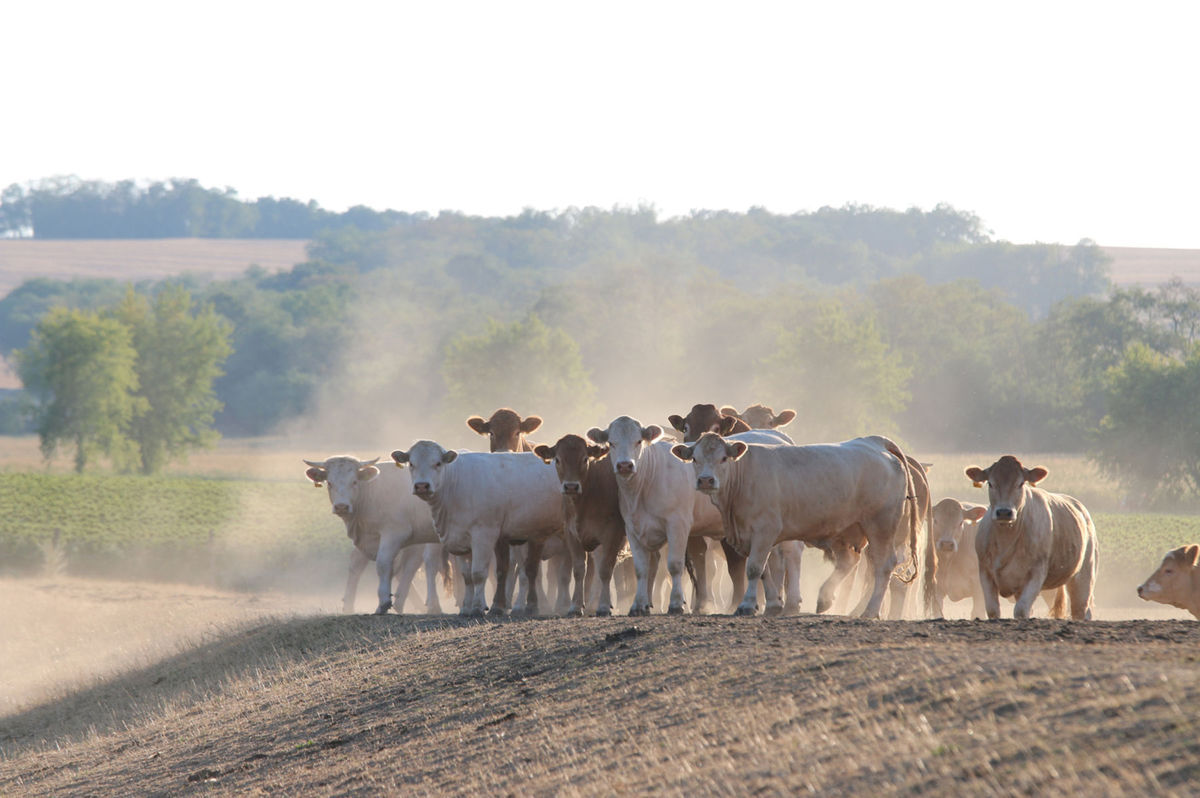 Photo: Jozef Sedlák, Pravda
cow, animal production Revival of animal production is more complicated every year.
And so let’s recall just a few facts proving that we have really come to the edge of the abyss. As recently as 1950, one inhabitant of Slovakia accounted for half a hectare of arable land, i.e. 5 thousand square meters, which is ten five-acre plots of land. These are often halved in satellites. We already have 0.258 hectares left for food production, as well as better management of groundwater, that is, one quarter of the post-war half a hectare, exactly 258 square meters per soul living in Slovakia.
We can still handle the situation. However, we must remember that soil, unlike water, is a non-renewable natural resource. It does not arise in the course of one human life. For example, a 50-centimeter layer of humus horizon sufficient for plant growth is formed in approximately 5-6,000 years in our climate. In an interview for Pravda in January 2015, soil expert Jaroslava Sobocká recalled this.
Really just property?
We have certainly not behaved like good stewards over the past 80 years. The contemporaries, regardless of whether they are owners or users of land, have a very narrow view of it. “People understand land as a commodity, as a bill of exchange that can be exchanged for a large sum of money where highways, industrial parks and housing estates are being built,” said Sobocká in the aforementioned interview.
 Read more People understand land as a well-paid bill
For farmers, land is a basic means of production, and many of them consider it mainly an economic category. According to Sobocká, those who perceive the value of land comprehensively are a minority. They are soil experts who must remind the whole society of the importance of soil. Their allies are honest farmers who inherited a warm relationship with the land from their parents and grandparents. She has always been their breadwinner and a valuable asset that must be conscientiously taken care of.
And one more message sent to Slovakia today by the 95-year-old academician Juraj Hraško. He said it at Christmas in 2019: “Let’s not treat the land as a commodity. The owner of the land is not always the farmer, and the one who works on the land is only its temporary user. The owner decides to whom he will sell the land. And the farmer is usually not the first buyer, but he is the one who offers the most – a developer, one investor or another. Automobile factories, industrial parks, and other residential satellites with houses have grown on the best lands surrounded by walls like prisons. Agricultural farms with dilapidated barns have become abandoned brownfields. We are becoming prisoners of dubious welfare.” If we don’t stop, we will miss this land one day. It’s actually missing.