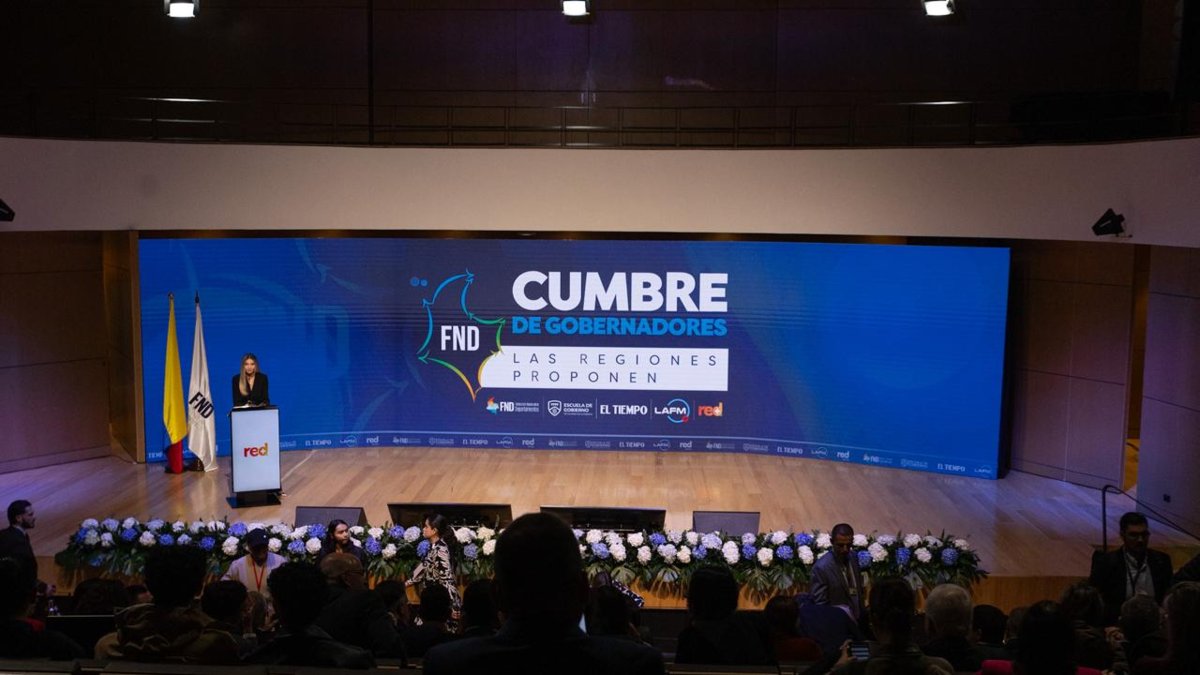
With a call to “the regions stop being a discourse and become a real priority in the candidates’ government plans”, the governor of Meta and president of the National Federation of Departments (FND), Rafaela Cortés, opened this Wednesday, April 15, the forum ‘The regions propose and the candidates listen’, in Chía, within the framework of the national tour of the governors’ summit.
The meeting, organized by the FND in alliance with EL TIEMPO, Red+ Noticias, La FM and the University of La Sabanavenue of the event, served as a stage for presidential candidates to present their positions on key issues for the regions. Among the central points were decentralization – especially the discussion on the law of powers -, the articulation between the Nation and the territories and the main regional problems.
Subsequently, Based on the ‘White Paper’, a document under construction that brings together the proposals and needs raised by the governors, the moderators asked questions to the candidates. The candidates Iván Cepeda – who canceled his participation -, Abelardo de la Espriella, Paloma Valencia, Clauda López, Sergio Fajardo, Luis Gilberto Murillo and Roy Barreras were invited.
Rafaela Cortés, governor of Meta. Photo:FND.
During the day, One of the main consensuses was the need to rebuild the relationship between the National Government and the regionsamid criticism of centralism and the lack of dialogue between the current administration and local leaders. Throughout the forum, it was insisted that strengthening this link and transferring more decisions, resources and execution of projects to the territories is key to responding strategically to needs.
“Regardless of who wins, there is something that must be clear: Colombia needs to rebuild the relationship between the National Government and the territories,” said Governor Cortés, insisting that the country needs resources to achieve decentralization.
In this sense, the powers law, which will define how functions will be distributed between the National Government and the territorial entities after the reform of the General Participation System (SGP) – with which resources for regions will go from 28 to 39.5% in a period of 12 years – was consolidated as one of the central issues. Despite the consensus regarding the need for the project, objections arose, especially regarding the differential territorial approach, the effective allocation of resources and competencies, and the implementation period.
Didier Tavera, executive director of the FND. Photo:FND.
For its part, the executive director of the FND, Didier Taveraassured that it is essential to maintain the institutions and strengthen the joint work between the National Government and the departmental administrations.
“This week there was a threat to local institutions, trying to emerge a hierarchy (of the National Government) that does not exist in the Constitution,” said Tavera when referring to the comments of President Gustavo Petro, who spoke of dismissing the mayors and even imprisoning those who did not manage to lift the blockades on the roads in the midst of the strike caused by the increase in the property tax.
Tavera assured that the protests, especially in Santander, were a consequence of the “lack of articulation, dialogue and agreement” between the Nation and the territories.
Rolando Roncancio, rector of the University of La Sabana. Photo:FND.
Along the same lines, Cortés assured that the country has suffered in recent years the consequences of the lack of dialogue and the weakening of institutional channels. “We need a government that understands that the regions are not passive executors, but allies in building the country.””.
The topic of strategic planning and execution was another of the central axes of the forum. Issues such as investment with social equity were thoroughly addressed, with emphasis on strategic infrastructure; public works—many have been slowed down in this four-year period—connectivity, regional economic development and security with a territorial focus. Added to this were debates on health, fiscal sustainability, royalties, energy transition and the fight against illegal economies, amid calls to unblock key projects, strengthen the institutional presence in the regions and improve coordination between entities.
From the academy, the rector of the University of La Sabana, Rolando Roncancio, assured that trust is an essential element that allows life in the community and a solid democracy. “Polarization in Colombia is not only ideological, it is also the inability to work together,” he said.
Didier Tavera and Rafaela Cortés. Photo:FND.
Overcoming polarization and ensuring that the proposals materialize was one of the transversal axes of the conversation. Both governors and assistant candidates agreed that, beyond ideological affinities, governing requires teamwork.
“The question is: are we going to allow it to be governed from the extremes? Or are we going to govern with proposals and with execution that allows us to reduce inequality and close the gaps?” Tavera pointed out.
The summit has already visited several regions and will continue on Friday in the Caribbean, and seeks to consolidate a regional agenda that will serve as input for government programs ahead of the next presidential elections.
JUAN SEBASTIÁN LOMBO AND PAULA VALENTINA RODRÍGUEZ
Political Writing