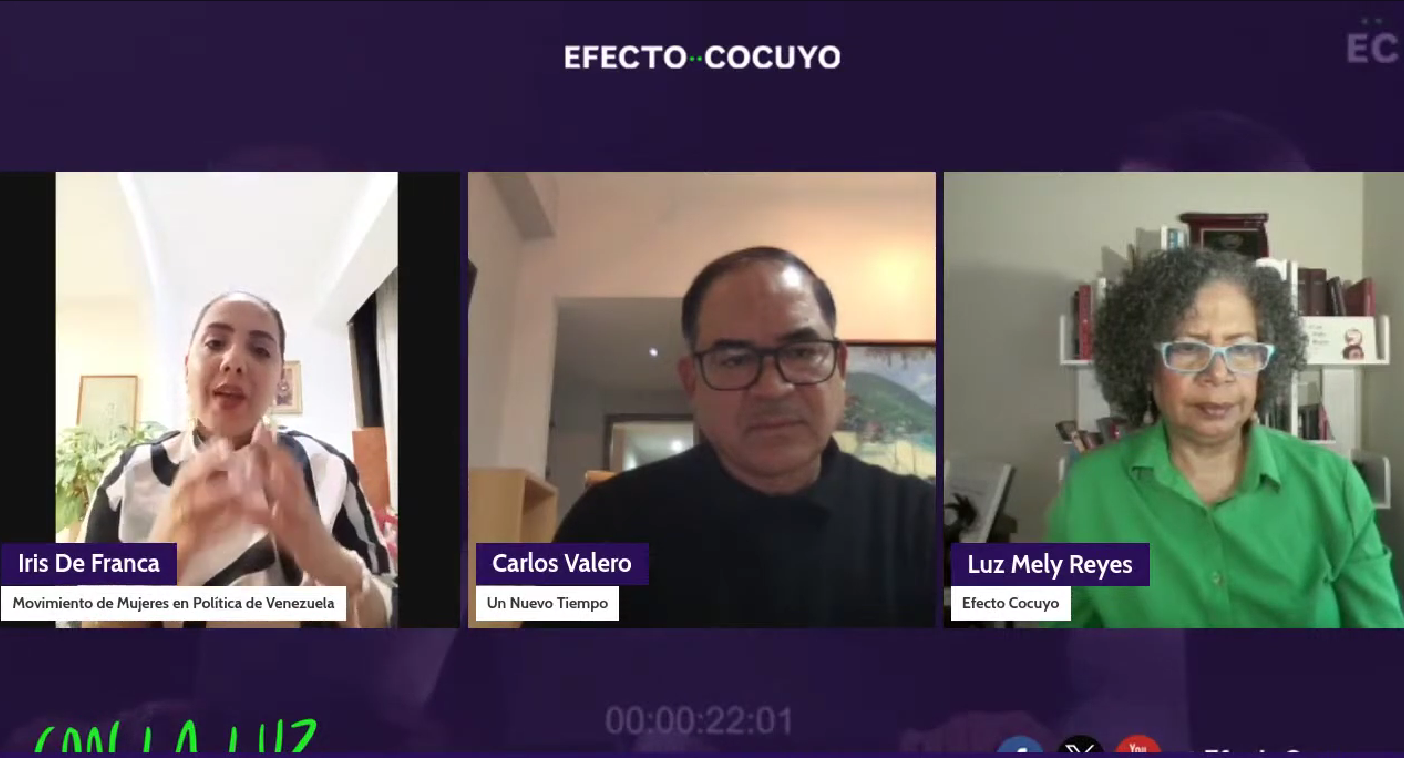
In the ConLaLuz program offecto Cocuyo, broadcast on the night of Tuesday, April 14, the director of this medium, Luz Mely Reyes, moderated a debate between Iris de Franca, national coordinator of the Women in Politics Movement, and Carlos Valero, secretary of International Affairs of Un Nuevo Tiempo, about the viability of a centrist or moderate politics in the current Venezuelan political context, marked by a “new moment” after the recent changes in power.
The episode, titled “A center in Venezuela?”, explored whether the country can move towards pragmatic positions away from polarized extremes, in the midst of transition, international relations and institutional reconstruction.

Carlos Valero emphasized the need to recognize past errors without relativizing responsibilities. “Our country was broken, the blame cannot be relativized,” said the leader of Un Nuevo Tiempo during the broadcast.
Both Valero and Iris de Franca agreed that Venezuela requires a more inclusive and dialogic approach to stabilize the country, although from complementary perspectives: Valero from social democracy and international politics, and Iris de Franca incorporating the gender perspective and the participation of women in political decision-making.
De Franca, from her role in the women’s movement, highlighted the importance of a policy that “incorporates all sectors and avoids sterile confrontation, promoting inclusion and reconstruction with a focus on human rights and equity.”
The debate focused on key questions: Is there real room for a centrist or pragmatic option in a still polarized scenario? Can this route contribute to stabilization and attract international support?
The guests analyzed the role of the opposition, the remaining ruling party and the expectations of Venezuelan society in the current situation.
Carlos Valero was clear in pointing out the fracture of the country and the need not to repeat cycles of confrontation.
“Our country was broken, the blame cannot be relativized… Here we must not relativize the blame.”
Valero, with 25 years in the opposition, recognized strategic errors of the unitary platform and defended the need to continue participating in electoral processes.
“We as a society should assume that a strategic error was made there… He who is free of errors should cast the first stone.”
Furthermore, he emphasized the importance of building an inclusive transition. “Building a democratic transition in Venezuela, a real transition happens because all Venezuelans assume from different political, ideological and even geographical positions… that for the transition to advance everyone must do their bit.”
Iris de Franca agreed on the need for broad agreements and was on the same line as Valero.
“I would place myself among those who believe that the transition must be built… that a great national agreement must be generated so that the conditions of that transition… are the most optimal for everyone.”
The leader of the Women in Politics Movement emphasized constitutional reconstruction and avoiding magical solutions.
“We are obliged to build agreements that will lead us to a transition towards democracy that is convenient for all of us… that this transition is in accordance with the Constitution.”
Regarding the Amnesty Law and the Peace and Coexistence Commission, Iris de Franca recognized progress, but criticized the slowness of the process:
“The amnesty law has had a terrible paralysis… There are terrible injustices that have not been solved.”
Both Valero and de Franca agreed that Venezuela needs to leave maximalism behind and build a broad, inclusive democracy with a focus on coexistence, especially incorporating the perspective of women and civil society.