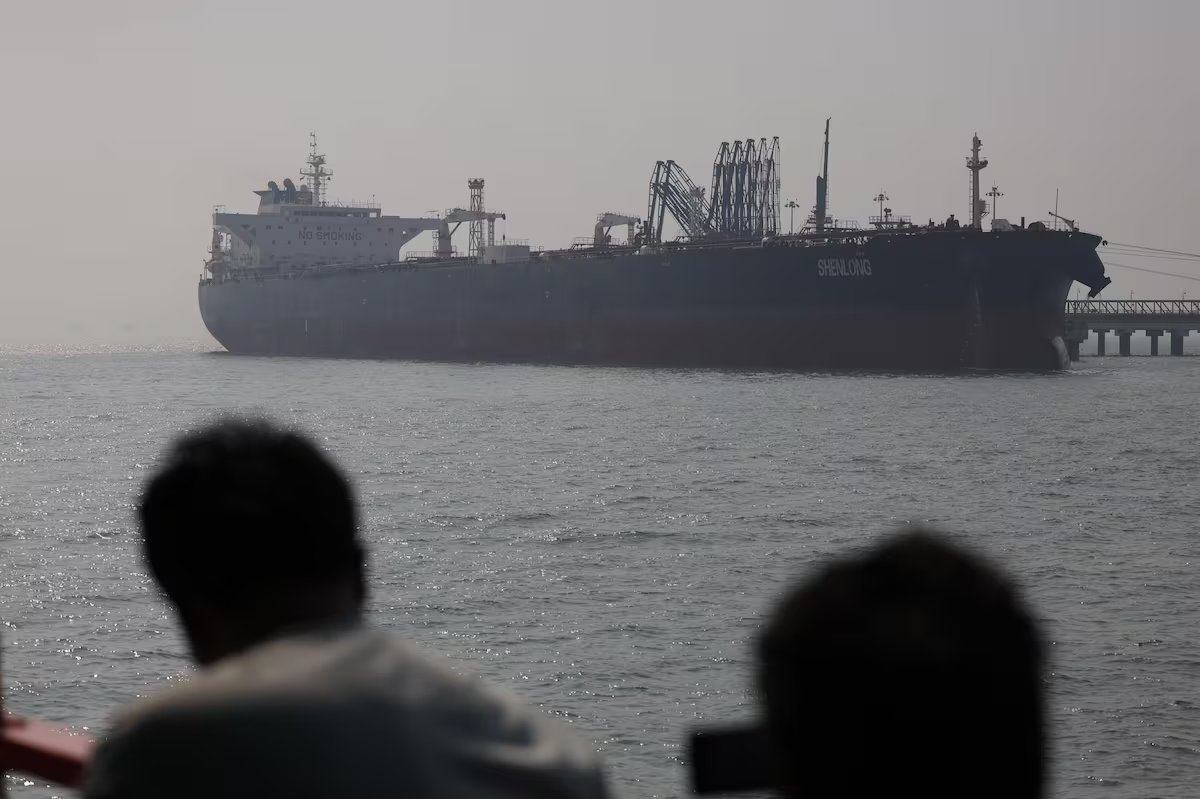
Asian shipping companies are cautiously watching the unblocking of the strategic Strait of Hormuz, vital for the continent’s crude oil imports, after Tehran said “safe passage” through the waterway will be possible during the two-week ceasefire reached with the United States.
This was stated by the Iranian Foreign Minister, Abas Araqchí, after the President of the United States, Donald Trump, announced a two-week truce, a period during which both parties will negotiate a peace agreement to end the conflict, in talks that will begin this Friday in Islamabad (Pakistan).
The restrictions imposed by Tehran on navigation through Hormuz, a route that channels around 20% of the world’s crude oil in peacetime, have severely affected nations such as Thailand, the Philippines, Japan and South Korea, which are highly dependent on fuel from the countries of the Persian Gulf.
“Positive sign” of normality
The Council of Shipping Companies of Thailand, which brings together several companies in the sector, considers the ceasefire a “positive signal” towards an eventual full resumption of transit through Hormuz, a key route for global energy trade, and blocked by Iran since the start of the war against the United States and Israel on February 28.
“However, two weeks is a relatively short period, and it is difficult to predict” the return to normality, the Thai Council noted on Facebook, in a publication in which it recalled the increase in costs that shipping companies are already suffering, including insurance surcharges.
The caution expressed by the Thai group coincides with the position of other shipping companies such as the Japanese Uno and Mitsui, which stated that the “safety” of their ships and crew is their main priority.
“Mitsui will continue to prioritize the safety of our sailors, cargo and ships during the voyage,” the company said in a statement sent to EFE.
Uno spoke in the same vein: “The safety of our crew, cargo and vessels continues to be our top priority, and we are prepared to adapt our operational plans as necessary to guarantee the continuity and reliability of our services,” he told EFE.
Possible “congestion”
For its part, the Council of Shipping Companies of Thailand also highlighted the possibility of “congestion” of ships both in the aforementioned strait and in the ports of the region and assures that even if a lasting peace is achieved, the situation will take weeks to normalize.
“Exporters around the world are likely to take advantage of this opportunity to deliver as much goods as possible, due to uncertainty about long-term peace,” the entity emphasizes.
Both Thai and Japanese ships have managed to transit Hormuz during the hostilities, despite the fact that navigation through the strategic strait was drastically reduced due to threats from Tehran to vessels operating in its waters, with few exceptions to vessels from countries such as Pakistan and India.
Since the start of the war, the British Maritime Trade Operations agency (UKMTO), which monitors the safety of ships and sailors around the world, has recorded 28 attacks on ships in the waters of the Strait of Hormuz and the Persian Gulfs and Oman, including one on a Thai ship that left three missing.