The construction of the emergency variant of the Trans-Ecuadorian Oil Pipeline System (SOTE) and the Heavy Crude Oil Pipeline (OCP) is developing according to schedule and registers a progress of around 70%.
The Minister of Environment and Energy, Inés Manzano, confirmed this during the visit she made on April 13 to the place, where a underwater permeable dikewhich will protect the water intake of the Coca Codo Sinclair hydroelectric plant against the regressive erosion of the Coca River. In the San Carlos sector, in the province of Napo.
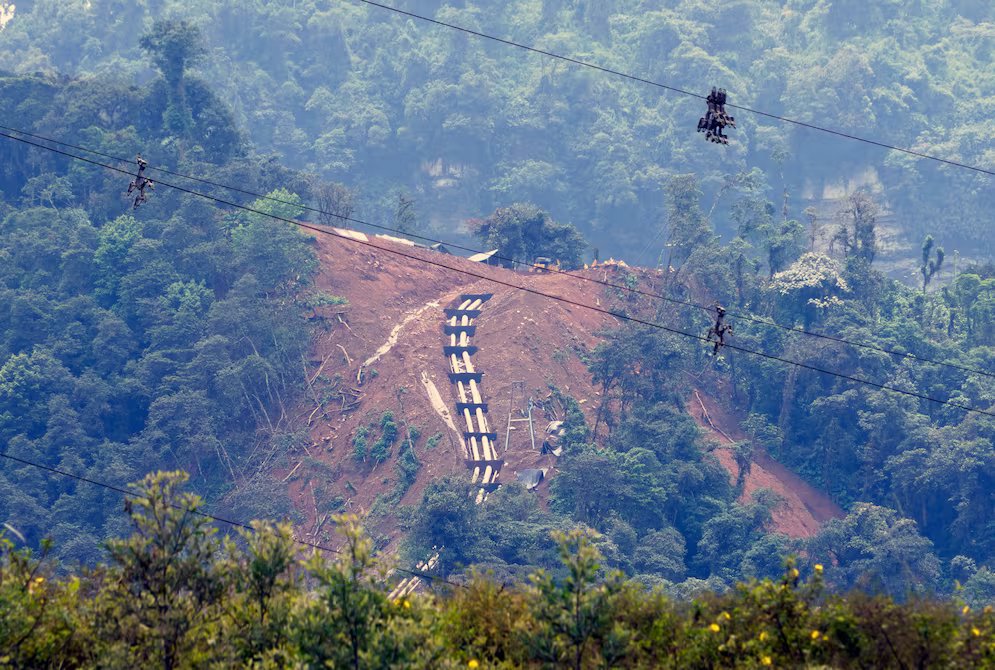
From that site you can see that two long pipes extend over the curve of the mountain, on the eastern side of the river.
Manzano pointed his hand towards that area and explained that it is the emergency variant of the SOTE, for which Petroecuador works jointly with the company Oleoducto de Crudos Pesados (OCP).
It is a provisional infrastructure that will be used to transport crude oil until the definitive variant is built, on the opposite side, behind the front mountain, far from the danger represented by the regressive erosion of the Coca, Loco and Quijos rivers.
The minister recalled that in July 2025 the SOTE and OCP pipes collapsed – as well as the road – due to the aggressive erosion of the Loco River, which rose rapidly due to heavy rains.
“The road and the bridge went down. And the two oil pipelines, the SOTE and the OCP, that run along this road, because they go side by side, stayed together like threads,” he summarized.
Starting in August of that year, work began on the emergency variant. What is now seen in the “eyebrow of the mountain” is the path that was opened for the passage of the pipes.
“The trail is being opened, on the mountain ridge. It is already at 70%. The mountain ridge has to be lowered. The final variant is going to be on that side, towards the back of the mountain (which is in front of the emergency work),” he described.
Regarding the final variant, Manzano said that the OCP company is carrying out processes with the National Public Contracting Service (Sercop) to purchase materials necessary for the work.
In March of this year, Petroecuador officials reported that two emergency variants are being implemented.
One of them is called SOTE Variant 10 and has been in operation since May. It will have an extension of 1,983 meters.
Regarding the final variant of the SOTE and the Shushufindi-Quito pipeline, it was indicated that it would cost approximately $135 million.
Of that amount, the SOTE infrastructure would account for $58.4 million, while the polyduct would account for $20.5 million. The other resources would be distributed in environmental sampling and payments for expropriations.
Petroecuador’s plan is to launch this year the tender for the construction of the final variant, which will have a route of 47.8 km for the SOTE and 49.68 km for the multi-purpose pipeline.
Until the emergency and definitive works are complete, the oil is transported by bypass. Between January and February 2026, 26.1 million barrels of crude oil were moved in total, according to figures from Petroecuador.
18.3 million barrels flowed through the SOTE, which meant transporting 310,566 barrels on average per day, 13.2% higher than in 2025.
7.7 million barrels were transported through the OCP, representing an annual drop of 30.8%, according to the public company’s report. (YO)