Monday, May 4, 2026
    The GeoStrategic Consensus
    No Result
    View All Result
    • Login
    • HOME
    • AMERICAS
      • Argentina
      • Brazil
      • Canada
      • Chile
      • Colombia
      • Costa Rica
      • Cuba
      • Dominican Republic
      • Ecuador
      • El Salvador
      • Greenland
      • Guatemala
      • Honduras
      • Mexico
      • Nicaragua
      • Panama
      • Paraguay
      • Peru
      • United States
      • Uruguay
      • Venezuela
    • ASIA-PACIFIC
      • Australia
      • Brunei Darussalam
      • Cambodia
      • China
      • Federated States of Micronesia
      • Fiji
      • Indonesia
      • Japan
      • Kiribati
      • Laos
      • Malaysia
      • Marshall Islands
      • Mongolia
      • Myanmar
      • Nauru
      • New Zealand
      • North Korea
      • Palau
      • Papua New Guinea
      • Philippines
      • Samoa
      • Singapore
      • Solomon Islands
      • South Korea
      • Taiwan
      • Thailand
      • Timor-Leste
      • Tonga
      • Tuvalu
      • Vanuatu
      • Vietnam
    • CARICOM
      • CARICOM – Non-English
        • Haiti
        • Suriname
      • CARICOM Associates
        • Anguilla
        • Bermuda
        • British-Virgin-Islands
        • Cayman-Islands
        • Curacao
        • Turks-and-Caicos
      • CARICOM English
        • Antigua and Barbuda
        • Barbados
        • Belize
        • Dominica
        • Grenada
        • Guyana
        • Jamaica
        • Montserrat
        • Saint Kitts and Nevis
        • Saint Lucia
        • Saint Vincent and the Grenadines
        • The Bahamas
        • Trinidad and Tobago
    • EURASIA
      • Armenia
      • Azerbaijan
      • Balarus
      • Georgia
      • Kazakhstan
      • Kyrgyzstan
      • Moldova
      • Russia
      • Tajikistan
      • Turkmenistan
      • Ukraine
      • Uzbekistan
    • EUROPE
      • Albania
      • Andorra
      • Austria
      • Bosnia and Herzegovina
      • Bulgaria
      • Croatia
      • Cyprus
      • Czech Republic
      • Denmark
      • Estonia
      • Finland
      • France
      • Germany
      • Greece
      • Holy See
      • Hungary
      • Iceland
      • Ireland
      • Italy
      • Kosovo
      • Latvia
      • Liechtenstein
      • Lithuania
      • Luxembourg
      • Malta
      • Monaco
      • Montenegro
      • Netherlands
      • North Macedonia
      • Norway
      • Poland
      • Portugal
      • Romania
      • San Marino
      • Serbia
      • Slovakia
      • Slovenia
      • Spain
      • Sweden
      • Switzerland
      • United Kingdom
    • MIDDLE EAST AND NORTH AFRICA
      • Algeria
      • Bahrain
      • Egypt
      • Iran
      • Iraq
      • Israel
      • Jordan
      • Kuwait
      • Lebanon
      • Lybia
      • Morocco
      • Oman
      • Palestinian Territories
      • Qatar
      • Saudi Arabia
      • Syria
      • Tunisia
      • Turkey
      • United Arab Emirates
      • Western Sahara
      • Yemen
    • SOUTH ASIA
      • Afghanistan
      • Bangladesh
      • Bhutan
      • India
      • Maldives
      • Nepal
      • Pakistan
      • Sri Lanka
    • SUB-SAHARAN AFRICA
      • Angola
      • Benin
      • Botswana
      • Burkina Faso
      • Burundi
      • Cabo Verde
      • Cameroon
      • Central African Republic
      • Chad
      • Comoros
      • Cote d’Ivoire
      • Democratic Republic of the Congo
      • Djibouti
      • Equatorial Guinea
      • Eritrea
      • Eswatini
      • Ethiopia
      • Gabon
      • Gambia
      • Ghana
      • Guinea
      • Guinea Bissau
      • Kenya
      • Lesotho
      • Liberia
      • Madagascar
      • Malawi
      • Mali
      • Mauritania
      • Mauritius
      • Mozambique
      • Namibia
      • Niger
      • Nigeria
      • Republic of the Congo
      • Rwanda
      • Sao Tome and Principe
      • Senegal
      • Seychelles
      • Sierra Leone
      • Somalia
      • South Africa
      • South Sudan
      • Sudan
      • Tanzania
      • Togo
      • Uganda
      • Zambia
      • Zimbabwe
    • HOME
    • AMERICAS
      • Argentina
      • Brazil
      • Canada
      • Chile
      • Colombia
      • Costa Rica
      • Cuba
      • Dominican Republic
      • Ecuador
      • El Salvador
      • Greenland
      • Guatemala
      • Honduras
      • Mexico
      • Nicaragua
      • Panama
      • Paraguay
      • Peru
      • United States
      • Uruguay
      • Venezuela
    • ASIA-PACIFIC
      • Australia
      • Brunei Darussalam
      • Cambodia
      • China
      • Federated States of Micronesia
      • Fiji
      • Indonesia
      • Japan
      • Kiribati
      • Laos
      • Malaysia
      • Marshall Islands
      • Mongolia
      • Myanmar
      • Nauru
      • New Zealand
      • North Korea
      • Palau
      • Papua New Guinea
      • Philippines
      • Samoa
      • Singapore
      • Solomon Islands
      • South Korea
      • Taiwan
      • Thailand
      • Timor-Leste
      • Tonga
      • Tuvalu
      • Vanuatu
      • Vietnam
    • CARICOM
      • CARICOM – Non-English
        • Haiti
        • Suriname
      • CARICOM Associates
        • Anguilla
        • Bermuda
        • British-Virgin-Islands
        • Cayman-Islands
        • Curacao
        • Turks-and-Caicos
      • CARICOM English
        • Antigua and Barbuda
        • Barbados
        • Belize
        • Dominica
        • Grenada
        • Guyana
        • Jamaica
        • Montserrat
        • Saint Kitts and Nevis
        • Saint Lucia
        • Saint Vincent and the Grenadines
        • The Bahamas
        • Trinidad and Tobago
    • EURASIA
      • Armenia
      • Azerbaijan
      • Balarus
      • Georgia
      • Kazakhstan
      • Kyrgyzstan
      • Moldova
      • Russia
      • Tajikistan
      • Turkmenistan
      • Ukraine
      • Uzbekistan
    • EUROPE
      • Albania
      • Andorra
      • Austria
      • Bosnia and Herzegovina
      • Bulgaria
      • Croatia
      • Cyprus
      • Czech Republic
      • Denmark
      • Estonia
      • Finland
      • France
      • Germany
      • Greece
      • Holy See
      • Hungary
      • Iceland
      • Ireland
      • Italy
      • Kosovo
      • Latvia
      • Liechtenstein
      • Lithuania
      • Luxembourg
      • Malta
      • Monaco
      • Montenegro
      • Netherlands
      • North Macedonia
      • Norway
      • Poland
      • Portugal
      • Romania
      • San Marino
      • Serbia
      • Slovakia
      • Slovenia
      • Spain
      • Sweden
      • Switzerland
      • United Kingdom
    • MIDDLE EAST AND NORTH AFRICA
      • Algeria
      • Bahrain
      • Egypt
      • Iran
      • Iraq
      • Israel
      • Jordan
      • Kuwait
      • Lebanon
      • Lybia
      • Morocco
      • Oman
      • Palestinian Territories
      • Qatar
      • Saudi Arabia
      • Syria
      • Tunisia
      • Turkey
      • United Arab Emirates
      • Western Sahara
      • Yemen
    • SOUTH ASIA
      • Afghanistan
      • Bangladesh
      • Bhutan
      • India
      • Maldives
      • Nepal
      • Pakistan
      • Sri Lanka
    • SUB-SAHARAN AFRICA
      • Angola
      • Benin
      • Botswana
      • Burkina Faso
      • Burundi
      • Cabo Verde
      • Cameroon
      • Central African Republic
      • Chad
      • Comoros
      • Cote d’Ivoire
      • Democratic Republic of the Congo
      • Djibouti
      • Equatorial Guinea
      • Eritrea
      • Eswatini
      • Ethiopia
      • Gabon
      • Gambia
      • Ghana
      • Guinea
      • Guinea Bissau
      • Kenya
      • Lesotho
      • Liberia
      • Madagascar
      • Malawi
      • Mali
      • Mauritania
      • Mauritius
      • Mozambique
      • Namibia
      • Niger
      • Nigeria
      • Republic of the Congo
      • Rwanda
      • Sao Tome and Principe
      • Senegal
      • Seychelles
      • Sierra Leone
      • Somalia
      • South Africa
      • South Sudan
      • Sudan
      • Tanzania
      • Togo
      • Uganda
      • Zambia
      • Zimbabwe
    No Result
    View All Result
    Agentially
    No Result
    View All Result
    Home ASIA-PACIFIC Papua New Guinea

    Power, water flow past them

    The Analyst by The Analyst
    April 14, 2026
    in Papua New Guinea
    Power, water flow past them


    COMMENTARY

    ELECTRICITY infrastructure in Papua New Guinea has historically disadvantaged landowners, as projects like Sirinumu and Edevu demonstrate a pattern of exclusion, urban bias, and delayed or partial remedies that reflect a national trend of inequity.

    According to an energy access diagnostic report by the World Bank in partnership with the Energy Sector Management Assistance Program (2024), a 2021 baseline study in Papua New Guinea revealed that only 13 per cent of the households across the nation were connected to electricity. The World Bank then reports in a different publication that 20.5 per cent of PNG’s population was connected to electricity by 2023.

    READ ALSO

    How has the Portuguese language influenced PNG?

    Tribe finds peace after seven years

    While the World Bank’s 2024 report also indicates that only 6 per cent of rural households have access to electricity – compared to the 56 per cent of urban households in the baseline study who have access to electricity – no other available reports have updated those figures beyond the 20.5 per cent electrification.

    From this alone, one can surmise that there is a need to carry out a proper study on the number of households that actually have access to electricity, and the number of households that do not. Information like this would greatly improve the Government’s service delivery going forward, which stands to reason that it should be included in a section of the National Census. The reliability of census data, and the speed with which it would be available to the public and concerned government bodies, is a topic for another discussion.

    Meanwhile, the Government announced that it is targeting 70 per cent access to electricity by 2030. That would greatly improve services, as well as industry and livelihood. However, the concern remains how they will go about achieving this goal, especially while dealing with the issues they currently have with landowners that play host to electricity infrastructures, such as the Edevu Hydropower Station and the long-operating Sirinumu Dam.

    The Sirinumu case: Abundance without benefit

    The Sirinumu Dam, constructed in the 1960s, was designed to supply Port Moresby with water and electricity. For the capital, it became a lifeline, ensuring urban growth and stability. For the landowners who gave up their land to host the reservoir, however, it became a symbol of exclusion.

    A Weekender feature from The National newspaper, titled “Water all around but little to drink” (April 28, 2023), documented how villagers around Sirinumu lived for decades without clean water or electricity, despite hosting the infrastructure that sustained the capital. Mothers and daughters carried water daily from the waterfalls that fed the reservoir, while the reservoir itself stored vast quantities for Port Moresby. The article framed this as a national injustice: landowners displaced, uncompensated, and excluded from the very benefits their land enabled.

    Theirs was a story of hunters and gatherers in a valley whose descendants now live as fisherman on islands in Lake Sirinumu, a water-filled basin that spans up to 12 kilometres.

    Follow-up reporting in The National in 2025 showed partial remedies. Berebei village finally received piped water after more than 60 years. And even though their joy was palpable, the fix was late and limited. Electricity access remained absent, and only one community benefited.

    The PNG Government recently restarted a ring-road upgrade project after about 40 years for the communities and villages that live on the dam. With a funding of K500,000 from the Central provincial government, the aim is for the road to be fully upgraded and properly connect communities to markets and services.

    The Sirinumu story thus illustrates both the depth of disadvantage and the inadequacy of delayed solutions.

    Edevu Hydropower: Continuity of urban bias

    The Edevu Hydropower Project, launched in the 2010s and commissioned in 2024, was hailed as a major achievement. Costing K770 million, with private investors putting up K650 million and the government contributing K120 million for transmission lines, it promised to stabilise Port Moresby’s overloaded grid.

    Sitting on the Brown River in Central province, Edevu’s 50 megawatt (MW) output was designed to benefit Port Moresby, but not rural landowners near the project site. While covering the story of the Edevu Dam’s commissioning, media personnel noted that it took a few hours for the reservoir to be filled and backed up. However, downstream, the river’s flow was all but diminished.

    This raises the question of whether or not the local people were well informed of the disadvantages that the dam would bring to their way of life as they lived off the river. Were they told the dam would affect the flow of the river?

    And would they be properly compensated for this disruption to their lifestyle?

    So far, there have been no reports that indicate compensation and benefit-sharing arrangements have been resolved or an agreement has been reached.

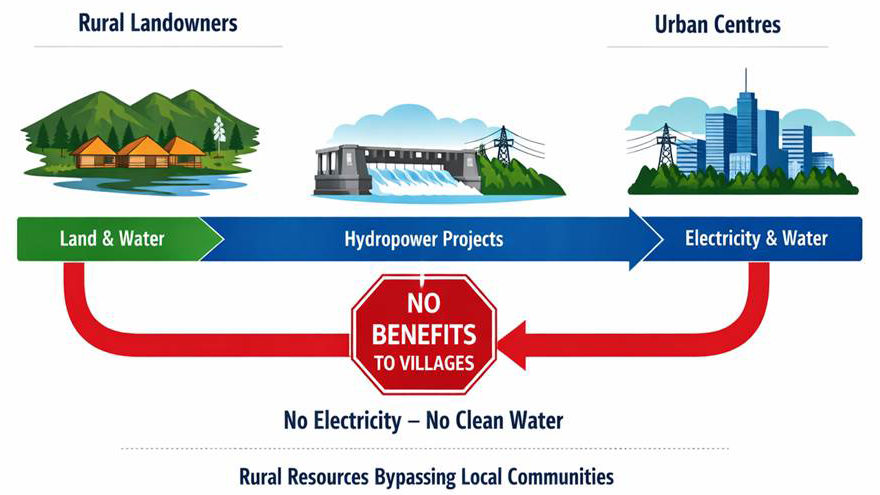
    A flow chart showing how benefits and who does not from hydroelectricity and water projects.

    The parallels with Sirinumu are striking: both projects harnessed rural land and resources, yet the benefits flow to the capital. Landowners host infrastructure but remain excluded from electricity access.

    Landowners in Central Province (especially the Koiari around Sirinumu and Rouna) have had to repeatedly threaten or attempt shutdowns of water and power to Port Moresby before the Government released partial compensation. At least half a dozen major disputes have been recorded since the 1990s, with the most recent ultimatum in July 2025 demanding K15 million in outstanding payments.

    Central Governor Rufina Peter, in one of her first addresses concerning the topic of benefit-sharing to landowners, spoke about needing the landowners to be properly compensated for the use of their land for electrification projects. Delivering this address at the commissioning of the Edevu Hydropower Project in 2023, Peter alluded to having benefit-sharing negotiations rooted in future negotiations and for landowners to be properly educated on what they would be giving up their land for.

    There have been no public complaints or outcry from landowners near Edevu as yet, but that raises another question of what the benefit-sharing arrangement – if there exists one –  looks like. Is it similar to the one the state has with Rouna and Sirinumu, or have they learnt from the Sirinumu case?

    Other hydropower experiences: Yonki and Warangoi

    The inequities of Sirinumu and Edevu are not isolated. In Eastern Highlands, the Yonki Hydropower Station supplies power to the Highlands region, yet surrounding landowners face unreliable supply and frequent blackouts. Communities near the station often complain that they host infrastructure without enjoying its benefits.

    Sources say in other parts of the Highlands, especially Western Highlands’ Mt Hagen, people have taken to illegal power connections either because they were not connected or refuse to pay for power.

    This does not help the argument but is worth mentioning as a standalone point to emphasise the lengths people would go to for electricity.

    In East New Britain, the Warangoi Hydropower Station has faced similar criticism. Despite its role in powering Rabaul and Kokopo, nearby villages experience poor access and outages. Again, the pattern repeats: infrastructure benefits urban centres and industries, while host communities remain disadvantaged to an extent.

    Other centres such as Wewak, Aitape, Alotau, Kerema, Daru, and Arawa use fuel-powered generators to keep power running. But because of the constant disruptions, either due to a shortage of fuel or other line problems, there is a measurable distrust in the reliability of electricity provided by state-owned PNG Power Limited.

    This also raises the question of whether PNG should look into other means to electrify the country, besides hydro-power and fuel. And would this then cut down the number of issues relating to remedies or compensation, or would this open the door to more problems in the electricity sector?

    Case studies in micro-hydro projects: Small wins

    Smaller hamlets such as Kairiru, an island off the coast of Wewak in East Sepik, have their own water sources that they draw from to provide drinkable water and power. Kairiru’s dam powers the mission station on the island, as well as the school. But they are not the only centre with this type of community-scale project.

    Hogave village, in Enga, has had a 20 kilowatt (kW) micro-hydropower system since 2024. This system provides electricity to the local school and also helps the community pump water. It was installed by a foreign foundation, enabling villagers to use and charge phones and light their homes. There is also an 8kW micro-hydropower project planned for the Wakop community in Morobe’s Salamaua local level government.

    These examples show the benefit of electricity infrastructure when the rural people are the target recipients of the intervention. And mind you, these are micro-projects. Whereas, where major projects exist, the rural people – the closest people – are hardly noticed.

    Resource projects: The PNG LNG parallel

    The PNG LNG project provides another parallel. Landowners in Hela, Southern Highlands, and Gulf host gas fields, pipelines, and processing plants. Yet disputes over compensation and benefit-sharing have been constant. Many host communities remain without electricity, despite living beside pipelines that fuel national revenue. And returns from these projects rarely get to the host communities on time, if ever.

    Like Sirinumu and Edevu, PNG LNG illustrates displacement without benefit, compensation disputes, and exclusion from services. It reinforces the national trend: infrastructure projects enrich urban centres and industries, while rural hosts remain marginalised.

    This pattern reflects structural inequities in PNG’s development model. It tells the people that landowners are hosts not beneficiaries. At least not timely beneficiaries.

    Ultimately, electricity infrastructure in PNG has historically disadvantaged landowners. Addressing this inequity requires a fundamental shift in development priorities, one that recognises landowners not just as hosts, but as rightful beneficiaries of the infrastructure built on their land.

    They are not just entitled to the money for use of their land, but to the services that these infrastructures provide.

    Future electrification projects must embed benefit-sharing and compensation into the agreement framework and negotiations if they are to work in the long-run.

    And local landowners must be educated on the impact and the effects of whatever project they might be choosing to lease their land off for. It should not just be about the money that will come in, or else they will be kept waiting like the landowners still waiting on mine benefits.
    Source link

    Related Posts

    How has the Portuguese language influenced PNG?
    Papua New Guinea

    How has the Portuguese language influenced PNG?

    May 4, 2026
    Papua New Guinea

    Tribe finds peace after seven years

    May 4, 2026
    Culture of a village shapes lives
    Papua New Guinea

    Culture of a village shapes lives

    May 4, 2026
    Papua New Guinea

    Kainantu sets a record at uni

    May 3, 2026
    Committees are there to scrutitinise government
    Papua New Guinea

    Committees are there to scrutitinise government

    May 3, 2026
    That there be peace in Aiyura Valley
    Papua New Guinea

    That there be peace in Aiyura Valley

    May 3, 2026
    Next Post
    Experts Meet in Belize to Tackle Deadly Storm Surge Threat

    Experts Meet in Belize to Tackle Deadly Storm Surge Threat

    POPULAR NEWS

    Justin Bieber fans flood Coachella festival for headlining show – Entertainment

    Justin Bieber fans flood Coachella festival for headlining show – Entertainment

    April 20, 2026

    Over 600 flee homes as Army, NPA clash in Negros Occidental

    April 21, 2026

    Ex-DPWH exec recalls P800-M ‘delivery’ to Zaldy Co 

    April 20, 2026

    Former PM Paluckas suspends party membership, to waive immunity over criminal probe

    April 24, 2026
    Pres. Ali challenges CARICOM to transform into health research powerhouse

    Pres. Ali challenges CARICOM to transform into health research powerhouse

    April 23, 2026

    EDITOR'S PICK

    Volaris suspends flights within Central America

    Volaris suspends flights within Central America

    April 15, 2026
    Police probe gun, SUV used in Ryan Wedding-linked homicide for ties to unsolved cases

    Police probe gun, SUV used in Ryan Wedding-linked homicide for ties to unsolved cases

    April 6, 2026
    “We do not have a notification to withdraw Comuna 420”

    “We do not have a notification to withdraw Comuna 420”

    April 13, 2026
    •
          Video
        
        1:37


        CNN

    • Video 1:37 CNN

    April 22, 2026

    Recent Posts

    • MUP KSH Arrest in Stari Grad, a thief was caught, the police announced about 4 hours ago
    • Shakira made history: Two million people attended her concert (VIDEO)
    • The declarations of the parliamentary groups: What are the requests?
    • Slobodna Dalmacija – Split’s ‘Spiderman’ left everyone breathless again; everyone looked at him on the way to the top, this time he also had company…

      © 2026 Agentially - Navigating shifting sovereignties and global risk .

      Welcome Back!

      Login to your account below

      Forgotten Password?

      Retrieve your password

      Please enter your username or email address to reset your password.

      Log In
      No Result
      View All Result

        © 2026 Agentially - Navigating shifting sovereignties and global risk .

        This website uses cookies. By continuing to use this website you are giving consent to cookies being used. Visit our Privacy and Cookie Policy.