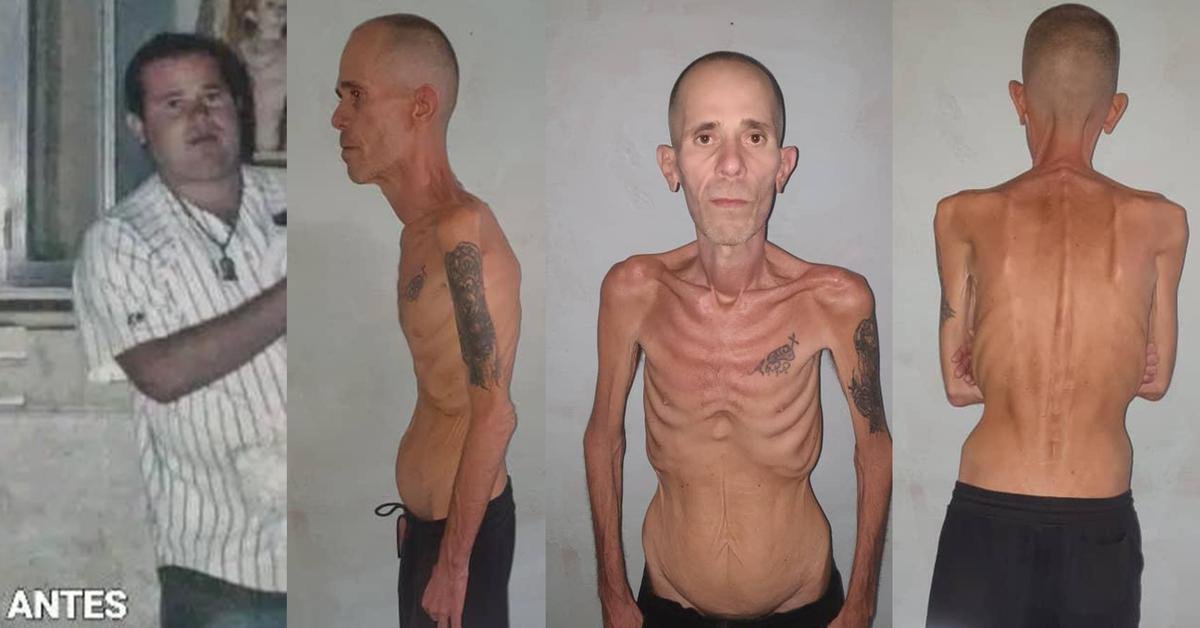
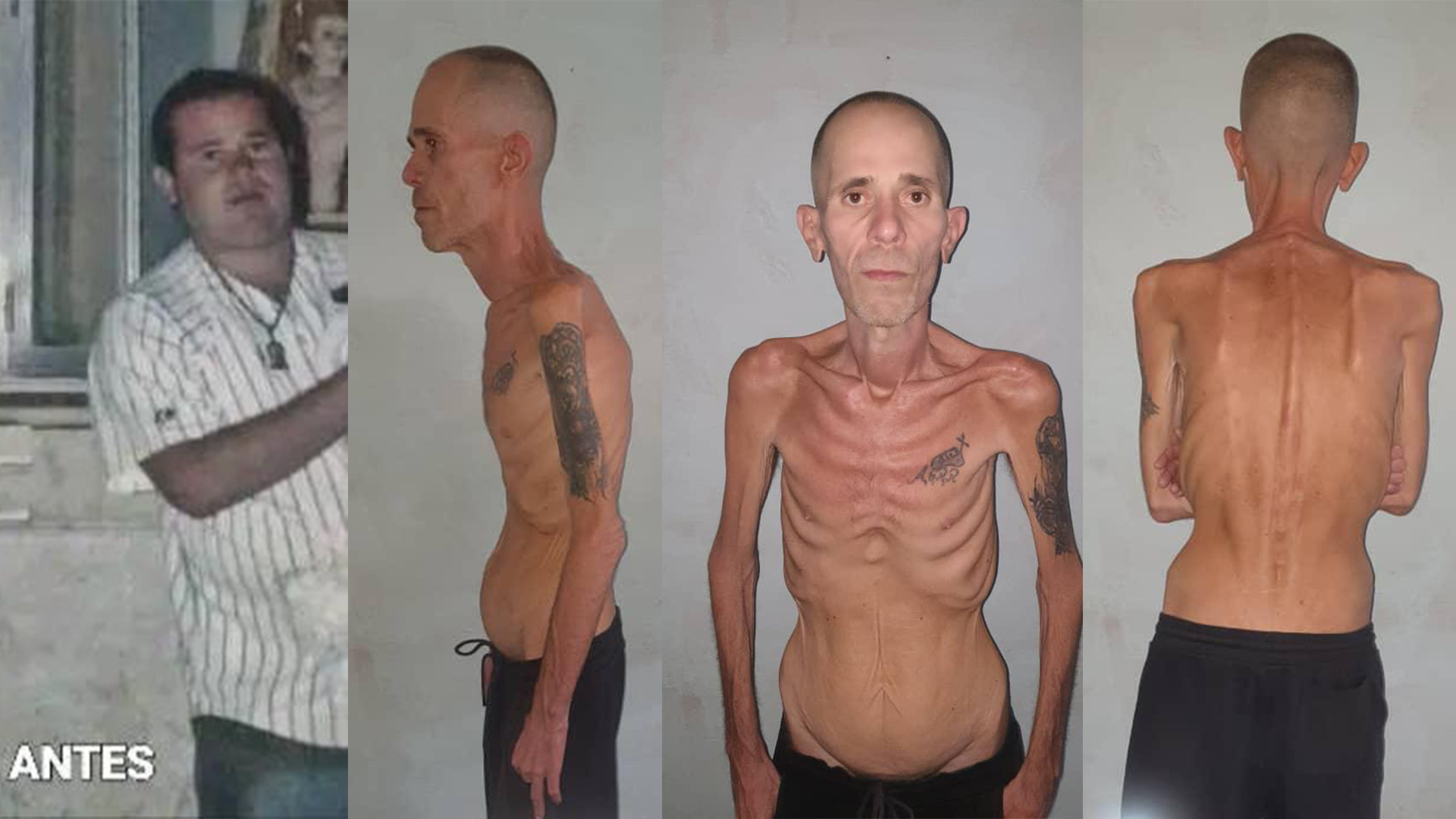
Havana/The Cuban opponent Alexander Díaz Rodríguez was released from prison on April 4 in Artemisa after fully serving a four-year prison sentence after demonstrating peacefully on July 11, 2021. The state of physical deterioration and malnutrition in which he was after his release highlights the levels of mistreatment to which prisoners of conscience are subjected in Cuba.
“When I saw the state he was in, I noticed what I have seen on other occasions in prisoners when leaving Cuba: they look like they were rescued from a concentration camp,” he told 14ymedio Javier Larrondo, president of Prisoners Defenders (PD), whom Díaz Rodríguez contacted by video call as soon as he left prison.
The photographs of the activist taken after his release, which Larrondo asks to share despite their harshness, speak for themselves. “I couldn’t believe it. I wanted to congratulate him but I was talking to a human being in his bones, completely destroyed,” says Larrondo.
During his imprisonment, in 2022, Díaz Rodríguez was diagnosed with cancer of thyroid in an advanced stage, but at no time did he receive adequate treatment. Added to this was the subsequent suffering from hepatitis B, anemia, inflammation in the extremities and a progressive state of malnutrition.
“We knew that he was fatal and we have fought for his life for years. He has requested extra-penal licenses, we have taken his case to the United Nations… but the Cuban regime has made him serve the entire sentence,” the PD president adds about his case.
There were numerous complaints about his deteriorating state of health and the irregularities that surrounded the entire judicial process against him.
In fact, during the sentence of the now 45-year-old former inmate, there were numerous complaints about his Deteriorated state of health and irregularities that surrounded the entire judicial process against him. According to family and independent organizations such as Justicia 11J, Prisoners Defenders and Cubalex, the political prisoner was deprived of medication and specialized care. On several occasions he had to be rushed to the Abel Santamaría hospital in critical condition, even vomiting blood, but he was always returned to prison without guarantees of treatment.
Despite his condition, he was subjected to forced labor. The former political prisoner declared that he was forced to work to access a less severe regime, despite his physical condition, and that by refusing to collaborate with State Security he lost prison benefits, including the reduction of sanctions.
The allegations also include physical attacks: in 2024 and 2025, his mother reported that he was beaten by prison officials. In addition, he was the target of threats so that his family would stop reporting on social networks. He also suffered constant interrogations and arbitrary restrictions, such as the withdrawal of his work in prison after refusing to collaborate with State Security.
Despite his critical condition, the authorities refused to grant him an extra-penal license. The refusal was based on his status as a “counterrevolutionary.”
Despite his critical condition, the authorities repeatedly refused to grant him an extra-penal license. According to his family, the denial was based on his status as a “counterrevolutionary,” despite meeting the medical requirements to access this benefit.
Díaz Rodríguez was arrested during the 11J protests in Artemisa and remained in provisional prison until his trial. On December 27, 2021, the Popular Municipal Court of Artemisa sentenced him to four years in prison for the crimes of contempt and public disorder.
Prisoners Defenders presented the case before the UN Human Rights Council as part of the collective complaint “1,000 Cuban Families vs. Cuban Government.”
This document claims that Díaz Rodríguez’s process was plagued by legal irregularities. Among them, the imposition of preventive detention without judicial intervention and the lack of access to an independent defense, when represented by lawyers from the National Organization of Collective Law Firms, subordinate to the State.
The document also points out the absence of judicial impartiality and the use of questionable evidence and testimony, mostly coming from state officials, and the complete dismissal of defense witnesses.
Cuba has established itself as the country with the most convictions for arbitrary detention in the world according to the UN Working Group (WGAD)
The court used subjective assessments such as “social misconduct” or “destabilizing actions” to justify the severity of the sentence, which reached the maximum limit provided. According to the complaint by Prisoners Defenders, these expressions, included in the sentence, show a political bias and a lack of neutrality incompatible with international standards.
The images, spread among activists and opponents, were also shared by the leader of the Patriotic Union of Cuba (Unpacu) José Daniel Ferrer, who publicly denounced the situation through a video on social networks, and recalled the situation of other prisoners of conscience who also suffer mistreatment, such as Roilán Álvarez, Luis Manuel Otero Alcántara or Félix Navarro, among the 1,213 political prisoners that Prisoners Defenders reports as of today.
Meanwhile, Cuban President Miguel Díaz-Canel, in his recent interview with NBChas once again denied the existence of political prisoners on the Island: “This image that, in Cuba, we put anyone who speaks against the revolution in prison, is a lie.”
The UN has shown that the arrests are political in nature and violate fundamental rights of expression and assembly
Prisoners Defenders reports that Cuba has established itself as the country with the most convictions for arbitrary detention in the world according to the UN Working Group (WGAD). The UN has shown that the arrests are political in nature and violate fundamental rights of expression and assembly.
Javier Larrondo also remembers that according to the latest report of the United Nations Committee against Forced Disappearances, Cuba is the fourth country in the world in urgent actions for this crime, only behind Mexico, Iraq and Colombia. Unlike these countries, he points out, in Cuba forced disappearances are attributed directly to the State.