What do a local portal from the interior of Venezuela and an international media like Sputnik have in common? More than it seems: Both may end up publishing, almost at the same time, the same story aligned with the ruling party.
The first installment of #LaMaquinariaDelEco, Conducted by ProBox, Cazadores de Fake News, Economía Cocuyo and Medianalisis, it identified 44 media outlets and portals that replicated the same narrative frames inside and outside Venezuela. That discovery opened a new question: how that network works and what makes it so effective in projecting official Venezuelan propaganda to different audiences.
To answer it, this second installment focuses on the national and international structure that supports this amplification. Based on semantic analysis, content comparison and social listening, an architecture organized by layers was identified, in which different actors fulfill specific functions: Some produce the initial framework, others replicate it within the country, others translate it and others legitimize it and project it outside of Venezuela.
In January 2026, this machinery was activated around figures such as Nicolás Maduro and Delcy Rodríguez, promoting narratives of victimization and resistance that crossed state media, related portals and platforms in Russia, China, Iran, India and even the United States. What follows is the map of that structure and how it interconnects to achieve its purpose.
What the findings reveal #LaMaquinariaDelEco It is not only a repetition of content between different media with the narratives of the Venezuelan government, but an organized amplification structure. The coincidences in headlines, key phrases and interpretive approaches show that this network does not operate as a sum of isolated reactions, but as an ecosystem that distributes functions between different actors and levels.
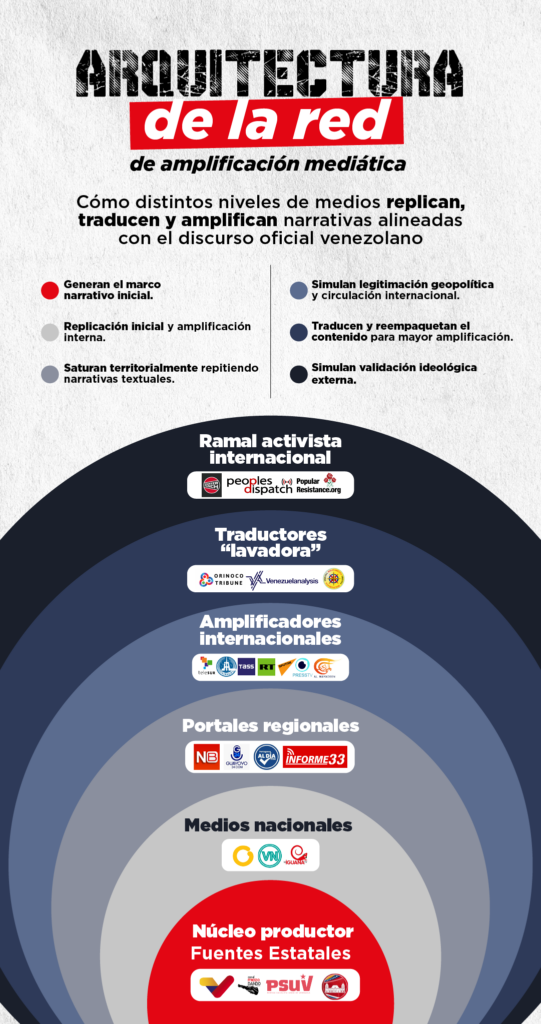
The previous graph summarizes the architecture of the media ecosystem identified in this research. Each layer plays a different role:
- Production core – state sources: generate the initial narrative framework and they define the terms with which what you want to communicate is interpreted. Highlights include media, government representatives and government entities, including: Venezuelan Television, “With the Gavel Giving”he United Socialist Party of Venezuela (PSUV), communications, official spokespersons, among others.
- Internal amplification – national media: replicate the content produced in the core and expand their reach within the Venezuelan media ecosystem. Some notable examples are Globovision, The Universal, TOVenezuela News agency, The Iguana TVetc.
- Internal saturation – regional portals: reproduce contents almost identical to those published by the national media, generating territorial saturation and perception of consensus internally narrative. Some of these are Barquisimeto News, Guayoyo 24, Al Día Portuguese, Falcon Report 33among others.
- International amplifiers: expand the circulation of speech outside Venezuela and contribute geopolitical legitimation to the story. The most notable are teleSUR, Xinhua, TASS, Russia Today, Sputnik, PressTV, Al Mayadeen, inter alia.
- «washing machine» translators: translate and repackage the content for international audiences, diluting the initial origin of the speech. Some examples are Orinoco Tribune, Venezuelanalysis, Al Mayadeen, Al Manar TV, Press TV, inter alia.
- International activist branch: spread and legitimize narratives within political, academic and activist circuits in the international debate. Some examples are FAIR, CounterPunch, Peoples Dispatch, Popular Resistanceamong others.
More than a sum of related means, in this architecture Some accounts and portals produce the initial narrative framework, others replicate and expand it within Venezuela, and others translate, legitimize, and project it toward international audiences.
This network of layers is not maintained only by the circulation of content between portals. It also depends on two complementary mechanisms: the repetition of the same narrative framework in different media and the cross-validation of actors who cite each other or appear as “expert voices” without exposing their links with the ecosystem, to present themselves as independent.
1. The same narrative framework:
The coherence of this network does not depend solely on certain content being repeated from one medium to another. It is also based on the repetition of the same narrative framework, identifiable in the language used, the actors who stand out and the way in which the events are presented.
This repeated use of the same vocabulary can be understood within a diffusion structure previously documentedwhere the MIPPCI established guidelines and distributed content to align the narratives between state actors, media, allies and networks of linked accounts.
In the publications analyzed, expressions associated with the legitimization of the official leadership and the characterization of US actions as external aggression appeared repeatedly. Among the most recurrent are “President Nicolás Maduro”, “coercive measures”, “naval blockade” and “naval piracy”. The most mentioned actors were Nicolás Maduro, Delcy Rodríguez, Donald Trump, Diosdado Cabello, Jorge Rodríguez and Miguel Díaz-Canel, accompanied by institutional references to China and Russia as sources of geopolitical legitimation.
At the international level, media such as teleSUR, Extra News World, TASS, Xinhua, PressTV, RT, Al Mayadeen, Al Manar and Sputnik Worldalong with English-language platforms such as Venezuelanalysis, FAIR, CounterPunch and Monthly Review Onlinedid not necessarily replicate content literally, but rather shared the same conceptual package to describe events as terms associated with the idea of “kidnapping“, “offices presidential“, “violations of international law“coercive measures” and “military attacks”.
Within this set, teleSUR concentrated a high production of content on the same topic to reinforce the story from different angles. For example, 29 articles associated with the narrative of oil appropriation Venezuelan, 13 on the support of strategic allies such as China, Russia, Cuba and Iran and 11 focused on delegitimization of the Nobel Peace Prize awarded to María Corina Machado.
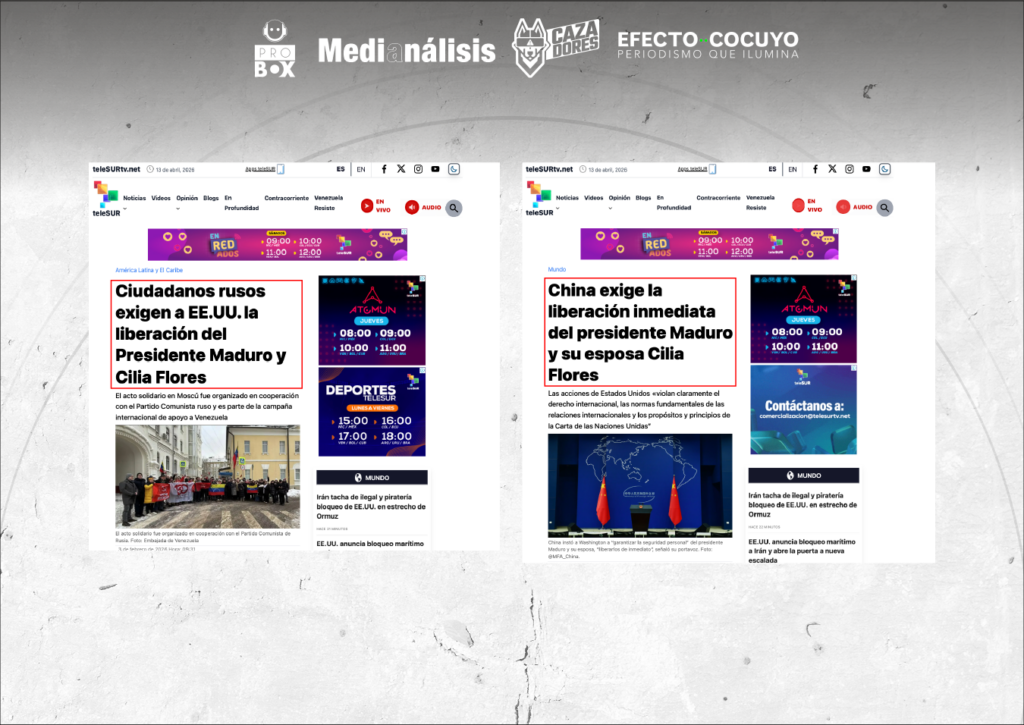
On English amps a relevant semantic shift was observed: the “capture” narrative was replaced for terms like “kidnapping” either “abduction” transferring the fact from the judicial level to that of an illegal aggression.
In addition, In regional portals, a repeated pattern of quotes from official sources was detected, without alternative contrast, and almost mechanical repetition of expressions like “US Aggression” (examples: 1, 2, 3, 4, 5, 6, 7, 8 and 9), “Kidnapping of President Nicolás Maduro” (examples: 1, 2, 3, 4, 5, 6, 7, 8 and 9) and references to “honor” wave “loyalty” to the government (examples: 1, 2, 3, 4, 5 and 6). More than isolated coincidences, This recurrence of sources and formulas contributes to establishing the same perspective in the coverage.
Although each medium introduces nuances according to its audience, Overall, the circulation of the same approach in different geographical contexts is observed.
2. Spokespersons to legitimize the story:
Architecture does not only distribute content. Also projects spokespersons that help validate those narratives outside the original ecosystem.
This is achieved with the presence of actors linked to proxy or disinforming media that are aligned with the official discourse, presented as analysts or “independent experts”, especially on international platforms. In these cases, their editorial links with other portals are not made explicit, which introduces an appearance of external authority and reinforces the legitimization of the story before new audiences.
This mechanism is related to a report on propaganda and disinformation practices in Russia, published by the State Department’s Global Engagement Center, described as “cross-fertilization”: the circulation of authors and columnists between different media that appear to operate independently, but share orientation and ecosystem.
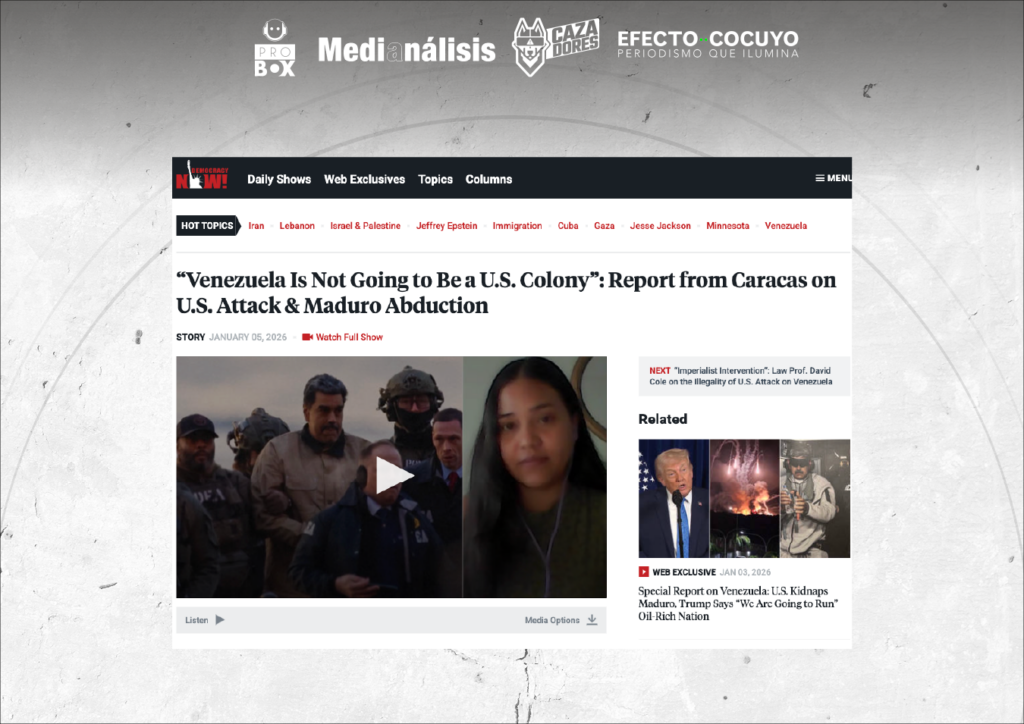
An example is Andreína Chávez, journalist linked to portals aligned with the official discourse (such as Venezuelanalysis, Drop Site, Benchmark and Trinidad Tobago News), presented as an “expert source” in international spaces such as Democracy Now! and later cited by media such as Z Magazineamplifying his interpretation of the events framed in the “kidnapping” of Nicolás Maduro and Cilia Flores beyond the original circuit.
Similar with Alvaro Suzzarini, cited as “historian” in articles by Truthdig to comment on speculation related to Maduro’s capture, without mentioning that he is the current editor of Venezuela News Magazine.
The reuse of sources within connected platforms reinforces this dynamic. Ricardo Vaz, editor of Venezuelanalysishas published in FAIR citing content from the medium he directs, generating a circuit where source and analyst belong to the same environment.
More than isolated cases, these omissions help present certain interpretations as independent analyses, when in reality they are part of the same narrative circuit. Thus, the network not only exports stories, it also exports voices that contribute to legitimizing them.
Taken together, the findings of #LaMaquinariaDelEco show that these are not editorial coincidences, but rather a organized amplification structure of information, where different actors fulfill specific roles: some produce the content, others replicate it locally, and others adapt it and project it internationally. This dynamic allows The same story spreads quickly, is reinforced at various levels and ends up generating a perception of consensus inside and outside the country.
This operation becomes especially relevant in a restrictive information environment, marked by censorship and communication control, where These dynamics end up shaping public conversation and, in part, the perception of events. The recent report of“The vigilantes in the crosshairs: technologies for political control in Venezuela”documents that an infrastructure of surveillance still active, based on monitoring content on networks, interception of communications and video surveillance systems that reinforce political control and limit civic space.
This context is also characterized by media locks, restrictions on access to independent information and sustained pressure on journalists: the proxy media and portals aligned with power find fertile ground to expand, present themselves as alternative sources and be perceived as legitimate or “independent” by the audience.
This control architecture does not replace the amplification network described, but is articulated with it: while one limits access to independent information, the other occupies that “vacuum”, facilitating circulation, repetition and normalization in the way in which narratives are positioned that end up influencing public perception and the legitimation of power.