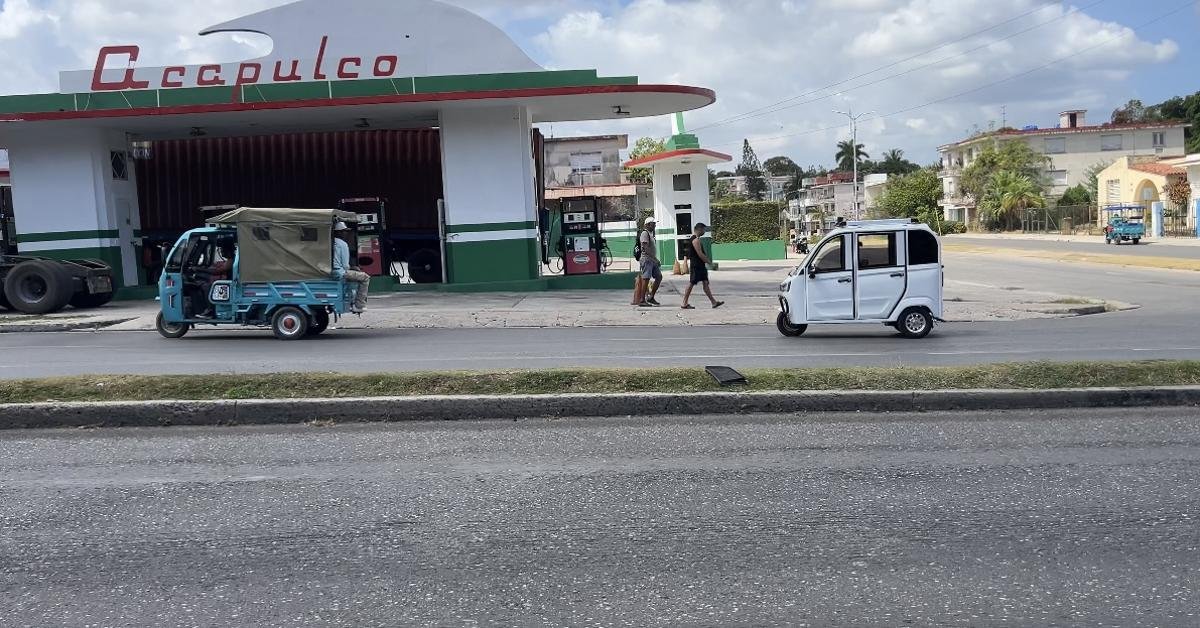
Havana/“I am observing a transition towards the mipymerized privatization of the Cupet,” a user of the Ticket application denounced last week. A tour of the gas stations in Havana seems to confirm this situation, at least at the Acapulco service center, on 26th Avenue in the Nuevo Vedado neighborhood. The authorities, however, remain completely silent about it.
Acapulco employees do not reveal to which private company the gas station has been rented, but they say that “only the businesses of that MSME are being supplied.”
The truth is that 11 days have passed since the last shifts opened for the app Ticket to buy fuel in dollars at the few gas stations that continue to operate in Havana and seven since the same has happened with those in Matanzas, the two territories with the most Cupets operating. Since then, the State has only offered appointments for Villa Clara (420), Cienfuegos (50 to distribute in four days) and, above all, Sancti Spíritus (405 in six days). Taking into account that service centers cannot sell more than 20 liters per shift, it means that in the last week in the country there has only been available to the public – there is a part, much larger and in pesos, reserved for state vehicles – the ridiculous amount of 17,500 liters, about 1,500 on average per day.

/ 14ymedio
Most gas stations in the capital are closed and, however, an increase in vehicle traffic is evident at least since Friday and in Havana. Above all, compared to days ago. Where does the fuel come from? It does not come, that is clear, from the cargo left in Matanzas by the oil tanker. Anatoly Kolodkin two weeks agosince not only would that Russian crude oil take at least 20 days to convert into diesel, but only a minimal part of it, already refined, is destined for gas stations, as the authorities themselves announced.
Discounting the tanker – and the strategic military reserve or other unknown deposits, possibly underground –, it remains to point to fuel imports by private companies. In the report published by the US-Cuba Economic and Trade Council (Cuba Trade) this Wednesday, it is reported that in February, once the Donald Trump Administration added fuels to the list of products authorized for export to private individuals on the Island, there were purchases of diesel and gasoline for a value of 2,573,594 dollars.
/ 14ymedio
John Kavulich, president of Cuba Trade, has said to American media that there are only six companies that are carrying out fuel exports to Cuba so far. They do it, says the executive, through isotanks (tank container) that depart mainly from Texas, Louisiana and southern Florida.
Companies operate with a profit margin of between 20% and 25%, says Kavulich. The product most shipped in February from the United States to the Island was diesel: 68 shipments for a total of more than 18,000 barrels. Information on gasoline exports also appears in the public statistics of the US Census Bureau, but in a limited way: there were three shipments valued at $161,100 that month.
It is assumed that, as approved by the Donald Trump Administration, only private companies within the Island can import the fuel, but experts such as Jorge Piñón, a researcher at the Energy Institute at the University of Texas, doubt that this can be guaranteed. “There are not countless federal police or FBI agents walking all over Cuba to ensure that these isotanks they are sending are used 100% in the private sector,” the specialist declared to Telemundo. “The question we have is who is guaranteeing that these rules of the game are carried out.”
/ 14ymedio
Piñón expressed the same thing recently, in a virtual conference organized by Cuba Study Groupin which the Cuban economist Ricardo Torres also participated. Who can control that this fuel is not reaching state entities? the researcher asked.
This Friday, a conversation caught on the fly by this newspaper in one of the service centers was revealing. “They give the state companies 10, 20, 30 liters a month, and basically they are selling it all,” said one driver to another, who nodded: “Imagine, if they sell everything they get 50,000 and even 100,000 pesos, like ten times their salary.”