¿Retaliation or non-compliance with maritime regulations? This is the debate regarding the arrests of Panamanian-flagged ships by China.
The US Secretary of State, Marco Rubio, suggested that the detentions of Panamanian ships in China are retaliation for the cancellation of the contract with the CK Hutchison subsidiary. Expert sources maintain that the background is regulatory: Panama appears on the “medium risk” list of its main trading partner, which legally justifies the increase in scrutiny and detentions of its fleet.
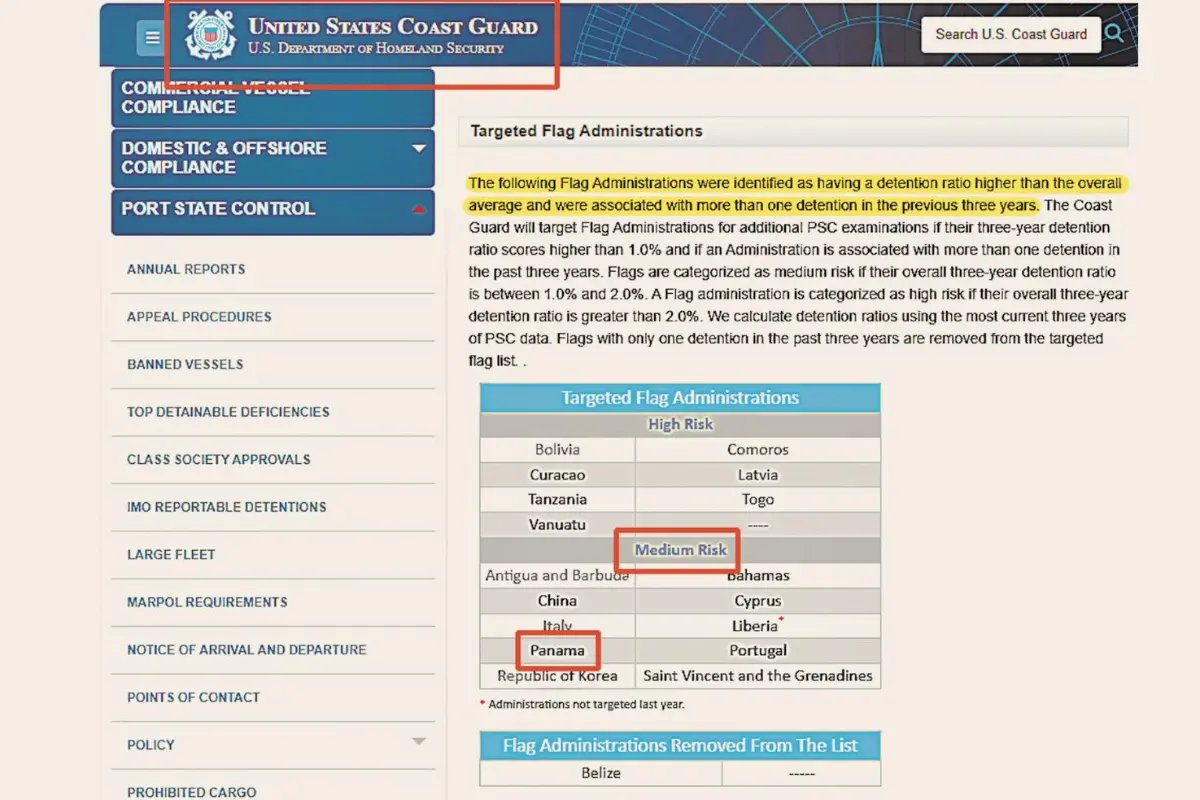
The most recent report from the Port State Control program of the United States (US) Coast Guard classified Panama in the medium risk category, due to its detention rate of 1.33% in the period 2022-2024.
The report was prepared after more than 8,700 inspections of ships from 79 countries, details the annual document of the Commercial Vessel Regulatory Compliance Office.
According to the data in the document, Panamanian-flagged vessels were subject to 1,270 inspections in US ports, of which 274 presented deficiencies, and 13 detentions were recorded. In total, these vessels made 1,598 different arrivals during the evaluated period.
With this data, 1.33% of the stop radius percentage was calculated, according to the flag management compliance performance statistics of the report.
This means that flags with a detention rate between 1% and 2% are considered medium risk, an intermediate category that does not imply automatic sanctions, but can affect the levels of scrutiny to which ships are subjected in foreign ports.
As for organizations recognized to carry out inspections of Panamanian registry vessels, the document also evaluates the performance of entities such as the Panama Maritime Documentation Service, which registered a detention rate of 1.11%, while others, such as the Panama Bureau of Shipping and the Panama Maritime Surveyors Bureau, did not report detentions in the period analyzed.
The Star of Panama consulted the Maritime Authority of Panama (AMP) about the scope of this qualification, its possible causes and the measures contemplated; However, as of the closing of this edition, no response had been received to the questionnaire sent since last Thursday.
This “Medium Risk” rating “is not serious, but that does not mean that it should not be addressed and improved,” according to the criteria of the former director general of the Merchant Marine of the Maritime Authority of Panama, Guillermo Márquez Amado.
It is an evaluation that covers various aspects and international standards related to safety and 30 or 40 years ago, the lawyer also recalled, Panama’s merchant marine had very little recognized international safety conditions and after substantial efforts it is among the merchant marines that it is within the best standards.
And the Panamanian flag, with 8,710 registered vessels, appears in the medium risk report along with its main competitor Liberia and Italy, with detention percentages of 1.13% and 1.99%, respectively.
The other countries listed at medium risk are Portugal, Republic of Korea, Saint Vincent and the Grenadines, as well as Antigua and Barbuda, Bahamas, China and Cyprus.
“Italy is a maritime country par excellence. If it has a medium risk and is the same as Panama, it means that we are not so bad. That does not mean that we should not improve. I come back and insist on that,” highlighted the former official.
While the list of high-risk countries is made up of Comoros, an East African country, with an arrest percentage of 50%, followed by Latvia with 33%, Bolivia, with 13.64%, Tanzania and Togo with 15%, Curacao with 7.64% and Vanuatu, in Oceania with 3.54%, between 2022 and 2024.
This qualification coming from the country that promoted the creation of the Panamanian open registry reduces the competitiveness of an activity that contributes $112 million in income to the National Treasury, without considering the economic impact of the business, experts agree.
The registry is ‘hit’
“It seems that these lists are being converted to discriminate or hit open registries because they are ‘targeting’, hitting the country, the registry” and causing more detailed inspections to be carried out on Panamanian flag vessels,” said Demóstenes Sánchez, former deputy director of the Merchant Marine of the AMP.
Sánchez explained that the registries do not manage ships, so detentions are not the responsibility of the registry but rather the technical conditions of the ship, which is the responsibility of the shipowner.
The maritime expert also explained that the US evaluation had an unfair way of measuring and that Panama’s ratio of 1.33% is low “if you compare the number of inspections with respect to detentions.”
He added that a flag should not be “stigmatized for individual faults,” since port control evaluates ship by ship.
Now it remains to be seen if in the next report, that of 2025, which must be published in the second quarter of this year, Panama leaves the risk list just as Belize did.
In the penultimate report of the US Coast Guard, that of 2023, Panama already appeared as a medium risk with a 1.25% radius of arrests between 2021 and 2023; In this report the arrests were also higher: 25.
And in a turn of the wheel, sailing from the US to Europe in the Mediterranean, on the list of the Paris Mou, of the Port State Control, Panama is on the gray list (until June 30, 2026) with 390 arrests between 2022 -2024, the annual report reads.
While last March 100 Panamanian ships were stopped in various Chinese ports, which caused the Chancellor of the Republic, Javier Martínez Acha, to recently demand respect for the legal sovereignty of Panama.
“As a result of the ruling (which canceled the contract with CK Hutchison) our Panamanian merchant navy has registered an increase in inspections and detentions of ships flying the Panamanian flag in ports of the People’s Republic of China,” the chancellor warned.
According to data from the Tokyo Memorandum, at least 18 Panamanian-flagged vessels were detained in the first week of April.
For his part, President José Raúl Mulino minimized these arrests, pointing to maritime security reviews.
“As a maritime lawyer, it is not usual…we want to see the validity and basis of these arrests, they have nothing to do with political retaliation, perhaps they want to intensify the review of the ships from the point of maritime security,” Mulino said last week.
The opportunity for improvement
The reality for René Gómez, president of the Maritime Chamber of Panama, is that there is “a trend” of greater detention of ships, 60% from China and the difference from the rest of the countries with which we do not have any situation like the Panama Ports Company.
“Yes, there is a situation with those ships of ours and they have deficiencies,” he said.
It is an accumulation of things, certifications, some issues of pollution regulations, so the country must consider the opportunity for improvement with the increase of technical personnel and for them to have an administrative career so that they grow in the specialty in the AMP, in addition to acquiring better digital tools.
Gómez also commented that due to the greater number of ships compared to other flags, the possibility of an arrest is high, “but it is not that because it is a large flag we have to be detained. We must anticipate in advance that if that vessel presents a deficiency it will be detained.”
“We can take the situation as an alert for re-engineering our flag registry, which is good, but as we have more ships we need personnel and tools,” said the president of the Maritime Chamber of Panama.