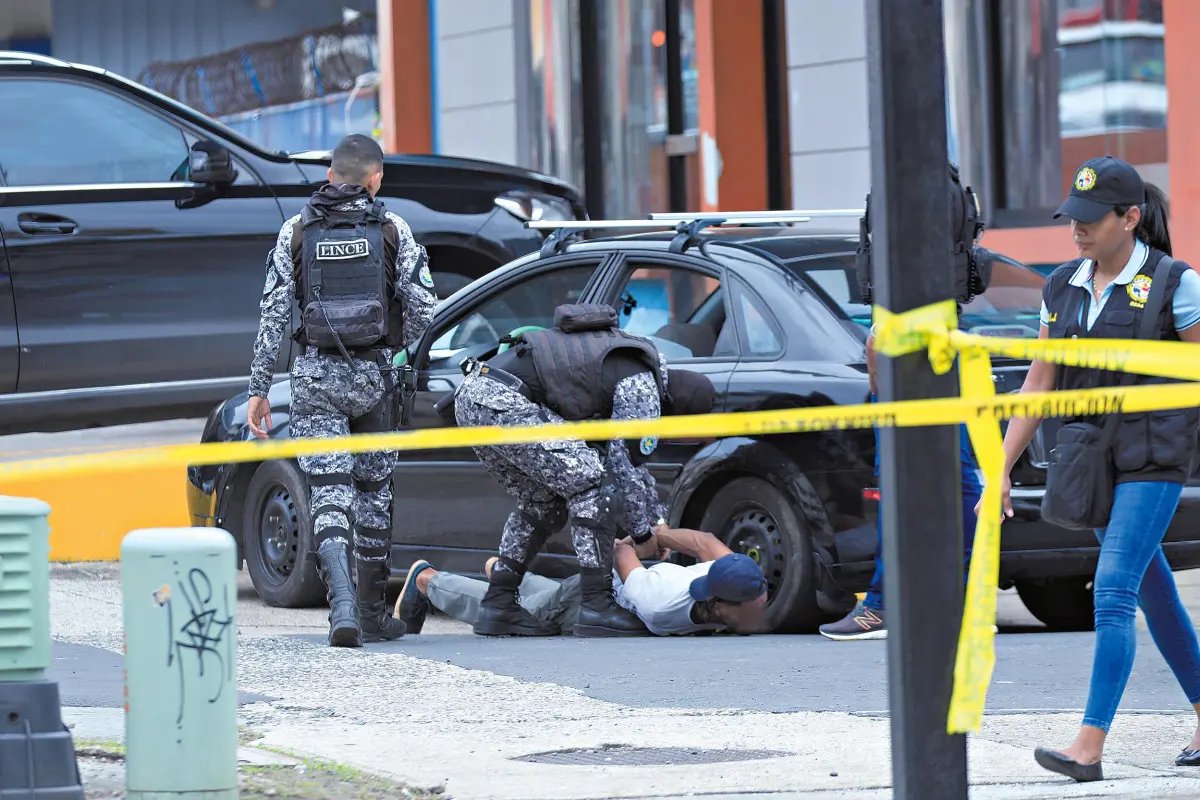
Citizens are concerned about violence and demand answers. National Government authorities assure that homicides are on the decline and that the dead are gang members and members of criminal organizations.
The reality is complex and worrying. It requires, according to experts in the field, a joint approach with the communities that are the main victims of violence as well as the place where many young people who end up becoming criminals come from.
In the first ten days of April, 17 homicides were recorded. In March, the number was 42, according to the count carried out by the newspaper team The Century.
The weekends are particularly bloody. Between Sunday, Monday and Tuesday of last week, 4 homicides were reported in Río Abajo and 4 homicides in San Miguelito.
This Saturday two people died during a shooting in Curundú. On Friday, a taxi driver was murdered inside his car in Colón.
During a press conference last Thursday, the President of the Republic, José Raúl Mulino, was asked about the number of homicides and the security strategy. Mulino passed the floor to the deputy director of the National Police, Francisco Antonio Castro.
“With regard to the issue of homicides, it is important to mention that in a comparison to this date with last year there is a 6% reduction in these cases. The Ministry of Security, the National Police, is making significant efforts together with the Public Ministry to find people who commit this type of crimes,” Castro responded.
But for social researcher Gilberto Toro, who has more than 30 years of experience working in communities and with governments, the story cannot be summarized in a simple percentage, nor should the importance of citizen perception be underestimated.
“If a person’s car has just been stolen from their house, for that person who has just been robbed, even if they say that there is 0.5% there is insecurity in the country, this person is going to say, my car was stolen from my house so the country is insecure. No percentage is going to convince them,” he stated.
The official figures published to date by the Public Ministry are updated until the month of February. According to them, 42 homicides were reported in January and 35 in February, for a total of 77 during the first two months of the year.
This is equivalent to more than one homicide a day in the country.
For the authorities, it is mainly a fight between criminals.
“It is important to mention that a very high percentage of these events are due to people who have their income illicitly, in different ways. That is why we are also carrying out a reinforcement in all the police areas that are showing us an uptick in these cases with police presence in the hands of the other security forces as well and the Public Ministry to be able to prosecute those organizations that are dedicated to these events,” explained the deputy director of the National Police.
For Toro it is not about rediscovering the wheel. Over the years different governments have used different strategies. In his province of Colón, he remembers that the “carrot and stick” strategy was successful, through which on the one hand the National Police exercised its role in punishing crime and at the same time worked with community leaders to prevent young people from falling into criminal groups and help those who were in gangs to develop legitimate skills and trades. The communities were held accountable for the work the police did and in turn the community worked with them. From the aunt who knew the gang member as a child, to the neighbor who watched him grow up, these figures are key because even those who are in the gangs can respect them.
The problem, Toro laments, is that the link with the communities has weakened.
“Here in Colón, we developed a prevention plan three years ago, a pilot prevention plan in Altos de los Lagos to later work on a provincial proposal and it is simply in the freezer,” lamented the social researcher. He warned that the impact of social intervention should not be underestimated. “You approach the group, you gain the trust of the group and you manage to do very technical and specialized work, which has nothing to do with barter, nor with blackmail, nor with changing anything. This is a process that is carried out with the person, a process of social transformation,” he explained.
During the administration of President Mulino, 19 days of the Weapons and Ammunition for Food, Medicine and Appliances program have been held. In fact, this Monday the 13th another one will be held from 8 am to 3 pm in Plaza 5 de Mayo.
But Toro warns that bartering weapons for food isn’t really effective. “That doesn’t work, because I can hand over my weapon, the one that is involved in an assault, and tomorrow I have a new one. What moves here in Panama are weapons,” he commented.
The key, he points out, is to go beyond barter programs, summer soccer leagues or painting courses. What is needed is constant monitoring, that transcends governments and officials, that recognizes the voices within the community and empowers them.
“While they say that crime is organized, society is disorganized. So, this is a fight that is not being won, but rather is being lost. Many people who want to participate at the national level are looking to the sky because it does not count and no one is going to give what they do not have,” said the expert. “The murders, the hitmen, which were previously exclusive to foreigners, are now local. All of this has evolved. While we, everything we work on at the prevention level, we have nothing left to do but observe,” he noted.
As criminal organizations grow worldwide, crime also becomes more sophisticated. “When you see the resources they have, there is no way to be competitive. You are offering them a course in a cabinetmaking workshop, they are being offered for a job, for a hitman, for participating in a single blow, up to a thousand (dollars) in one day,” Toro explained.
The budget assigned to the Ministry of Security for 2026 is 985 million dollars. Of that total, 784.3 million are for National Public Security. The efficient use of these resources, not only for repression but also for prevention, will be key to achieving a safer Panama.