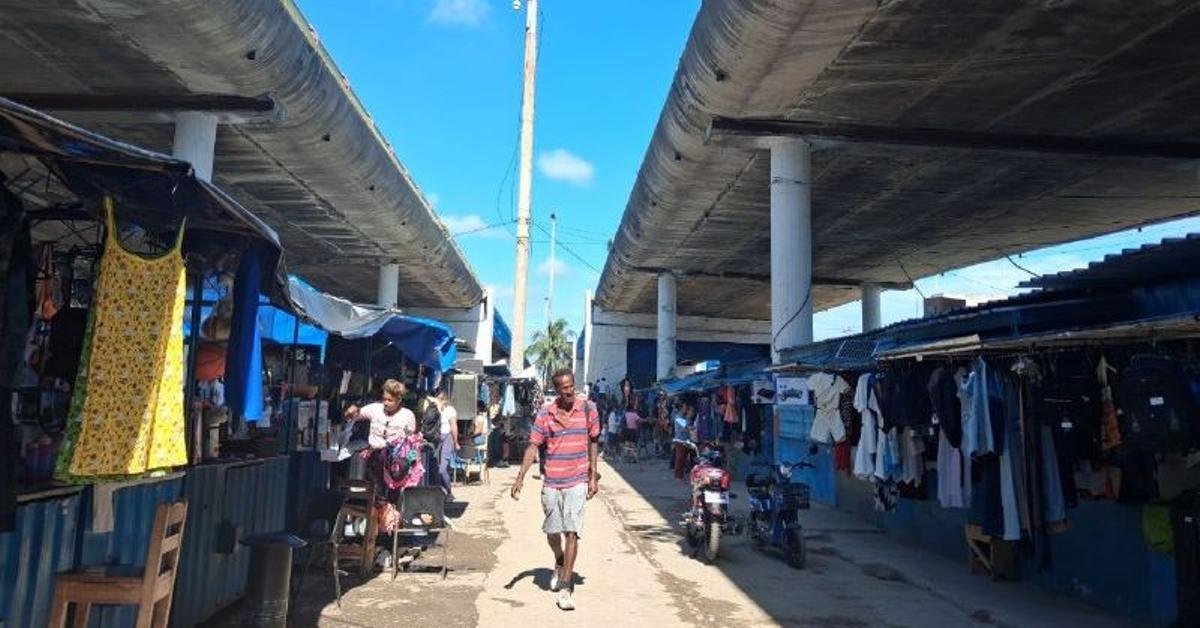
Havana/This time the route is south. I must get to the fair that extends under the elevated bridges of 100 and Boyeros in Havana. My eternal search for a piece to repair leaks brings me closer to one of the main open-air markets in this city. “We have everything here,” reads a sign that I find in a kiosk at the entrance of the candongawhere you can buy antibiotics as well as solder.
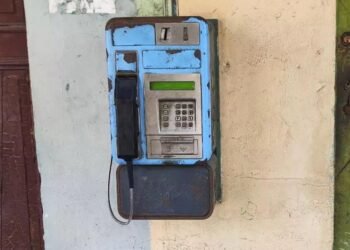
There is no internet connection anywhere along the way to the fair and, for stretches, the mobile signal is not even picked up to make calls. We Cubans have come to the conviction that chatting with friends, watching reels or posting on Facebook is becoming a thing of the past. Too bad X no longer has the ability to post via text-only messages (SMS) as was possible on the old Twitter. We have even lost the smoke signals.

/ 14ymedio
Disconnected but with a quick step I approach the elevations. If during the entire trip I had only bumped into half a dozen people, as I get closer to the market the panorama changes. There are more people on 100 and Boyeros than on 23 and L, the iconic corner of the Rampa, in El Vedado. The crowds that no longer surround the cinemas, clubs or the Coppelia ice cream parlor seem to have gathered around the stalls offering instant glue, clothing and tools.
By selling, you even sell a company. Stationed at some points in the market are women and men in tight clothing and flirtatious looks. Here they trade in rice cookers and caresses; with dishwasher and with sex. None of those who prostitute are over 30 years old. They did not even try to make that generation the “new man”, rather they left it stranded in classrooms where the television replaced the teachers. They are the ones who mostly fueled the protests of July 11, 2021 and also the ones who went to jail the most after those demonstrations.
I go between the kiosks. Above my head the bridges that once roared with the passage of trucks and buses are now almost silent. Life is below. Tamales, soft drinks, motorcycle helmets, trash cans, plastic trinkets and the cries of “I buy gold” or “I buy dollars” resonate everywhere. There are narrow corridors, surrounded by stalls made of zinc plates and other more sophisticated ones that have been erected with bricks. At one point I get lost in that labyrinth.
/ 14ymedio
I finally find the sifa sink (siphon) that I need and I decide to look into other pieces. To avoid confusion, in a market where there are people from all over Cuba, I approach a seller and tell him from a wheelbarrow, “Do you have a battery-key-pen-sink-faucet?” The mix of regions and the many ways of naming the same object throughout the Island prompt me to emphasize what it is about. The man lets out a laugh at my excessive precision. “I ran out, but I’ll bring more tomorrow,” he replies.
I start the return. On the way I pass by the Boyeros and Camagüey markets where food and basic products are sold in dollars. The interior smells of spoiled meat, probably thawed by long power outages. The refrigerators are practically empty and an employee asks me to take a count on my cell phone calculator because they are prohibited from entering the store where they work with a cell phone.
The phone we carry in our pockets is becoming more and more useless. The foreign currency trading workers are not allowed into the premises and when I follow the path to my house, mine barely works. At the height of the Ciudad Deportiva, nostalgia hits me. On the same grounds where The Rolling Stones played live ten years ago, today the grass grows and a couple of abandoned dogs look at me with eyes that beg for something to eat. Only a few electric tricycles pass along the avenue and, very occasionally, an almendrón.
I’m already crossing the Cerro road. From a nearby doorway a man offers me “medications of all kinds.” While the state pharmacies are practically empty, the streets of Havana have become a very well-stocked pharmacy. What customers most offer and seek are antidepressants, anxiolytics, and mood-stabilizing drugs. It seems that three out of every five people who move through the streets are under the influence of some drug.
/ 14ymedio
It is hard to believe that a regime that tries to control every corner of life does not know that in Havana it is easier to get sertraline than pork, diazepam than coffee, amitriptyline than eggs. A friend says that it is “state policy” to make it easier for people to be asleep and sedated. There are those who spend part of their salary on a good amount of pills to transport them to another place where the garbage on the corner does not accumulate so much, prices do not rise every day and their children do not pack their bags to emigrate.
In Tulipán I turn left. I see my building with its huge water tank. I look for my cell phone to call home. Three tries and nothing. Every time the voice comes out saying “the number you are calling is turned off or outside the coverage area”, but I must insist. “We are in blackout,” the voice on the other end finally tells me when I manage to communicate. Isn’t there some pill that can make me grow wings so I can reach the 14th floor without climbing the stairs? I fantasize and start humming what says “cause I try, and I try, and I try, and I try.”