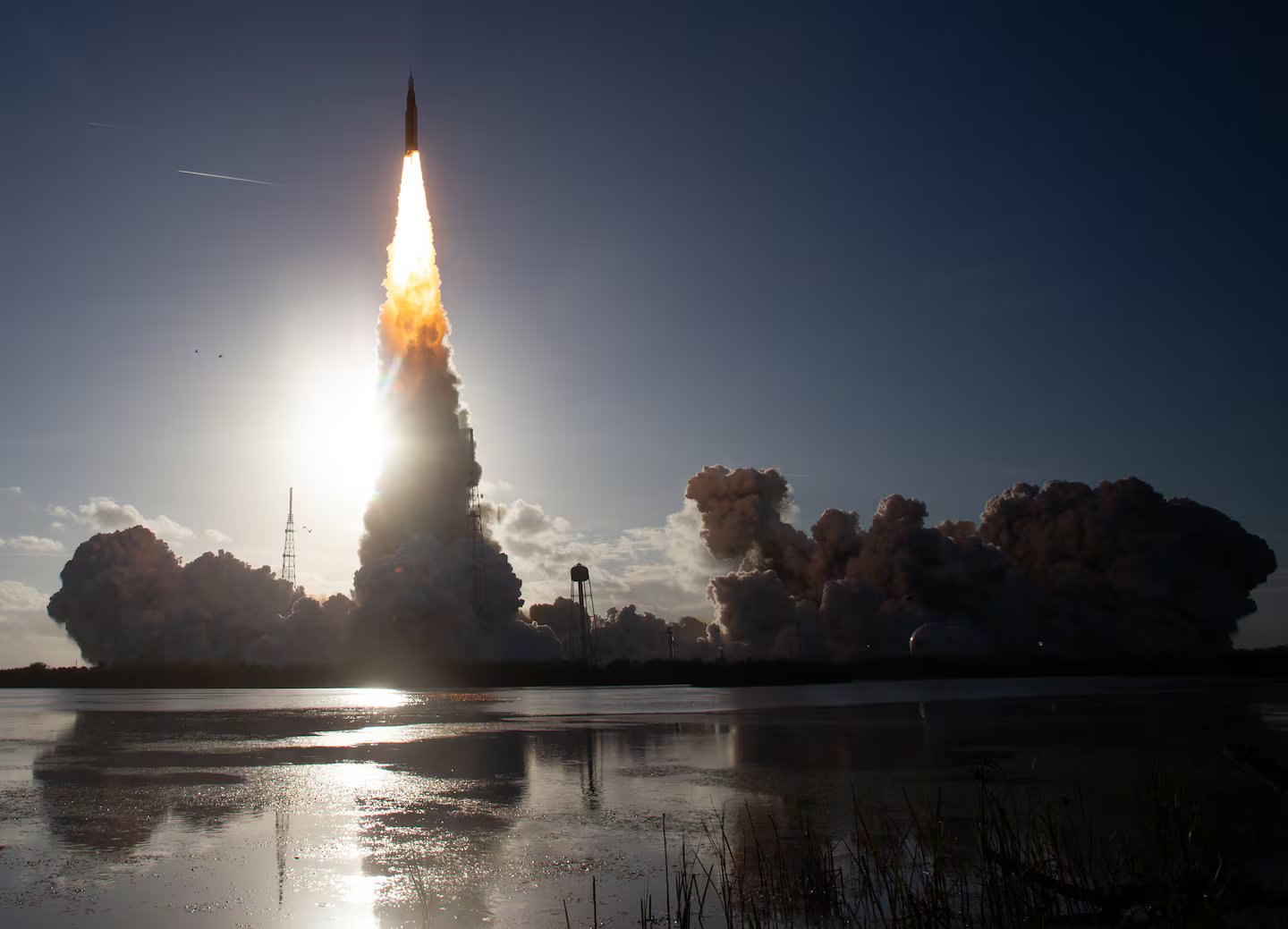
The mission Artemis II It does not need to start engines to return to Earth. The Orion spacecraft’s return journey is defined by a maneuver known as “free return,” which uses the gravity of the Earth and the Moon to guide the return in a controlled manner.
The method allows a spacecraft to circle the Moon and return to the planet without relying on continuous propulsion. The path describes an infinity-like shape and ensures that the capsule maintains a safe return path.
This maneuver was not born with the Artemis program or with Apollo. It was modeled decades before, in the middle of the space race. A 1963 NASA technical report already described these routes as “symmetrical free return” trajectories: paths that allow travel to the vicinity of the Moon and return to Earth without the need for propulsion after the initial impulse.
In fact, the analysis already contemplated failure scenarios. If a critical system did not allow braking to enter lunar orbit, the spacecraft could still circle the Moon and return to Earth under controlled conditions. That logic is what decades later allowed the return of Apollo 13.
The process is as follows: the spacecraft is launched toward the Moon at an angle that allows the satellite to partially “capture” it and redirect it back. Lunar gravity acts as a curve in the trajectory. There is no active braking on the return. The Earth, in the end, completes the process.
This type of navigation responds to a classic physics problem: the three-body system. The ship moves under the simultaneous influence of the Earth, the Moon and, to a lesser extent, the Sun. The result is a stable route, but sensitive to small variations.

From ‘infinity’ to descent: the most critical part
The return does not end with the correct trajectory; rather, the most demanding phase begins there.
Orion will enter the atmosphere at about 11 kilometers per second, faster than any spacecraft in low orbit. The energy it must dissipate is almost double that of a return from the International Space Station.
This speed generates temperatures higher than 3,000 °C. The air is ionized and forms plasma around the capsule. For several minutes, communications are interrupted.
According to researcher Chris James, expert in hypersonic aerothermodynamics from the University of Queenslandthat moment concentrates the greatest risks: extreme heat, deceleration forces and total isolation of the crew.
To reduce that impact, Orion does not descend in a straight line. It uses a variant of “skip re-entry,” a maneuver inherited from the Apollo missions. The capsule generates aerodynamic lift by entering at a certain angle, which allows it to partially “bounce” in the atmosphere and distribute heat and deceleration over a longer period of time.
Without that effect, the forces could be lethal to humans.
A choreography measured in minutes
Orion’s return does not occur in isolated stages, but as a continuous sequence that transforms a hypersonic ship into a capsule floating in the ocean in less than 20 minutes.
Everything starts before touching the atmosphere. The service module, which carries solar panels and propulsion systems, separates and is lost upon reentry. From that point, the crew is inside the command module, protected by a heat shield designed to withstand extreme temperatures.
The capsule enters an altitude of about 400,000 feet at almost 11 kilometers per second. The air in front of the ship is compressed, heated and turned into plasma. For several minutes, that plasma blocks communications. The ship continues descending without contact with Earth.
When it emerges from that blackout, it has already lost much of its speed, but it is still traveling at supersonic speeds. At that point, the system begins to decelerate mechanically. First the front cover comes off. The small but critical drag parachutes then deploy: they stabilize the capsule and reduce the initial speed.
At lower altitudes, the main parachutes come into action. There are three of them and they open in phases to avoid sudden tensions. In a matter of seconds, the capsule goes from a violent fall to a controlled descent.
The final impact is not gentle. Orion hits the ocean with enough speed to feel like a dry crash, although within the expected ranges. The structure is designed to absorb that impact and maintain proper orientation.
Once in water, the capsule is not immediately stable. It can swing or even flip over. That is why it deploys an automatic system that straightens it before the arrival of rescue teams.
In less than two hours, helicopters and boats recover the crew and transfer them to the assigned vessel. The journey ends in the ocean, but the mission continues with medical evaluations and data analysis that will define the next steps of the lunar program.