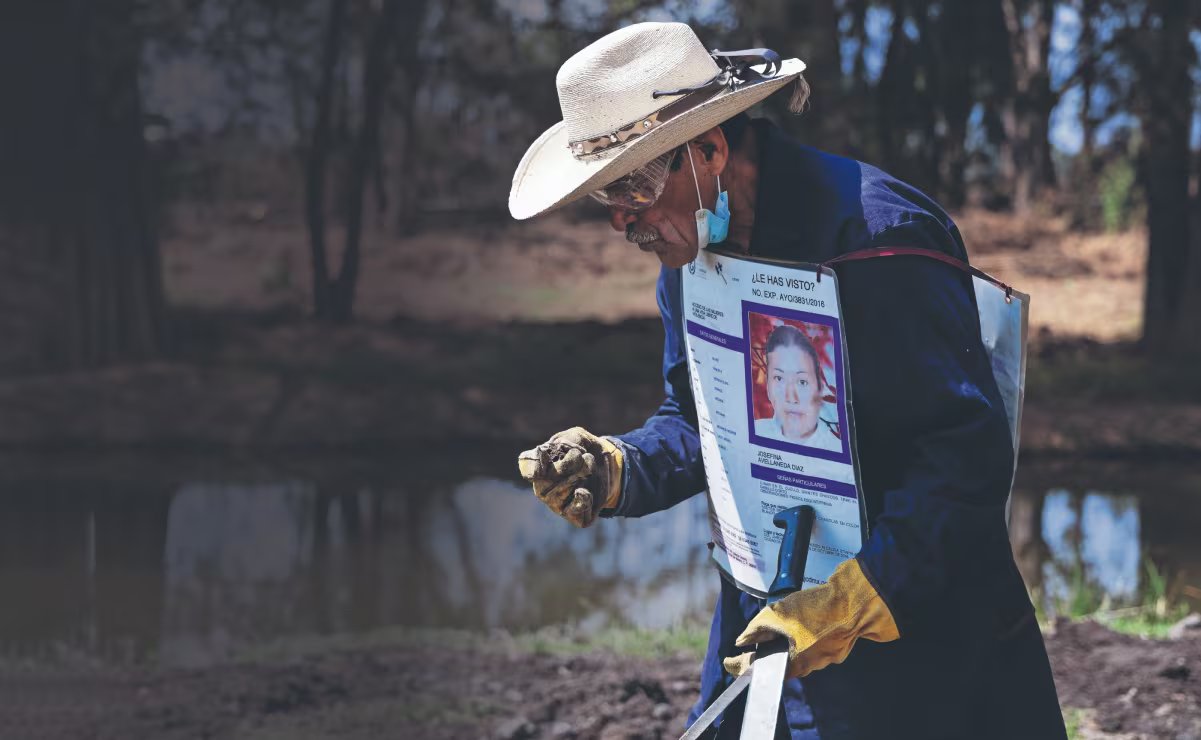
In the swamps of Chalco lakewhere the earth sinks underfoot and the air smells of stagnant humidity, the silence is broken only by the tapping of pickaxes against the ground. There are nearly 40 thousand square meters—an area comparable to the Zócalo of Mexico City—converted into the scene of searchof contained grief and a hope that refuses to disappear.
It is the last day of the tracking day led by groups of relatives of missing personswithin the limits of the Tláhuac mayor’s office and the municipality of Chalco Valley. From early on, women, men and older adults entered the chinampas, black water canals and crops. The terrain: wet, muddy, sticky. Each step requires strength; every advance, determination.
The search was carried out manually. Picks, shovels, rods and rakes replaced any heavy machinery, impossible to use in an area where water and mud dominate the landscape. At least 219 skeletal remains They were located dispersedly.
In 2025, in that same area, they had already been found human remains. The geographical characteristics—isolation, difficult access, presence of water—have made it a recurring point of interest for those searching for their missing people.
The groups A Light on the Path, Until we find them CDMX, Butterflies Searching Hearts and National Justiceas well as independent families expressed their indignation, deep concern and firm demand regarding the discovery of remains of human origin, as it represents the disappearance crisis that counts 132 thousand cases in Mexico.
“We consider that this area is of high interest forensic and should be explored exhaustively in the following days, given the relevance of the findings obtained,” they noted.
They reiterated that all processing, analysis and identification processes derived from this and future sessions must be carried out with the maximum I respectin a framework of effective collaboration and with permanent listening to families.
They demanded full and prompt identification of the remains with complete transparencyas well as timely and continuous access to information on the progress of the corresponding expert reports. “Families have the right to truth, justice and dignified treatment,” they said.
Accompanied by elements of the CDMX Search CommissionSearch Commission State of Mexicopersonnel from prosecutors’ offices from both states, firefighters, from the Commission of Natural Resources and Rural Development (Corena), among others; the search engines This Tuesday, April 7, they found 49 bone remains of human origin; On Wednesday they located 29 remains; On Thursday, 51 remains were found and this Friday, 90.
All the findings were counted by authorities and experts who confirmed their human origin and that they could be up to three people.
In the mud, with his hands covered in dirt, he is Beatriz Mendoza. She has been searching for her husband for more than 17 years, who disappeared in 2009 in Valle de Chalco.
“He was picked up by armed men in his business… since then we haven’t heard anything,” he says, his voice breaking.
Mother of two children, she has divided her life between work and research. His in-laws, he says, have stopped insisting due to fatigue and illness. Not her.
“They asked us for 500 thousand pesos… the payment was not completed and we never heard from him again,” he says.
Filing the complaint, following the investigation file, insisting before authorities, has been, he says, a long and exhausting process, marked by omissions.
In the middle of the swamps, Beatriz digs with reduced but firm hope. “I want to find him in any way… I wish he was alive, but those hopes are ending.” “I search so that my children know where their father is,” he adds.
“At one point I lost sight of her.”
A few meters away, an older man raises the earth with a pickaxe. He wears blue overalls, a sun hat, and clear glasses. His name is Jose Diaz.
Search for Josefina, her adopted daughter, who disappeared in October 2016 in Iztapalapa. He remembers the moment with difficulty.
“We were on the street… I was playing music… at one point I lost sight of her… it was two minutes… and I didn’t see her again.”
Josefina, he explains, had impairments in his mental faculties. Disappeared in the San Lorenzo Tezonco colony and almost ten years have passed since then.
“I want to see her again… she must be 46 years old now… I want her to return to her son.”
José is not only looking for Josefina, he claims that he is also there for others. “If I find something, even if it’s not hers, it’s someone’s… and someone is looking for it.”
María del Rocío Fregoso digs with a rake and sometimes with his hands. The mud sticks to your fingers, your clothes, your face. Look for your daughter Karen Stephaniedisappeared on October 17, 2018 in Santa Fewhen I left work.
“It was Saturday… he was on his way home… he never arrived.” The last time they saw her, she was crossing the The Tinajasaround noon. He was 23 years old. Today I would be 30.
Maria talks about security camerasof stopped procedures, of unanswered requests.
“Bureaucracy has stopped everything… there are videos, but they are not delivered.”
It stops. Look at the ground. Then, as if her daughter could hear her through the wind and stagnant water, she raises her voice: “Please, daughter, come home… we are waiting for you… you don’t know how much we miss you.”
The terrain, irregular and little traveled, makes any task difficult. Mud sticks to boots, tools sink, bodies get tired. Even so, no one stops because in that place, where the city seems far away, the search is also a form of resistance.
At the close of the day, the recovered remains were kept by experts for analysis and ID. For families, however, the work does not end. They leave with dirty hands, sore backs and uncertainty intact.

Join our channel EL UNIVERSAL is now on Whatsapp! From your mobile device, find out about the most relevant news of the day, opinion articles, entertainment, trends and more.