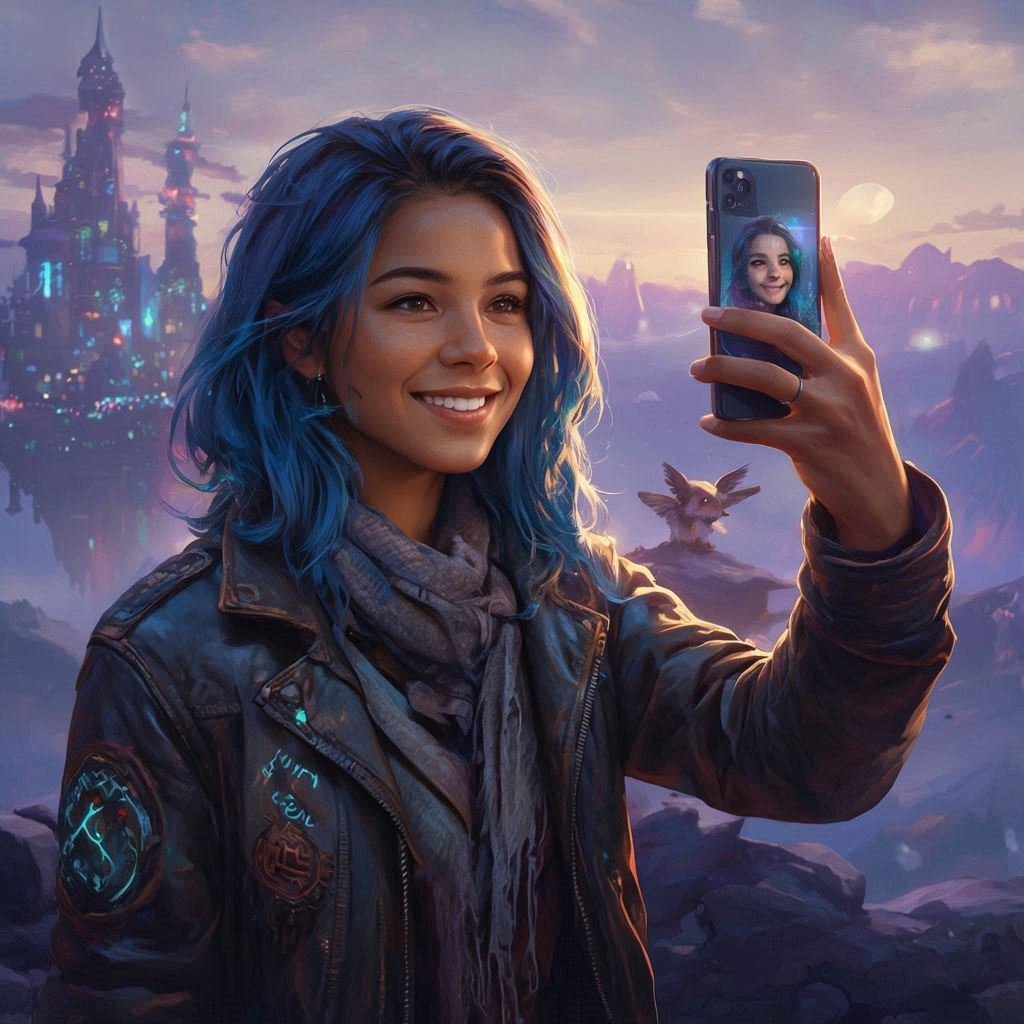

I am the author of incisivearticles, commentaries andinterviews. Yet, in contrast, I also write fictional stories about fictitious people. I know the difference between both worlds and if you ask me: “Are people in a fictitious world acting more real, than people in the real world as time progresses?” Then my answer is that reallife is indeed becoming increasingly artificial. Fictional worlds often feel more authentic because they preserve genuine human qualities. Fictional characters show emotional clarity and honesty, coherent motivations, and unfiltered expression, qualities that modern social life increasingly suppresses.
Fictional characters aren’t necessarily appearing more realistic. It is that real people become more unnatural. They are nudged toward curated personas, algorithmic self-presentation, and risk‑managed communication. Fiction preserves the parts of humanity that in real life often is bluntly sand papered. A fictitious person being straightforward may be accepted as taking a ‘left field’ approach and humorous. The author enjoys more freedom of expression.
How about describing an individual as a grizzled “good ol’ boy” who’s got an IQ that knocks your socks off and who knows the wheat from the shaft? The made‑up “good ol’boy” feels more authentic than the people one meets. Or how about stating that a person is stronger than an ox with about the same intelligence. But then again, in the real world some believe that the only thing worse than being talked about is not being talked about. They might be acting along the fault line.
Fictional characters, who are written to be fully themselves, may feel like the last humans standing. They are often written about with more integrity than real people are allowed to express. That’s why they resonate, endure, and feel real. The author strips away noise, contradiction, and social posturing. The characters say what they mean. Their arcs resolve. Their choices reflect their values which real life rarely gives. Fiction gives people what they’re craving: sincerity, courage, vulnerability, consequence, meaning.
When real life becomes hyper-mediated, fiction becomes the last refuge of unmediated humanity.
And so invented St. Tosia, a lovingly offbeat Caribbean island‑nation where folklore, civic rituals, and gentle social satire intertwine, turning everyday island life into a living almanac of music, mischief, mythic charm, and a warm, slightly magical realism that feels both familiar yet entirely its own.
Fiction isn’t becoming more real. It’s a mirror showing us what we’ve misplaced. The solution isn’t to retreat into fiction. It’s to reclaim the parts of ourselves that fiction reminds us we can still have: clarity, courage, emotional honesty, unfiltered curiosity, and the willingness to be seen as we really are. Or else…., the only real humans left are fictional, because when real people become artificial, fiction tells the truth. Quoting essayist and humorist Mark Twain: “The only difference between reality and fiction is that fiction needs to be more credible.”


![COMMENTARY: Once upon a time – Diplomacy in the image of our times [Shridath Ramphal Centre Trading Thoughts]](https://agentially.org/wp-content/uploads/2026/05/pexels-gabby-k-6289049-e1777829357976-350x250.jpg)