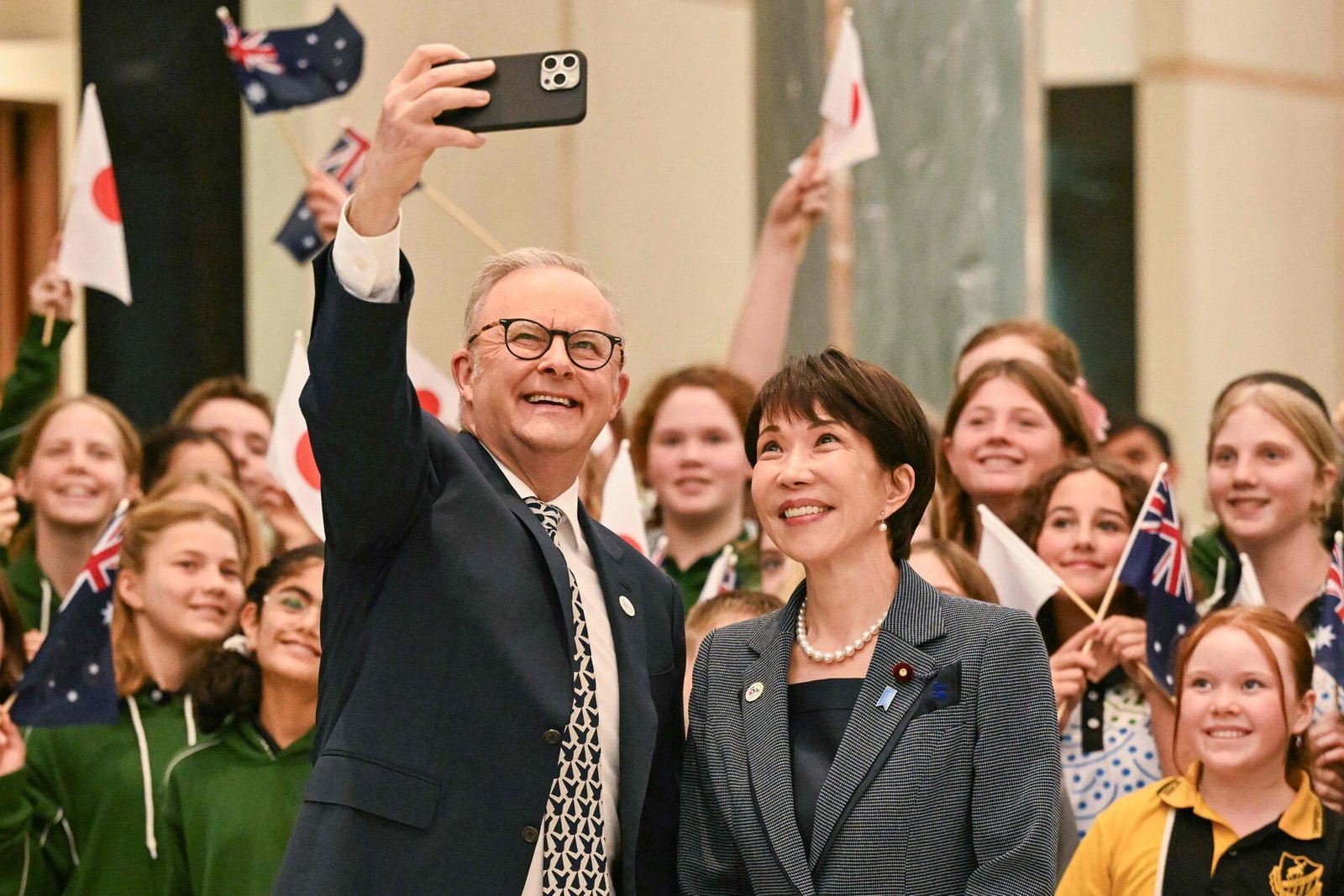
When Sanae Takaichi, Japan’s first female prime minister, landed in Canberra this week, she officially celebrated an anniversary: 50 years of the so-called “Nara Treaty.” The Friendship Agreement of 1976 was once highly controversial – the wounds of Australian prisoners of war from the Second World War were too deep. Today the bitterness has given way to realpolitik. Melissa Conley-Tyler from the University of Melbourne sums up the change: “Not because Japan lost the war, but because we have turned into friends,” the great-grandchildren of those soldiers now eat sushi together.
But behind the sentimentality lies a hard, strategic necessity. The visit comes at a time when the old order is eroding. The war in the Middle East and the blockade of the Strait of Hormuz have exposed the vulnerability of global supply chains. At the same time, the overstretch of US resources is forcing Washington to withdraw capabilities from the Indo-Pacific, including naval units previously stationed in Okinawa.
From the spoke to the independent axle
For decades, the region’s security architecture was structured like a wagon wheel: the United States was the hub, Japan and Australia were the spokes. “Japanese diplomats used to say, ‘We can’t do this without the United States,'” Conley-Tyler recalls. This time is over. There is a growing realization in Tokyo and Canberra that one can no longer blindly rely on Washington’s stability.
The answer is an unprecedented bilateral arms buildup. Australia and Japan have concluded several agreements to strengthen cooperation on defense, energy and critical minerals. It was already announced in August last year that Australia was purchasing eleven Japanese Mogami-class frigates – Japan’s first significant arms export since 1945. It is a “turning point”. Takaichi now openly refers to Australia and Japan as “quasi-allies.”
The Alliance of Central Powers: Pistorius, Carney, Takaichi
Interestingly, this coming together is not an isolated phenomenon. Rather, a broader pattern is emerging: a new world order in which the “middle powers” fill the gaps left by the superpowers. It is no coincidence that German Defense Minister Boris Pistorius was present in Canberra shortly before Takaichi and Canadian Prime Minister Mark Carney sought proximity to his Pacific partners.
Berlin, Ottawa and Tokyo share the same dilemma: They are economic heavyweights that have long sailed in the slipstream of the USA when it comes to security policy. Given the instability in the Middle East and the unpredictability of future US administrations, they now constitute a kind of “Central Powers insurance policy”. It’s about “variable geometry”, as Shiro Armstrong from the Australian National University calls it: no rigid blocs, but a network of security and trade agreements that holds up even without Washington’s leadership.
The balancing act: raw materials without being blackmailed
The core of the new Tokyo-Canberra axis is material security. “Eight hours of electricity per day in Japan comes from Australian coal and LNG,” Armstrong said. The crisis in the Gulf has made this dependency a question of existence. But the new cooperation goes far beyond fossil fuels. The new mineral agreement identifies six specific strategic projects, including the Lynas Rare Earths project in Kalgoorlie and Alcoa’s gallium recovery project. These are raw materials that are indispensable for electric cars, wind turbines and defense systems – and whose processing China still dominates.
The agreement directly targets Beijing’s monopoly on processing these resources. Both countries are pursuing a diplomatic balancing act. Economic exchange with China – for example within the framework of RCEP – should consciously be maintained in order not to endanger one’s own prosperity. At the same time, however, strategic blackmail should be ended. However, Armstrong warns that the real weak point still lies in industrial refining, where Beijing is maintaining its lead for now.
And although the joint Australia-Japan economic statement criticizes “all forms of economic coercion” – a clear swipe at Beijing – Takaichi and Albanese’s strategy is less confrontational than hedging. The aim is to reduce dependencies without fundamentally questioning trade with China. This shows a pragmatic approach to strategic independence in the Indo-Pacific, which is also being discussed in Europe. While concepts are still often being debated there, Japan and Australia are already implementing concrete measures in individual areas – for example in raw materials, supply chains and defense cooperation.