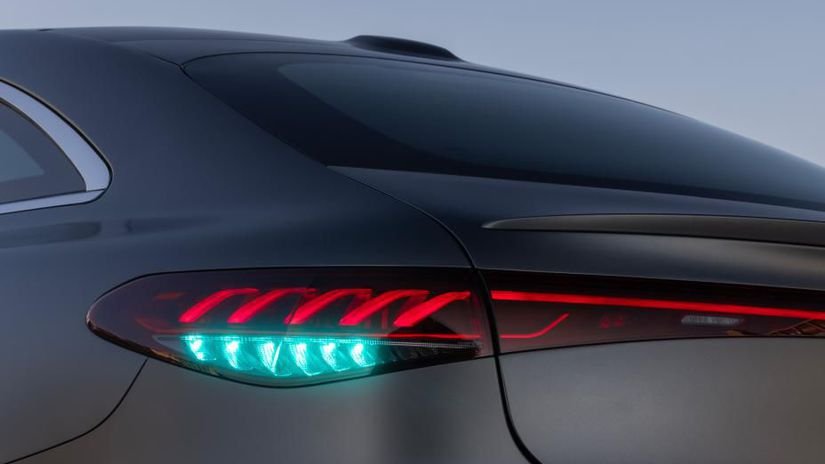
Turquoise lights appear not only in the rear, but also in the front and even in the rear-view mirrors. Their activation alerts others to a rather fundamental matter.
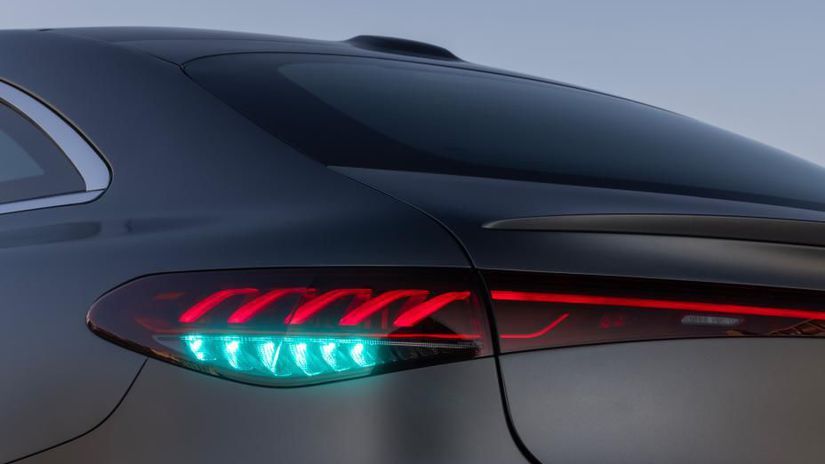
Photo: Mercedes-Benz
Meredes-Benz is also experimenting with turquoise lights.
A new visual element has appeared on Chinese roads over the past year. Many new cars have small turquoise or blue-green lights that do not serve as main headlights, turn signals, or brake lights. Their task is to signal that the vehicle is using an intelligent autonomous driving system. In China, the term “little blue lights” became popular for them, and what was originally a technical detail quickly became a design and marketing sign of technological maturity.
 Read more WARNING! Cars in Europe will get new brake lights this year. Do you have to have them too?
For Chinese brands, these lights most often appear in the rear-view mirrors and at the back, for example in the rear light graphics or at the tail lights. However, some models also have them in the front. Chinese media reports that Li Auto uses them on the sides of the front part, in the mirrors and in the back, some models of the BYD and Xpeng brands especially in the mirrors, and exceptionally, most often in the form of an illuminated strip connecting the lights, this new element also appears in the front.
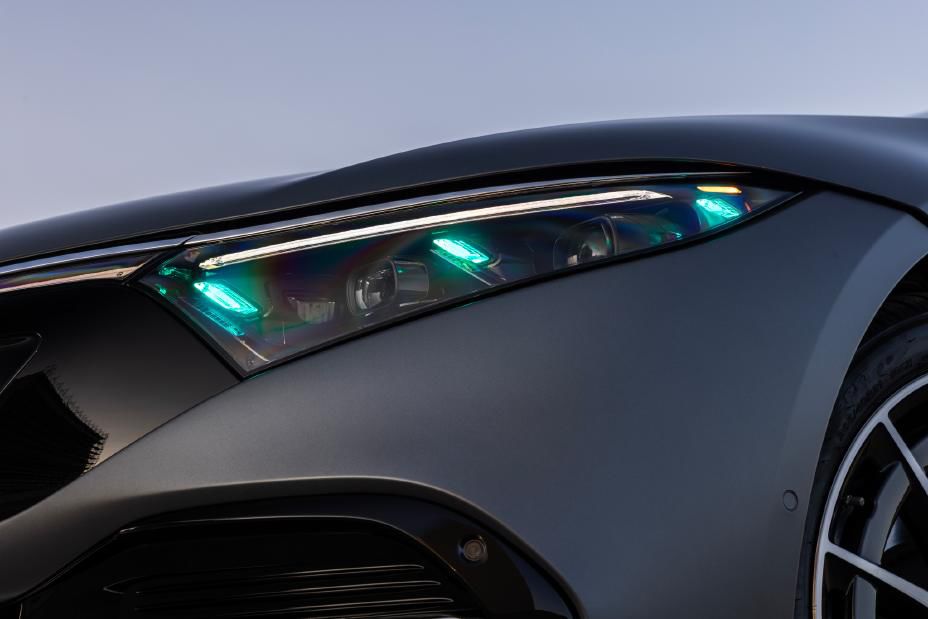 Photo: Mercedes-Benz
preview-928×522 1 Turquoise lights are intended to signal to other road users that the vehicle is driving in autonomous or semi-autonomous mode.
In the Chinese environment, turquoise lights are often associated with L2 or L2+ systems, i.e. with advanced assistants that are capable of semi-autonomous driving without the driver’s hands on the wheel, but the driver remains responsible for driving, must follow the action and be ready to take control immediately. Although the Chinese authorities have opened space for tests of level L3 technology (fully autonomous driving, the driver does not need to control it, but must be ready to intervene when prompted by the system), but current series cars do not offer it in China.
At the same time, regulation is developing faster than in Europe. The new Chinese standard for light signaling of vehicles applies from July 2025, but its final version does not yet include the obligation to install these lights in all smart cars. Their deployment is driven by the anticipation of the enactment of this safety “feature” and, of course, the marketing effort to show that their vehicles belong to the cutting edge of technology.
 Read more WeRide and Lenovo want to get 200,000 autonomous cars on the road within five years
Interestingly, Mercedes-Benz also started testing turquoise lights. However, the German brand uses turquoise lights exclusively when testing the Drive Pilot level L3 system, i.e. for conditionally automated driving. Unlike many Chinese cars, it connects them with a higher level of automation. Mercedes says the lights are integrated at the front, rear and in the rear-view mirror indicators and should be on continuously when Drive Pilot is active. Other European brands have not yet confirmed the deployment of such lights for automated driving systems, but in our opinion it is not a bad idea at all and its inclusion in the legislation certainly makes sense.