The reduction in American presence in Germany signals deeper differences between the US and Europe.
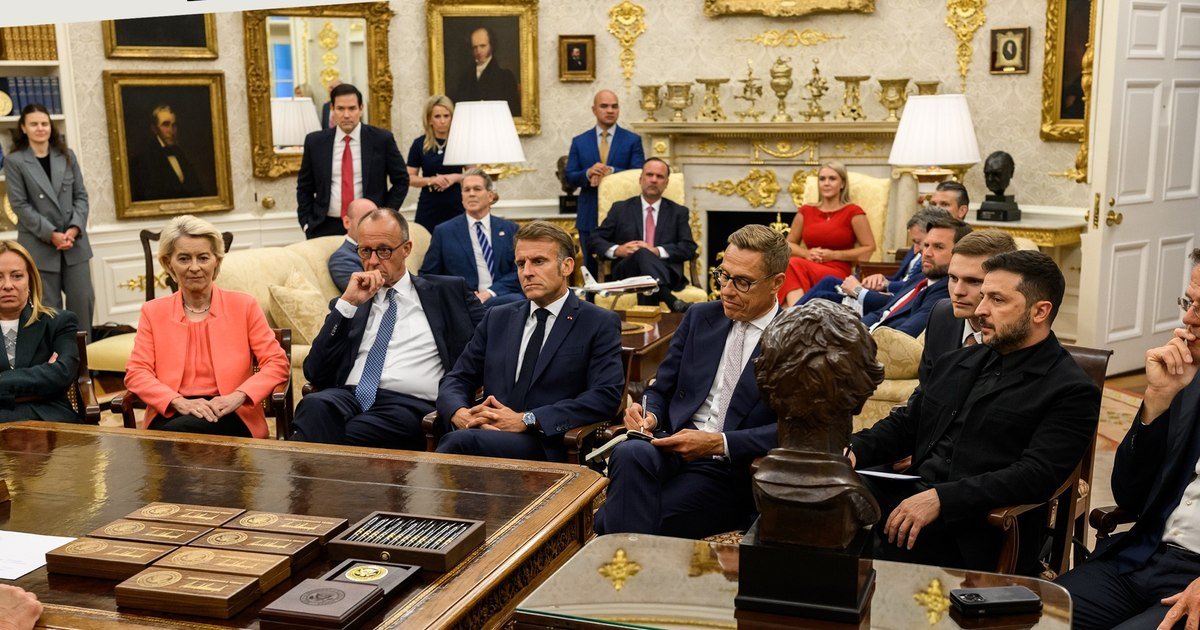
European leaders in the Oval Office, at the meeting with Trump/PHOTO: Profimedia
German officials welcomed US President Donald Trump’s decision to withdraw 5,000 US troops from the country as a symbolic step, but analysts warned that the deepening transatlantic rift risks jeopardizing Europe’s economy and security.
They warned that Trump’s latest increase in tariffs on European cars, his apparent reversal of plans to deploy long-range missiles in Germany and the economic and military consequences of a war in Iran will have a greater impact on the region, writes The Wall Street Journal.
“All of this is more important than a token reduction of five thousand troops. As is the rapid depletion of America’s arsenal due to the waste of vast amounts of valuable resources in the Iran war”said Torsten Benner, director of the Institute for Global Public Policy, a Berlin-based security think tank.
Senior US War Department officials said the Pentagon would withdraw a military brigade from Germany within six to 12 months, days after German Chancellor Friedrich Merz said the US appeared to have no exit strategy from Iran and accused Tehran of humiliating America in talks.
Instead, a senior US official said Trump, US adversaries and the world are watching the actions of European countries like Germany, particularly in the Middle East, adding that their actions and words matter to the president.
The announced drawdown would represent about 14 percent of the roughly 36,000 troops currently in the country — not much more than normal troop level fluctuations and far less than the 12,000 troop reduction that Trump sought during his first term. Most of these soldiers are involved in US military operations around the world and are not there to defend Germany in the event of an attack.
“It was predictable that the US would withdraw troops from Europe, including Germany. Germany is on the right track”German Defense Minister Boris Pistorius said, adding that Europe is already investing to fill the gap.
More worrying than troop withdrawal
The WSJ adds that even more worrying is the news that the US has decided not to deploy a battalion to Germany to operate Tomahawk cruise missiles and Dark Eagle hypersonic missiles – a deal struck in 2024 by the administration of former US President Joe Biden to deter Russia from attacking NATO after the invasion of Ukraine two years earlier.
Nico Lange, director of the German Institute for Risk Analysis and International Security and a former senior official in Germany’s Defense Ministry, said officials in Berlin anticipated that the Trump administration would not honor the agreement because it had never made such a commitment.
“However, the fact that now, when we face such a serious threat level in Europe, this gap in conventional deterrence is not being filled is a real problem. We have our own troops, but no one in Europe has this specific capability yetLange said.
Another cause for concern is that the refusal to send the battalion is another sign of easing tensions between the Trump administration and Russian President Vladimir Putin.
This follows the lifting of oil sanctions against Russia, imposed after Iran closed the Strait of Hormuz. European leaders see these measures as undermining efforts to reach a truce between Ukraine and Russia.
The problems of German manufacturers
Military analysts said Berlin was on track to reduce its reliance on American military protection, but the spat between Merz and Trump was a useful reminder of the urgency of those efforts.
Also of greater concern is the economic hardship caused by a series of Trump policies that have undermined Germany’s ability to maintain its huge defense investments.
German exports to the United States – a key factor helping to offset the long-term loss of market share in China – have fallen sharply since Trump launched a trade war with Europe last year. The EU-US trade deal struck last summer has done little to ease the burden on many German producers, who are still subject to separate US tariffs on steel and aluminium.
Government officials and economists had hoped that Berlin’s high defense spending and a separate public infrastructure investment campaign would boost economic growth this year, but a spike in energy prices after the attack on Iran dashed those hopes.
“Germany’s prolonged economic crisis is also undermining Merz’s political maneuvering in the country. After a gradual decline in his approval ratings since coming to power last year, the chancellor has become one of the least popular in post-war history“, the correspondents concluded.
The EU worries that Trump could “push” Putin to war against NATO
Europeans fear that the Russian dictator Vladimir Putin could start a war against them and test the strength of NATO in the next two years, taking advantage of the fact that Donald Trump will continue to be the president of the USA, and the Union itself will not have time to strengthen its defense capabilities, Politico writes. Therefore, politicians there do not rule out the possibility of a Russian ground operation, although they consider it unlikely, since the invasion of Ukraine has really exhausted Russia’s resources.
“Something could happen very soon — Russia has a window of opportunity “, explained Mika Aaltola, member of the committee for foreign affairs of the European Parliament. “The US is pulling out of Europe, transatlantic relations are in shambles and the EU is not yet fully ready to take responsibility alone.”
Aaltola points out that in Europe it is believed that the Russian Federation will do “something more targeted” or launch an invasion to create ambiguity. The goal of the Kremlin, according to the Finnish MEP, is to sow discord in NATO regarding the appropriateness of applying Article 5 of the Collective Labor Agreement.
The media points out that European defense spending has indeed increased significantly in recent years, but may not feel the full effect of this now for a few years. Even the Defense Readiness Roadmap states that NATO will be ready to “credibly deter its adversaries and respond to any aggression” by 2030. Meanwhile, Trump’s term as US president ends in January 2029.
“This is actually the worst thing that can be created in democratic countries”Aaltola said of states trying to downplay the Russian threat, saying it could mislead Europe about security risks.