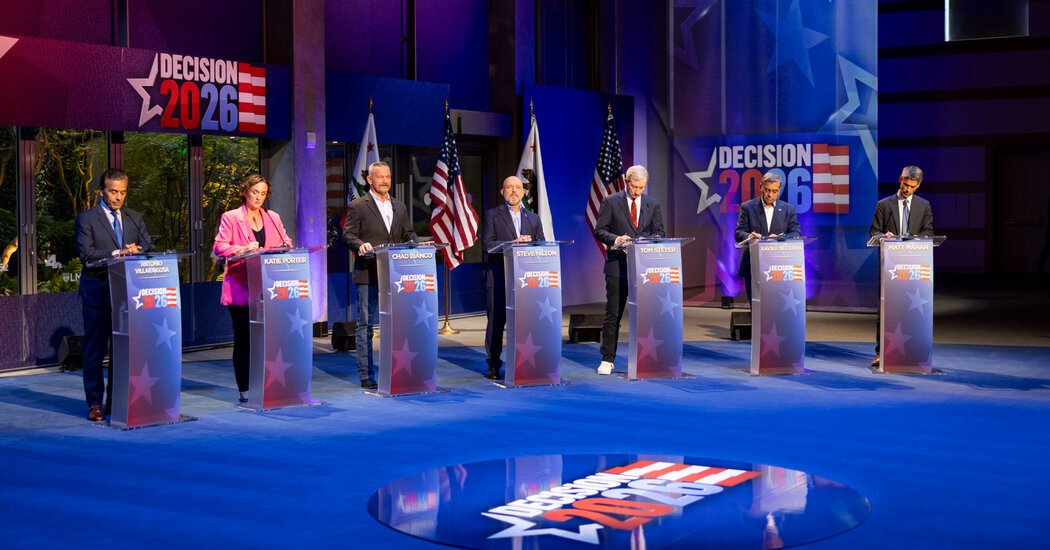
What began as a tame, hourlong debate on Wednesday between seven candidates running for California governor morphed by the second half into a flurry of barbs during the last televised face-off before the June 2 primary.
The debate, held at the Skirball Cultural Center in Los Angeles, was the second in two days in the race to replace Gov. Gavin Newsom to run the nation’s most populous state. Two Republicans and five Democrats took the stage for the event, hosted by NBC Los Angeles and the local Telemundo station, seeking enough support to be among the two top vote-getters next month.
The two Republicans, Steve Hilton, a former Fox News host, and Chad Bianco, the Riverside County sheriff, have teamed up to attack Democrats but have not differentiated themselves much from each other on policy.
They were joined by a crowd of Democrats: Xavier Becerra, a former California attorney general and cabinet secretary under President Joseph R. Biden Jr.; Tom Steyer, a former hedge fund manager; Katie Porter, a former congresswoman; Matt Mahan, the mayor of San Jose, Calif.; and Antonio Villaraigosa, a former mayor of Los Angeles.
Under California’s election laws, the top two candidates in the primary will advance to November’s general election, regardless of party.
Here are five takeaways from the debate.
Only the billionaire would vote for the billionaire tax initiative.
Early in the debate, the moderators asked each candidate whether they would support a billionaire tax initiative that is expected to qualify for the November ballot.
The issue seemed to unite Democrats and Republicans. The Republicans have said it would drive innovation away from the state, and Democrats have said it doesn’t make sense as a onetime tax, did not spread revenues to education and would only apply to a small number of people. Some Democrats said they would support a different way of taxing billionaires.
But everyone on the stage said they would oppose the current measure on the table — except for Tom Steyer, himself a billionaire. Mr. Steyer has run as a progressive Democrat who believes in raising taxes on corporations and the wealthy, as well as taking more aggressive steps against climate change.
Two words said so much more.
Mr. Bianco has not hesitated to lean into an aggressive MAGA persona, which continued during the debate, when he said that immigrants had perpetrated many violent crimes.
When Ms. Porter tried to push back, he interrupted her by saying she should tell that to the mothers of victims.
“Sir, I don’t need any lectures from you about being a mother,” she replied.
Mr. Bianco shot back: “You might.”
It was the most caustic exchange of the debate, and Ms. Porter immediately threw him an icy glare. With those two words, it seemed Mr. Bianco was questioning her skills as a mother, an identity that Ms. Porter has embraced throughout her political career.
After the debate, Mr. Bianco said about the testy exchange, “Katie’s trying to raise herself in the polls.” Asked what he meant by his two-word response, he would not explain further.
Ms. Porter said after the event that Mr. Bianco had been disrespectful to her — and to all women.
“No man has a right to tell a woman what it is like to be them,” she said. ”
In Los Angeles, housing anxieties take center stage.
Nothing dominated the debate as much as discussions of housing and homelessness. In 60 minutes, the candidates said the words “housing,” “home” or “homelessness” more than 120 times.
It felt particularly relevant given that the debate was held in Los Angeles, where enormous wildfires last year wiped out swaths of the Pacific Palisades and Altadena and have since raised many questions about construction costs, fire insurance and the housing supply.
Many of the candidates framed the issue as personal. Mr. Villaraigosa said he had been kicked off his private fire insurance and had to pay for the state’s bare-bones plan. Ms. Porter said that she was raising three teenagers and was worried about how they would ever afford rent.
Of one of her children, she said, “I think there’s a pretty good chance he’s going to wind up living on my couch if we don’t figure out how to build more affordable housing.”
Candidates floated very different ideas for how to make housing more affordable for Californians.
Mr. Hilton said he wanted to build more subdivisions linked by freeways and to cut regulations to make construction cheaper. Mr. Steyer said he supported denser zoning near public transit and off-site construction to save costs.
Mr. Bianco said he wanted to eliminate bedrock environmental policies in California — the California Environmental Quality Act and the Coastal Commission — to allow housing to be built more rapidly. Several candidates said they supported down-payment assistance, especially for first-time home buyers.
Villaraigosa could play spoiler.
Mr. Villaraigosa was the lowest polling candidate on the debate stage. But that didn’t stop the veteran politician from landing significant blows against his opponents.
Even if the polls don’t change, Mr. Villaraigosa seemed to relish his opportunity to play spoiler in the race. He was the one who made sure viewers knew that Mr. Bianco was once a member of the Oath Keepers, the hard-right militia group. He was the one who portrayed Steve Hilton, the leading Republican candidate, as an election denier by asking Mr. Hilton at the CNN debate on Tuesday if he believed President Joseph R. Biden Jr. won the 2020 election.
But it was his repeated attacks on Mr. Becerra, an ascendant Democrat who has surged in polls since the departure of Eric Swalwell from the race, that stood out the most.
Mr. Villaraigosa repeatedly cited a New York Times investigation in accusing Mr. Becerra of allowing 85,000 migrant children to be exploited in the work force when Mr. Becerra was the Mr. Biden’s secretary of health and human services. Mr. Becerra responded that the allegations were “Trump lies” and that the Biden administration instead protected the migrant children.
The tension seemed personal. Mr. Villaraigosa and Mr. Becerra both have Los Angeles political bases and were mentored into politics by the same political godfather and former legislator, Art Torres. But they also have a certain amount of history: When they both were running for Los Angeles mayor in 2001, a dirty phone trick that disparaged Mr. Villaraigosa was traced to Mr. Becerra’s campaign staff.
Mr. Becerra didn’t counterattack. But after Mr. Villaraigosa landed blows on Wednesday night, Mr. Becerra responded by saying to him, “Cálmate” — Spanish for “calm down.”
Nobody delivered a knockout blow.
There were no meltdowns on Wednesday night but no shining stars, either. The candidates did what they needed to do to preserve their positions in the race, and there were few signs that this final televised debate would fundamentally change the dynamics.
Among the Democrats, Ms. Porter most likely scored viral clips out of her exchanges with Mr. Steyer and Mr. Bianco. Mr. Steyer communicated his platform more assertively than he had in some previous debates. Mr. Becerra was forced into a defensive posture over his record in the Biden administration, but used it as an opening to attack President Trump. Mr. Villaraigosa and Mr. Mahan presented themselves as moderate alternatives but seemed likely to remain underdogs.
The two Republicans were more focused on attacking the Democrats than on attempting to best each other. At one point, Mr. Bianco even said, “I’ll stick up for Steve,” a reference to Mr. Hilton, adding that the only solution to California’s problems was to elect one of them.
“The policies that the rest of the people on these on this stage are proposing to all of you is just a repeat of all of the problems that got us here in the first place,” Mr. Bianco said.
If anything, the evening underscored the reality: California is used to larger-than-life politicians, but there aren’t any in this group. It’s one reason that many voters haven’t paid attention to the race until now.
Shawn Hubler, Jennifer Medina and Jill Cowan contributed reporting.