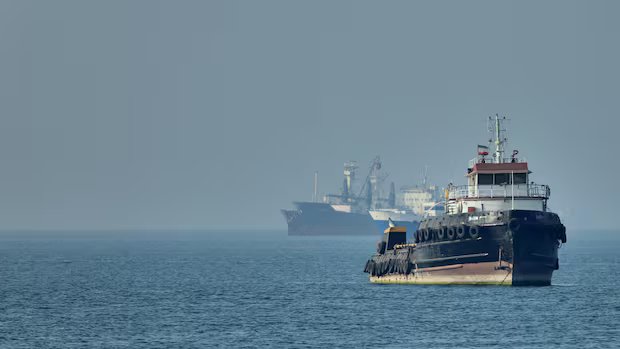
The U.S. plan to safely escort hundreds of stranded ships from the Strait of Hormuz could face major difficulties, including the ongoing threat of Iranian missile attacks and the challenge of navigating through thousands of mines planted in the sea, analysts say.
“Being able to take out all of the capabilities that Iran has through that waterway would be extraordinarily difficult,” Jennifer Gavito, a former U.S. State Department and National Security Council official, told Bloomberg News.
“I would posit that it is essentially impossible.”
U.S. President Donald Trump launched “Operation Freedom” on Monday to open up the waterway that Iran effectively closed after the U.S. and Israel started the conflict on Feb. 28.
Trump has given few details about the plan, but according to U.S. Central Command (CENTCOM), the military operation will include guided-missile destroyers, more than 100 land and sea-based aircraft, multi-domain unmanned platforms and 15,000 service members.
“Commercial vessels that transit through the area will see, hear, and frankly, feel U.S. combat power around them, on the sea, in the skies and on the radio,” Chairman of the Joint Chiefs of Staff Gen. Dan Caine said in a news briefing on Tuesday.
“We prefer this to be a peaceful operation, but are locked and loaded to defend our people, our ships, our aircraft and this mission without hesitation,” added U.S. Secretary of War Pete Hegseth.
Iran deploys missiles, drones, small ships
Hundreds of commercial vessels and as many as 20,000 seafarers have been unable to transit the strait during the conflict, the International Maritime Organization says.
Caine reiterated on Tuesday that American forces had successfully opened a passage through the strait that is free of Iranian mines.
He said Iran had also launched cruise missiles, drones and small boats at U.S. forces, defending commercial shipping in the strait, but that U.S. navy and army helicopters “successfully defeated those threats.”
Caine also noted that Iran has attacked U.S. forces more than 10 times, but all below the threshold of restarting major combat operations at this point.
“The threshold of restarting is a political decision above my pay grade. What I’ll say is, it’s low, harassing fire right now,” he said. “It feels like Iran is grasping its straws to try to do something across the southern flank.”

President Donald Trump announced on social media that the U.S. would start escorting ships out of the Strait of Hormuz, but it remains unclear if the move will help or hurt ongoing peace talks with Iran.
He repeated that two U.S.-flagged merchant vessels had made it through the strait and that they anticipate more in the coming days.
But Gavito said that’s only two vessels among the 100-plus that would normally transit on a daily basis through the strait before the conflict.
“With the strait in particular, all you have to do is disrupt. You don’t have to stop traffic. You just have to make people think twice about transiting,” she said.
Emma Salisbury, a senior fellow at the Philadelphia-based Foreign Policy Research Institute, said it appears that the U.S. plan is to provide air cover for the commercial vessels and shoot down drones and missiles before they get close to the ships.
Will warships escort commercial vessels?
“What I’m not sure about is whether the warships will be accompanying the commercial ships through the strait,” she told CBC News.
“Are you sailing with them or staying far enough out of the strait to not piss off the Iranians too much?”

Joe Sestak, a former deputy chief of U.S. naval operations, says ships stuck in the Strait of Hormuz will likely be reluctant to take up U.S. President Donald Trump’s offer to guide them out because of the uncertainty around the U.S. plan and Iran’s ability to continue to restrict traffic through the strait.
The U.S. reportedly has 12 destroyers in the region that could be used to escort commercial vessels.
But Jonathan Hackett, a retired Marine Corps special operations specialist and counterintelligence agent, told Al Jazeera that the U.S doesn’t have the resources, and that with only 12 navy vessels and 100 transits of commercial vessels travelling daily before the war, the math “simply does not work out.”
Ships stuck in the Strait of Hormuz will likely be reluctant to take up Trump’s offer to guide them out because the mission is “not very clear,” said Joe Sestak, a former deputy chief of U.S. naval operations.
“This is very difficult territory. I’ve been through it,” he told CBC News Network.
Sestak said there are “missile cities” in the cliffs on either side of the strait that may have 800 to 1,000 anti-ship cruise missiles that can “pop out of a cave, turn around and fire quickly at a ship that’s trying to escort one going out of the strait.”
Drones and missiles can also be launched from trucks and mines and could be deployed from small fishing boats or even pleasure crafts, CNN reported.
“Are you going to be able to destroy all those vessels to eradicate the threats?” Collin Koh, research fellow at the S. Rajaratnam School of International Studies in Singapore, told CNN.

U.S. Central Command said on Monday it assisted two U.S.-flagged ships transit the Strait of Hormuz, a day after President Donald Trump said his country would ‘guide’ stranded ships through the key waterway. The claim comes after Iran warned American military forces not to enter the strait and reportedly struck a U.S. warship — a report the Pentagon denied.
As well, Sestak said Iran still has about 5,000 naval mines that can be deployed in the sea, and they can all be attached to a GPS device.
“They don’t even need a fishing boat to drop them overboard. They can just guide them over from the land and drop it down into an area where their shipping might go through,” he said.
“It’s so easy just to keep laying them. If you sweep them, then just lay another 50 or 60 down,” Sestak said. “This is really a very difficult, improbable problem.”
Salisbury, of the Foreign Policy Research Institute, echoed that whatever air cover the U.S can provide, it will not deal with problems with mines.
‘A game of chicken’
She also said that the Islamic Revolutionary Guard Corps (IRGC) has carved out areas where they claim military control and have threatened to fire on any ship that comes through without permission.
“We’re kind of almost [in] a game of chicken here, where the Iranians are saying, ‘We see what you’re planning on doing, try it and we’ll fire on you.’ And the U.S., they’re kind of staring back and saying, ‘We’re going to do it anyway,'” Salisbury said.
“It’s that kind of brinksmanship.”
So far, the fragile ceasefire has held since it took hold early April. But Salisbury said there’s the real possibility that Project Freedom could lead to an escalation of Iranian attacks, with the U.S. firing back.
“And then we’re back to conflict.”