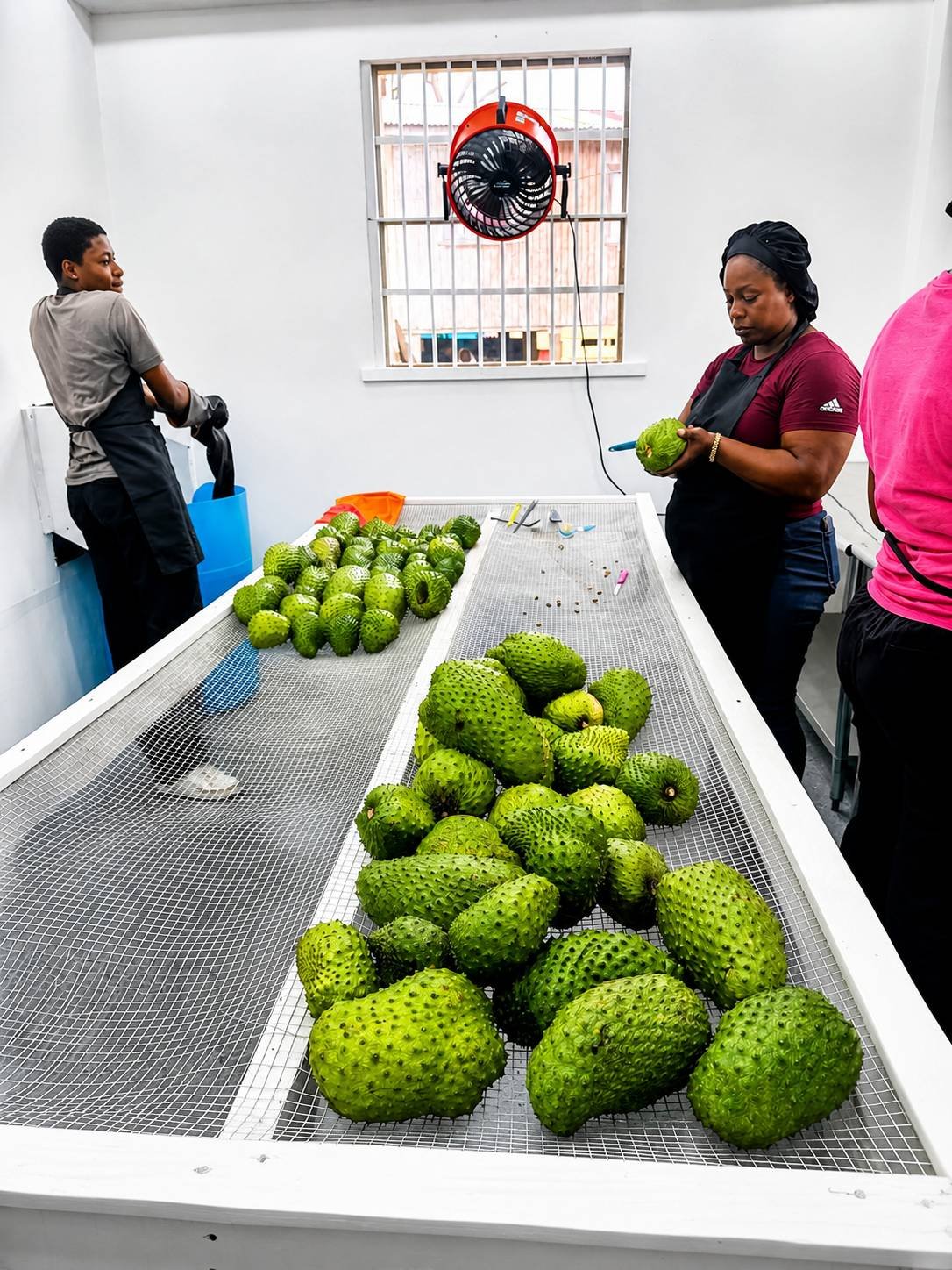
Building on ongoing efforts to strengthen Grenada’s soursop value chain, the Food and Agriculture Organisation of the United Nations (FAO), in close collaboration with the Ministry of Agriculture, Lands and Forestry and the Standards and Trade Development Facility (STDF), has launched a targeted certification pilot aimed at advancing compliance with international food safety standards and improving export readiness.
This latest intervention forms part of the project Enhancing Sanitary and Phytosanitary (SPS) Capacity and Market Access for Grenadian Soursop Exports and represents a critical shift from foundational capacity building to market-oriented compliance and certification. The initiative will support 2 selected packhouses and ten associated farmers in achieving GLOBALG.A.P. certification.
GLOBALG.A.P. certification is a globally recognised, voluntary farm assurance standard that verifies safe, sustainable, and ethical agricultural production. It focuses on food safety, environmental protection, worker welfare, and product traceability from farm to retailer, acting as a passport for producers to access global markets. It strengthens risk management through structured food-safety controls and increases buyer confidence in the quality and safety of the produce. The addition of Food Safety Modernisation Act (FSMA) requirements further aligns producers with United States regulations, supporting compliance with evolving import standards.
A national training workshop held at the Grenada National Stadium on 21 April 2026, officially launched the pilot initiative. The session focused on implementing GLOBALG.A.P. Integrated Farm Assurance Fruit and Vegetables GFS v6, along with the FSMA Add-on requirements. These are voluntary, audit-based modules designed to verify that farms and food facilities comply with specific Food and Drug Administration (FDA) preventive control, produce safety, or import rules. With 31 participants representing a wide range of stakeholders, including the Ministry of Agriculture, the Grenada Bureau of Standards, the Caribbean Agricultural Research and Development Institute (CARDI), the Inter-American Institute for Cooperation on Agriculture (IICA), farmers, exporters, and other private sector representatives, attendance considerably exceeded expectations due to the workshop’s significant importance.
The first week of launch activities signalled the beginning of the certification pathway. In addition to the training workshop, the participating packhouses and farms underwent on-site preliminary assessments to evaluate their current level of compliance with GLOBALG.A.P. and FSMA requirements. Based on these evaluations, customised corrective action plans will be developed for each entity, identifying the specific improvements needed to achieve certification in a practical and targeted way. Training and technical assistance were led by the FAO, in close collaboration with the Ministry of Agriculture, Lands and Forestry of Grenada, with support from Inversiones Riel S. de R.L., a technical consulting firm from Honduras specialising in SPS systems and international certification processes.
“We are pleased to support the launch of this pilot initiative to advance GLOBALG.A.P. certification within Grenada’s soursop value chain. This effort represents an important step in strengthening food safety, improving production standards, and expanding market access for our stakeholders. By aligning with internationally recognised certification systems, we are positioning our exports to compete more effectively,” stated Thaddeus Peters, Chief Agriculture Officer (Ag.).
Ricardo Pineda, Lead Consultant, Inversiones Riel S. de R.L noted, “We are pleased to have successfully completed Phase 1 with the selection of 2 highly qualified exporters. This milestone lays a strong foundation for certification under GLOBALG.A.P. IFA v6 with the FSMA add-on by November 2026, opening new opportunities for Grenada’s soursop in high-value international markets.”
“This process is pushing us to tighten our operations and be more consistent across the board; it will be challenging, but it’s exactly what we need to grow and compete in more demanding markets,” stated Marlon St Louis, General Manager of Simply Pure Agroprocessing, in response to the initial activities.
FAO Plant Production and Protection Specialist Anne Desrochers emphasised, “While this pilot presents a valuable opportunity to advance GLOBALG.A.P. certification, it is not a passive process. Selected farmers and packhouses must commit time, resources, and consistent effort to implement the required improvements, an essential step toward achieving certification and accessing higher-value export markets.”
The next phase of the pilot will focus on intensive, hands-on training and technical support across key certification areas, including good agricultural practices, record-keeping, traceability, post-harvest handling, and audit preparedness.
FAO