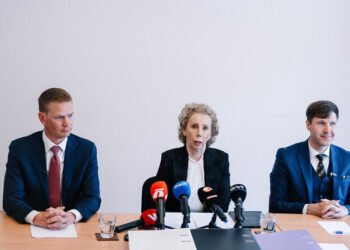
Minister of Finance Jürgen Ligi has rejected a proposal by business organizations to temporarily lower the tax on diesel.
Ligi (Reform) said the Ministry of Finance does not see scope for cutting excise duties. Broad-based tax cuts would have a very large and lasting negative impact on the state budget. At the government’s initiative, a concrete step has already been taken: the planned increase in fuel excise duties set for May 1 has been canceled, Ligi wrote.
He explained that in the current security situation, both national defense and social welfare require additional funding and it would not be responsible to reduce revenues without real sources of coverage.
“A broad-based excise cut would benefit all consumers equally, including those who do not need assistance. It is more sensible to use the state’s limited resources for targeted measures to support the most vulnerable households and sectors,” Ligi noted.
According to the finance minister, it should not be overlooked that the current situation is artificially created, with rising fuel prices primarily driven by reduced supply. Government measures aimed at lowering prices would not solve this problem but would instead increase demand, which in turn would fuel further price growth.
“Calculations by the Ministry of Finance show that the total impact of a diesel excise cut would be €24.5 million if the reduction were to remain in effect for two months, i.e., until the end of July. Each additional month would increase the cost by approximately 50 percent,” Ligi said.
Ligi added that the ministry continuously monitors and analyzes the practices of other member states. For example, Latvia has had a lower excise rate than Estonia since early April, yet diesel prices there remain higher.
“The maximum possible impact of the excise reduction in Latvia, including VAT, was 8.6 cents per liter, but only 2–3 cents of that reached the final price. Given that daily price fluctuations over the past month have reached up to 30 cents per liter, a change of a few cents is not even noticeable to consumers. As a result, the impact on cross-border trade can be considered extremely small.”
The finance minister also noted that most consumption in Estonia is domestic, meaning that any excise cut would have a negative impact on the budget, which would not be offset by a modest increase in consumption by foreign customers — assuming the tax reduction is even reflected in prices.
Minister of Economic Affairs and Industry Erkki Keldo (Reform) also rejected a proposal from business organizations to temporarily lower the diesel excise duty. He cited the government’s decision to cancel the planned May 1 excise increase and the tight state budget as reasons. Shortly afterward, the ministry clarified to ERR that Keldo meant there would be no reduction for now, leaving open the possibility that such a measure could be introduced later, for example through a supplementary budget.
Organizations representing Estonia’s transport, logistics and fuel sectors have proposed to the government and the Riigikogu that the diesel excise duty be temporarily reduced to the European Union minimum level of €330 per 1,000 liters.
—